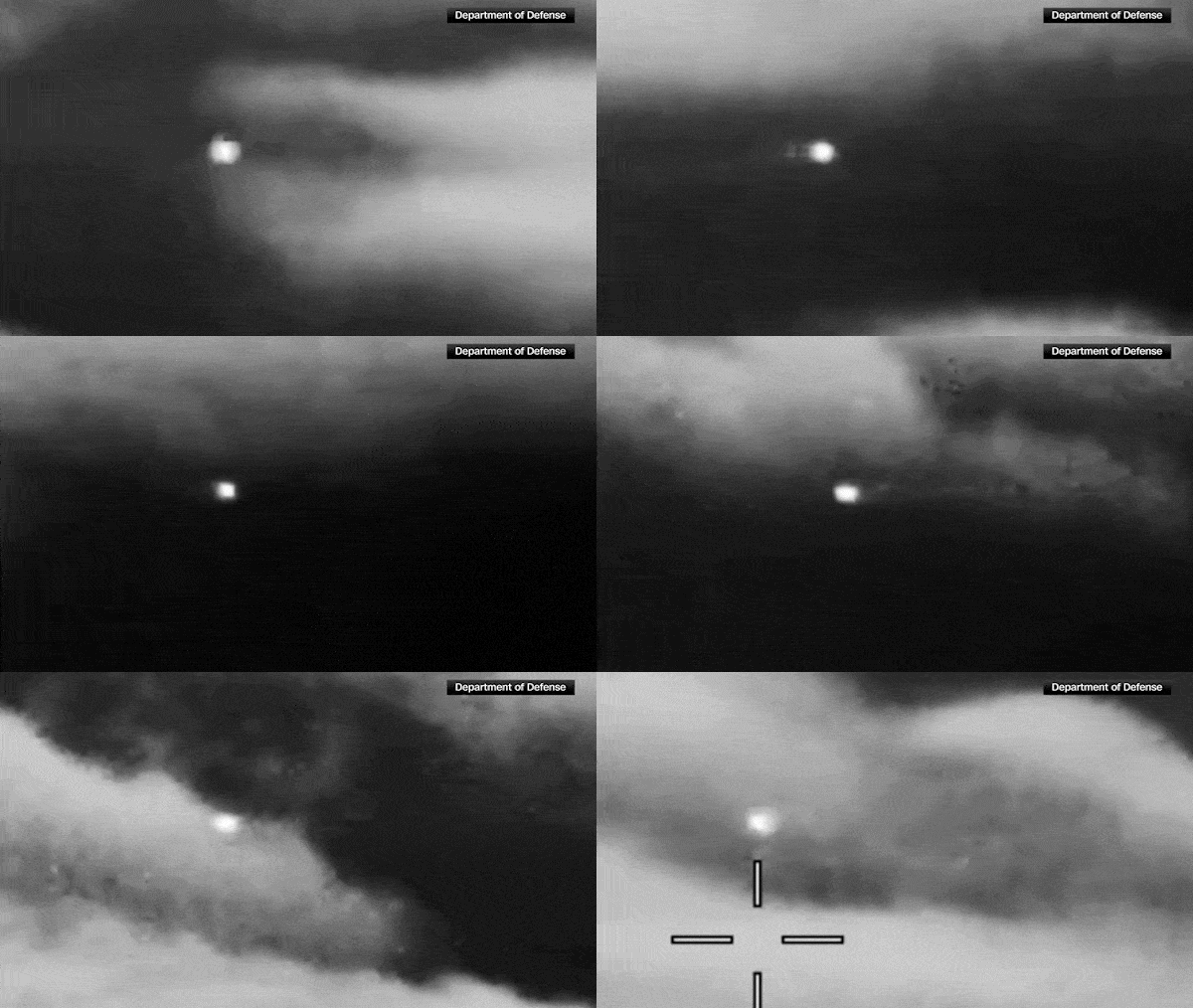
The Pentagon just dumped another batch of declassified "UAP" files, and the internet is doing exactly what the Department of Defense hoped it would do: chasing ghosts.
The media is salivating over grainy infrared footage and redacted sensor logs. They treat these releases like a slow-drip disclosure of intergalactic visitors. It isn't. This isn't a "soft reveal" of little green men. It is a cynical, brilliant exercise in administrative obfuscation. While everyone argues over whether a blurry smudge on a FLIR screen is a Tic-Tac-shaped craft or a weather balloon, they are missing the far more terrifying reality of terrestrial incompetence and black-budget shell games.
The Myth Of The Hyper-Competent Sensor
The "lazy consensus" among UFO enthusiasts and mainstream journalists is that if a multimillion-dollar sensor suite on an F/A-18 Super Hornet picks something up, it must be real. This assumes our military hardware is infallible. It isn't.
I have spent years looking at how data gets mangled in high-stress environments. Military sensors are tuned to find specific signatures—missiles, enemy aircraft, known electronic warfare profiles. When they encounter "clutter" or atmospheric anomalies, the software tries to make sense of it. Sometimes, the "UFO" is nothing more than a parallax illusion caused by the jet’s own velocity relative to a slow-moving object, or a software glitch in the sensor’s gimbal tracking.
By labeling these "Unidentified," the Pentagon isn't saying "we found aliens." They are saying "our systems failed to categorize this." There is a massive difference between a mystery and a miracle.
Why The Government Wants You To Believe In Aliens
Think about the timing. Every time the DoD faces a massive audit failure or a shift in geopolitical tension, a new batch of "declassified" files hits the wire. It is the ultimate shiny object.
- Funding Shields: If the military admits they can't identify objects in their own restricted airspace, they have a permanent justification for more funding. "We need better sensors to track the anomalies." It is a self-licking ice cream cone.
- Counter-Intelligence Smokescreens: If the US is testing a high-speed drone with a radical propulsion system, what is the best way to hide it? Let people think it’s a flying saucer. The "UFO" narrative provides a convenient layer of ridicule and mystery that prevents serious investigative journalism into actual secret programs.
- The Competency Trap: Admitting that a $100 million jet can be fooled by a $500 consumer drone or a localized weather event is embarrassing. Calling it a "UAP" of unknown origin shifts the blame from the engineers to the universe.
The Math Of The "Tic-Tac"
Let’s look at the physics that everyone ignores. The famous "instantaneous acceleration" described by pilots. If an object truly moved from a hover to Mach 20 in a fraction of a second within our atmosphere, the sonic boom alone would shatter windows for miles. The thermal signature of the friction against the air would light up the entire sky like a second sun.
$F = ma$
To move an object of any significant mass at those speeds without a visible heat signature or a pressure wave implies a violation of every law of thermodynamics we currently understand. While some "insiders" claim this is proof of "transmedium travel," the simpler, more logical explanation is that the sensor data was spoofed.
Electronic Warfare (EW) has reached a point where we can project "ghost" targets onto enemy radar. If we can do it, China can do it. If Russia can do it, private contractors can definitely do it. The Pentagon’s files aren't a record of alien visitation; they are a public diary of the US military getting outpaced by EW technology.
The Grift Of Disclosure
We are currently seeing the rise of the "Disclosure Professional." These are former intelligence officers who jump ship to join media startups or "research" organizations. They claim to be "whistleblowers," yet they never actually release classified data that would put them in jail. Instead, they provide "context" and "insinuations."
If you had proof of non-human intelligence, you wouldn't be doing a six-part docuseries on a streaming platform. You’d be showing the world the wreckage. The fact that the "truth" is always just one more declassified file away is the hallmark of a long-con.
The Real Threat Is Boring
The obsession with aliens is a distraction from the real, terrestrial threats documented in these files. The "UFOs" are often drones—some foreign, some domestic. The Pentagon’s inability to distinguish between a sophisticated Chinese surveillance platform and a "mystery craft" is a catastrophic failure of national security.
By framing this as a search for extraterrestrial life, we lose the urgency to fix our airspace surveillance. We treat a potential security breach like a sci-fi movie.
Stop looking for lights in the sky. Start looking at the people telling you to watch them. They are the ones with something to hide, and it isn't a body in a freezer at Area 51. It’s the fact that they’ve lost control of the sky to anyone with a soldering iron and a basic understanding of radar spoofing.
The files are a confession of ignorance, rebranded as a mystery to keep the budget flowing. You aren't being told the truth; you’re being given a hobby.