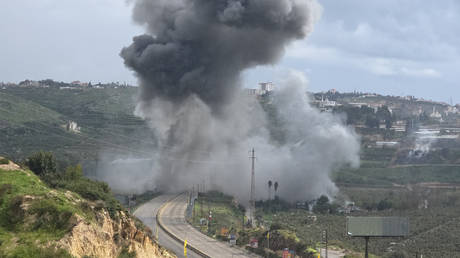
The headlines are screaming about a "Greater Israel" and the annexation of Southern Lebanon. Pundits are clutching their pearls over the latest firebrand rhetoric from the Israeli cabinet, treating it like a sudden, radical pivot in regional strategy. They are missing the point entirely. While the media treats every inflammatory quote as a blueprint for a new border, they are failing to see the actual mechanics of modern attrition.
Annexation isn't the goal. It’s the smokescreen.
The obsession with territorial lines is a 20th-century hangover. In a world of drone swarms, precision-guided tunnels, and digital financial warfare, physical soil is often a liability, not an asset. When an Israeli minister floats the idea of "securing" Lebanese territory, the international community reacts with a predictable script of condemnation. But if you look at the logistical reality on the ground—the "battle scars" of decades spent trying to hold "security zones"—you realize that formal annexation would be a strategic suicide note.
The Myth of the Security Buffer
The "lazy consensus" suggests that taking land provides safety. History proves the exact opposite. Between 1982 and 2000, Israel maintained a "security belt" in Southern Lebanon. It didn't stop rockets; it created a target-rich environment for a nascent insurgency.
Land is expensive. Land requires boots. Boots require a supply chain that can be bled dry by a single IED.
When people ask, "Will Israel occupy Southern Lebanon?" they are asking the wrong question. The right question is: "Why would they want to?"
Annexation implies governance. Governance implies responsibility for a civilian population, infrastructure, and international legal standing. In the current conflict, the objective isn't to own the dirt—it's to deny the enemy the ability to use it. You don't need a flag in the ground to create a "dead zone." You just need superior kinetic reach.
The Cost of Sovereignty vs. The Utility of Chaos
If you've ever managed a high-stakes crisis, you know that formalizing a problem often makes it permanent.
- Annexation means Israel takes on the debt, the schools, and the electricity grid of a destroyed region.
- Buffer Zones mean a permanent military drain with no exit strategy.
- The Current Reality is a high-intensity "mowing the grass" strategy that avoids the diplomatic cost of occupation while achieving the tactical goal of displacement.
The talk of annexation is a political tool used to move the "Overton Window." By demanding the whole mountain, the hardliners make a permanent, uninhabitable military zone seem like a moderate compromise. It’s a classic negotiation tactic played out on a bloody stage.
Stop Treating Rhetoric as Doctrine
Most analysts fail to distinguish between internal political theater and actual military doctrine. In Israel’s fragmented coalition government, ministers compete for the most aggressive posture to satisfy a traumatized base.
When a minister calls for annexation, they aren't talking to the UN. They aren't even talking to the Lebanese. They are talking to their own voters.
I’ve seen how these policy sausages get made. You throw out a radical idea to see where the friction points are. If the US doesn't push back hard enough, you move the line. If the international markets freak out, you walk it back and call it a "personal opinion."
The real danger isn't a new map. It’s the normalization of permanent displacement. By the time the world finishes debating the legality of annexation, the "Security Zone" will already be an established fact—devoid of people, riddled with sensors, and governed by nothing but the rules of engagement.
The Logic of the "Grey Zone"
We are witnessing the birth of a new kind of border. It’s not marked by fences and customs booths, but by the absence of life.
Imagine a scenario where the border isn't a line, but a twenty-mile wide vacuum. No one lives there. No one builds there. No one governs there. This "Grey Zone" is more effective than any annexed territory because it carries none of the legal baggage of an occupation.
If Israel annexes Southern Lebanon, they are an "occupier" under every international statute. If they simply make it impossible for anyone else to live there, they are "defending their northern border." It’s a brutal, cynical distinction, but in the halls of power, it’s the only one that matters.
Why the "Two-State" Logic Fails Here
Most "experts" try to apply the West Bank model to Lebanon. It doesn't fit. The West Bank is about demographics and deep-seated religious claims to specific hilltops. Southern Lebanon is about Hezbollah’s $Radars$ and $Launchers$.
The math is simple:
$$Security \neq Land + Flags$$
$$Security = Range - Intent$$
If you can't change the intent of your neighbor, you must increase the range between their weapons and your civilians. You don't need a deed to the land to push back a rocket launcher. You just need a thermal signature and a Hellfire missile.
The Economic Suicide of Expansion
Let’s talk about the numbers that the hawks ignore. Israel’s economy is built on tech, venture capital, and global integration. Annexing Lebanese territory would trigger a wave of sanctions and divestment that would make the current BDS movement look like a bake sale.
- Credit Ratings: Agencies like Moody’s and S&P don't care about "Greater Israel." They care about debt-to-GDP ratios and regional stability.
- Labor Shortages: An occupation requires a massive reserve call-up. You can't run a startup from a foxhole in the Galilee for three years straight.
- Infrastructure: The cost of "civilizing" an annexed zone would run into the tens of billions.
The contrarian truth is that the Israeli defense establishment—the people actually holding the rifles—is the biggest hurdle to annexation. They know that holding land is a resource sink. They want a "lean" military, not a sprawling colonial administration.
Dismantling the "People Also Ask" Fictions
Is Israel going to invade Lebanon?
They already have. But don't look for a 1967-style conquest. Look for a 21st-century demolition. The goal is the destruction of infrastructure, not the installation of mayors.
What happens to the Lebanese civilians?
They become a permanent diaspora within their own country. This is the "nuance" the media misses. You don't need to expel a population if you simply make their villages unlivable. It is annexation by proxy through environmental destruction.
Can the UN stop this?
No. The UN is designed to stop states from moving borders. It is completely unequipped to deal with states making borders irrelevant.
The Brutal Reality of Modern Conflict
The status quo is dead. The idea that we will return to the 1949 or 1923 borders is a fantasy for geographers and dreamers.
We are moving toward a period where borders are defined by the effective range of a drone’s battery. The ministerial calls for annexation are just noise to keep the public distracted while the real work of creating an uninhabitable buffer continues.
Stop looking at the maps being drawn in speeches. Start looking at the topography of the ruins. The land isn't being taken; it’s being erased.
If you're waiting for a formal declaration of annexation to get outraged, you've already lost the war. The shift has already happened. The border didn't move north; the living world just moved south.
Accept the reality: the dirt is a trap, and the rhetoric is the bait. If Israel is smart, they’ll keep talking about annexation and never actually do it. If they’re foolish, they’ll listen to their own ministers and drown in the mud of the Litani.
The smart money is on the vacuum.
Get used to the Grey Zone. It’s the only map that matters now.