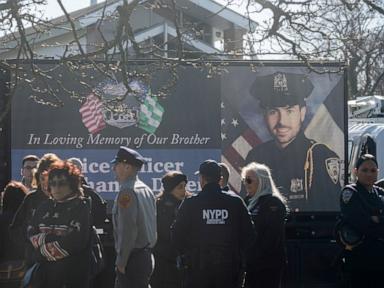
Justice is not a scoreboard. When a judge bangs a gavel and announces a sentence of 115 years to life for the killing of an NYPD officer, the public cheers for a "victory" that doesn't actually exist. We are addicted to high numbers because they provide a temporary hit of moral superiority, but they mask a hollow reality: our sentencing system has become a theater of the absurd where the math is made up and the long-term points don't matter.
The recent sentencing of the individual responsible for the death of an NYPD officer follows a predictable script. The media focuses on the triple-digit figure. The politicians claim the streets are safer. The public feels a sense of closure. Every bit of that narrative is flawed. If we want to actually honor the fallen and protect the living, we have to stop treating sentencing like a high-stakes auction and start looking at the mechanics of why these "historic" sentences are often little more than PR stunts for the Department of Corrections. You might also find this connected article interesting: Why China is finally coming for European defense companies.
The Myth of the Three Digit Deterrent
The "lazy consensus" suggests that 115 years sends a "message" that will stop the next shooter. This is a fundamental misunderstanding of criminal psychology and the biology of the human brain.
Most violent crimes are not the result of a cost-benefit analysis. A person reaching for a firearm during a confrontation is not calculating the difference between a 25-year sentence and a 115-year sentence. They are operating in a state of hyper-arousal where future consequences are invisible. Research from the National Institute of Justice has shown repeatedly that the certainty of being caught is a vastly more powerful deterrent than the severity of the punishment. As discussed in latest articles by The New York Times, the implications are widespread.
By the time you get to the 115-year mark, you aren't deterring crime; you are just performing a ritual. We are spending political capital and tax dollars on the backend of the problem—the funeral and the sentencing—while ignoring the systemic failures on the front end that put that officer in harm's way in the first place.
The Fiscal Black Hole of Geriatric Prisons
Let's talk about the numbers no one wants to touch: the cost of aging. When you sentence a man in his 20s or 30s to 115 years, you are effectively signing a multi-million dollar contract for the state to provide high-end geriatric healthcare decades down the line.
According to data from the American Civil Liberties Union (ACLU) and the Bureau of Justice Statistics, it costs roughly three times more to house an elderly prisoner than a younger one. We are talking about turning our maximum-security facilities into the world's most expensive, least efficient nursing homes.
- Dialysis machines in cell blocks.
- Palliative care units behind barbed wire.
- Specialized transport for chronic conditions.
By the year 2040, a significant portion of the New York State corrections budget will be swallowed by the healthcare costs of men who can barely walk, let alone pose a threat to an NYPD officer. Is that justice? Or is it a massive misallocation of resources that could have been used to fund better body armor, more advanced training, or mental health crisis teams that prevent these violent escalations? We are mortgaging the safety of future officers to pay for the medical bills of today's villains.
Stacked Charges are a Statistical Lie
The 115-year figure is usually reached through "stacking"—running sentences consecutively rather than concurrently. This is a prosecutor’s favorite trick to juice the headlines.
Imagine a scenario where a person commits a single act of violence that results in five different technical violations of the penal code. Instead of sentencing for the act, the court sentences for the list. This creates a "phantom population" of sentences that exist only on paper. A human life is roughly 80 years. Anything beyond that is a mathematical ghost.
When we stack charges to reach 115 years, we are admitting that the primary sentence for the murder wasn't enough. It's a confession of weakness in the law. If "life" meant life, we wouldn't need the extra 90 years as a cushion. We use these massive numbers because we don't trust our own parole boards or our own legal definitions of "permanent." It is a systemic vote of no confidence in the very institutions that manage these inmates.
The Collateral Damage of the "Monster" Narrative
To justify 115 years, the legal system must paint the defendant as a singular, irredeemable monster. While the actions in this case were undeniably horrific and the loss of the officer is a tragedy, the "monster" narrative is a trap.
If we categorize every violent offender as a supernatural anomaly, we stop looking for the patterns. We ignore the illegal firearm pipelines, the failure of parole supervision in previous cases, and the breakdown of community intelligence. If he's just a "monster," then it’s an act of God, and nothing could have been done.
I have seen this play out in city after city. We celebrate the 100-year sentence, go home, and the next week another officer is standing in a dark alley facing the exact same set of circumstances. The "monster" is gone, but the factory that produced him is still running at full capacity.
The Hard Truth About Closure
The most controversial part of this is the impact on the families of the fallen. We tell them that 115 years equals "justice." We tie their emotional healing to a number.
But what happens in twenty years when the headlines fade? What happens when the legal appeals begin—because 115-year sentences are magnets for high-level appellate scrutiny? By seeking these "record-breaking" punishments, we often create more legal avenues for the defense to find procedural errors.
True justice for an NYPD officer isn't a headline about a century-long sentence. True justice is a system where that officer never had to face that gun. We are settling for the consolation prize of a long sentence because we are too cowardly to fix the broken machinery of the city.
Stop Cheering for the Numbers
We need to stop being impressed by the math. A life sentence is a life sentence. Adding decades to it doesn't make the officer "more" dead or the criminal "more" punished. It just makes us feel better for five minutes while we ignore the bill that's coming due.
If we want to honor the police, we should spend less time obsessed with the length of the sentence and more time obsessed with the quality of the intervention. A 115-year sentence is a monument to a failure that already happened. It is a tombstone, not a solution.
Demand a system that values the lives of officers enough to prevent the crime, rather than one that just counts the years after the casket is closed.
Stop buying the hype. The math is fake, the costs are real, and the streets aren't any safer today than they were before the judge spoke.