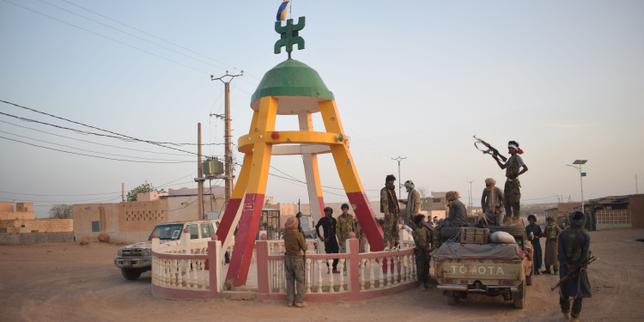
Kidal is not a city. It is a Rorschach test for geopolitical failure.
The mainstream press treats the recent shift in control over this desert outpost as a sudden, catastrophic breach of Malian sovereignty. They paint a picture of a "fall," as if there was a functioning state to begin with. This is the first lie. You cannot lose what you never truly held.
The obsession with who flies which flag over the Governor’s palace in Kidal misses the tectonic shift happening in the Sahel. While analysts in Paris and Bamako argue over the semantics of "rebel-terrorist alliances," they ignore the fact that the nation-state model in West Africa is dying a loud, violent death.
The Sovereignty Illusion
Western reporting remains trapped in a 1960s Westphalian fever dream. They see a map with clear borders and assume the government in Bamako has a mandate to rule every square inch.
I have spent years watching central governments in the region pretend to exercise power while their influence evaporates thirty miles outside the capital. The "recapture" or "loss" of Kidal is a vanity project for the Malian junta and a tactical regrouping for the CMA (Coordination of Azawad Movements).
The harsh reality? Kidal has operated as a de facto independent state-let for the better part of a decade.
When the Malian Armed Forces (FAMa) and their Russian Wagner Group partners pushed into Kidal in late 2023, the media called it a turning point. It wasn't. It was a real estate transaction backed by mercenaries. Occupying a town is not the same as governing a territory. By forcing the rebels out of the urban center, the junta didn't defeat them; they simply pushed the insurgency back into the Adrar des Ifoghas mountains, where they are far more dangerous and far less visible.
The Lazy Narrative of the Jihadist Monolith
The biggest mistake "experts" make is lumping the CSP-PSD (Permanent Strategic Framework) rebels and JNIM (Group for the Support of Islam and Muslims) into a single, cohesive bogeyman.
Yes, they share the same desert. Yes, they sometimes share an enemy. But their goals are diametrically opposed.
- The Rebels (CMA/CSP): They want Azawad. They want a secular, or at least ethno-nationalist, Tuareg state. They are fighting for land and recognition.
- The Jihadists (JNIM/ISGS): They want a global caliphate. They don't care about Tuareg identity. They want to erase borders, not draw new ones.
By treating them as a unified front, the Malian state pushes them into a marriage of convenience. This is strategic malpractice. If Bamako wanted to win, they would be exploiting the massive ideological fissures between these groups. Instead, the junta’s scorched-earth policy, bolstered by Russian tactical support, provides the glue that keeps these rival factions from killing each other.
The Wagner Variable: A High-Interest Loan
The reliance on Russian private military companies is not a "game-changer"—it’s a high-interest loan that Mali will never be able to repay.
I’ve seen this play out in the Central African Republic and Libya. The Wagner model provides immediate, brutal tactical wins. They don't care about human rights, which appeals to a military frustrated by Western "conditionality." But mercenaries don't do counter-insurgency. They do "clearing operations."
They roll in, use heavy-handed tactics that radicalize the local population, and then retreat to guarded mineral sites. This leaves a vacuum that the jihadists are more than happy to fill. When the FAMa and Wagner celebrated in Kidal, they didn't realize they were walking into a siege. They are now responsible for supplying a city in the middle of a hostile desert with cut-off supply lines.
The jihadists don't need to win a battle in Kidal. They just need to wait for the logistics of the Malian state to collapse under its own weight.
Why the Algiers Accord Was Dead on Arrival
Pundits love to mourn the 2015 Algiers Accord. They treat its collapse as a tragedy.
It wasn't a tragedy; it was an inevitability. The Accord was built on a fundamental lie: that the Tuareg elite in the north and the military elite in the south actually wanted to share power.
The North didn't want "decentralization." They wanted independence.
The South didn't want "reconciliation." They wanted submission.
The Accord was a piece of paper used to unlock international aid and keep the UN (MINUSMA) in place as a buffer. Once the UN was kicked out, the mask fell off. The current conflict is actually more "honest" than the peace that preceded it. We are finally seeing the real balance of power, stripped of diplomatic theater.
The "People Also Ask" Fallacy
People ask: "Can the Malian army hold Kidal?"
This is the wrong question. The right question is: "Can the Malian state afford Kidal?"
The cost of maintaining a garrison in the north, thousands of kilometers from the logistics hubs, is draining the national treasury. Meanwhile, the security situation in the "center" of the country—Mopti and Segou—is disintegrating. By obsessing over the symbolic victory of Kidal, the junta is losing the heart of the country.
They are trading the fertile, populated center for a pile of rocks in the north to satisfy a nationalist ego. It’s a bad trade.
The Inevitable Partition
The international community is terrified of the word "partition." They think it will set off a domino effect across Africa.
But look at the facts on the ground. Mali is already partitioned. There is a linguistic, cultural, and security chasm between the south and the north that no amount of military parades can bridge.
The Tuareg are not going away. The jihadists are not going away. And the Malian army cannot stay in the north forever.
If we want to stop the bloodletting, we have to stop pretending that "territorial integrity" is a sacred, unchangeable reality. It’s a colonial relic. The future of the Sahel isn't one big Mali; it’s a collection of autonomous zones, local shuras, and tribal confederations.
The fall of Kidal to the rebels, then to the army, and eventually back to the rebels is just a cycle of a dying system.
Stop looking at the flags. Look at the supply lines. Look at the local markets. That’s where the real power lies, and right now, Bamako isn't even in the room.
The era of the unified Malian state ended years ago. The world just hasn't bothered to read the obituary.