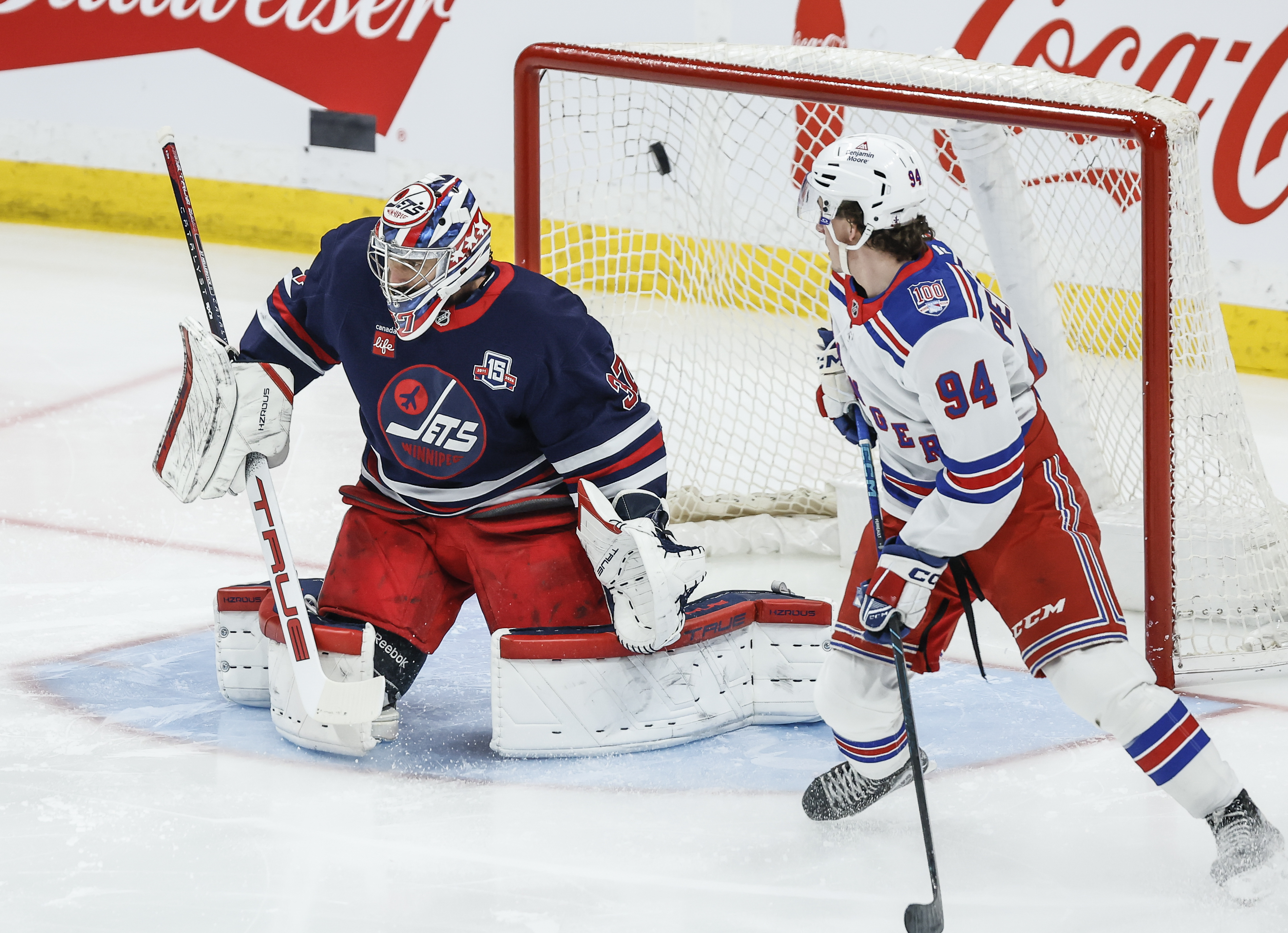
The Winnipeg Jets aren't just losing hockey games right now. They're self-destructing in a way that feels increasingly permanent. Watching them cough up a 6-3 decision to a New York Rangers team that has spent most of the season in the Eastern Conference basement was a cold reminder of how far this franchise has drifted from being a legitimate threat. You can't blame this one on bad bounces or a hot goalie. The Jets had the shots. They had the zone time. What they didn't have was the backbone to stop a bleeding wound that has been open since the calendar flipped to 2026.
If you’re a fan looking for a silver lining, you’re looking at the wrong roster. Thursday night at Canada Life Centre was a tactical nightmare. Despite outshooting the Rangers 27-17, Winnipeg found a way to let in six goals on just 16 shots against Connor Hellebuyck. That's not a typo. The Rangers scored on nearly 40% of their shots. When your Vezina-caliber goaltender is posting a .688 save percentage, even against high-danger chances, your defensive structure hasn't just failed—it has vanished.
A comedy of defensive errors
The story of this game was the Jets' inability to clear the front of their own net. It's the most basic tenet of NHL defense, and Winnipeg ignored it all night. Every time the Jets fought back to tie the game, they immediately handed the lead back by letting a Ranger park in Hellebuyck's kitchen.
Adam Fox opened the scoring just 68 seconds into the game. Gabriel Vilardi had barely sat down in the penalty box for hooking before Fox’s point shot found its way through a screen. That set the tone. Winnipeg spent the rest of the night chasing.
Isak Rosén, one of the few bright spots lately, tied it up with his first goal as a Jet. It was a beautiful deflection off a Jacob Bryson shot. For a moment, the building had life. But then Alexis Lafrenière—who is currently on a tear with six goals in his last five games—redirected a Will Borgen shot to make it 2-1. This was the pattern. Winnipeg would execute a high-skill play to pull even, only to give up a "soft" goal by failing to box out a winger.
The illusion of a comeback
Kyle Connor did his best to keep the ship afloat. His goal late in the second period was a reminder of why he’s the team's offensive engine. He took a feed from Mark Scheifele, danced around Adam Fox, and lifted the puck over Igor Shesterkin. It was a world-class goal that tied the game at 2-2.
But the third period was a disaster. Tye Kartye scored 75 seconds after the intermission. Again, it was a deflection. Again, the Jets' defense was caught puck-watching. Even when Vilardi tied it at 3-3 by pouncing on an Adam Lowry rebound, the parity lasted less than four minutes. Gabe Perreault shoveled a puck past Hellebuyck at 6:57 to make it 4-3, and Adam Edstrom—who was surprisingly promoted to the Rangers' second line—put the dagger in at 11:08.
Noah Laba’s empty-netter was just salt in a very deep, very public wound.
By the numbers: A breakdown of the collapse
- Shots on Goal: Winnipeg 27, New York 17
- High-Danger Chances: Winnipeg 12, New York 6
- Saves: Hellebuyck 11, Shesterkin 24
- The Problem: The Rangers scored five times on their first 16 shots.
Why the playoffs are slipping away
Honestly, this team looks fragile. After a disastrous start to the season that included a franchise-record 11-game losing streak in January, the Jets had actually clawed their way back into the wild-card conversation. They entered March looking like a group that had finally figured out Scott Arniel’s system. Then the wheels came off.
They are currently 3-2 on an eight-game homestand that was supposed to cement their postseason spot. Losing to the Rangers—a team with a sub-.500 record (27-30-8)—at home is the kind of result that gets coaches fired or rosters blown up. You can't drop points to the bottom-dwellers when the Colorado Avalanche and Dallas Stars are waiting for you in the schedule.
The lack of urgency is the most frustrating part. Dylan DeMelo played his 700th NHL game on Thursday, and the veteran presence he usually provides was nowhere to be found. The Jets' defensive core, once thought to be a position of strength, is currently a sieve. They aren't winning the battles in the corners, and they aren't winning the battles in the crease.
What needs to change before Colorado
The Jets host Colorado on Saturday afternoon. If they play the same "hope-based" hockey they showed against New York, Nathan MacKinnon and Cale Makar will put up double digits.
First, the coaching staff has to address the net-front presence. You can't allow six goals on 16 shots and blame the goalie entirely, but Hellebuyck also needs to be better. He’s the backbone of this team. When he’s off, the rest of the roster plays like they’re waiting for the inevitable.
Second, the power play has to actually do something. Going 0-for-2 while giving up a goal nine seconds into your own penalty kill is a recipe for a 6-3 loss every single time. The trade-deadline acquisitions like Rosén and Bryson are providing some depth scoring, but the core leaders—Scheifele, Connor, and Morrissey—need to demand more from the defensive zone.
If Winnipeg wants to avoid another "lost season," they have to stop playing down to their competition. The Rangers came in with nothing to lose and played like it. The Jets played like a team terrified of making a mistake, and in doing so, they made nothing but mistakes.
Fix the defensive gap control. Clear the crease. Stop letting mediocre teams dictate the pace in your own building. If those things don't happen by Saturday, you can officially start looking at 2027 draft prospects. The margin for error is gone.
Go back to basics on the defensive rotations. Stop chasing the puck behind the net. The Jets have the talent to be a playoff team, but right now, they lack the discipline. It's time to prove they actually want to be playing in May.