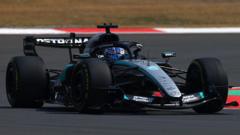
George Russell leading the sole practice session for the Chinese Grand Prix is a data point requiring extreme normalization before it can be used to forecast the competitive order for Sprint Qualifying. The return of Formula 1 to the Shanghai International Circuit after a five-year hiatus introduced a critical information vacuum, exacerbated by a weekend format that allocates only 60 minutes of track time before parc fermé conditions begin. In this environment, "topping the charts" is often an artifact of run-plan offset rather than pure aerodynamic efficiency.
The performance delta observed in Free Practice 1 (FP1) is governed by three primary variables: track evolution on a "green" surface, tire thermal degradation on the unique Shanghai bitumen, and the strategic distribution of power unit modes.
The Friction Coefficient and Surface Uncertainty
The Shanghai International Circuit features a track surface that has undergone "bitumen treatment" rather than a full resurface. This creates a non-linear grip progression. Traditional racing logic dictates that track evolution follows a predictable curve as rubber is laid down; however, the chemical interaction between the Pirelli C2, C3, and C4 compounds and this specific surface treatment remains an unquantified variable.
Russell’s fastest lap (1:36.330) occurred in the final moments of the session, capitalizing on the peak of the track’s rubberization. During this same window, Max Verstappen and Sergio Pérez focused on high-fuel long runs, prioritizing the collection of tire-wear data over low-fuel qualifying simulations.
The cost of a "green" track is measured in graining. Graining occurs when the tire slides across the surface, causing the rubber to tear and سپس re-adhere in an uneven fashion. The Shanghai layout, particularly the "snail" Turn 1 and the high-speed Turn 13, subjects the front-left tire to immense lateral loads. Teams that prioritized setup stability over raw lap time in FP1 are hedging against a high-graining scenario in the Sprint race, where tire management will dictate the points distribution.
The Power Unit Duty Cycle and Energy Management
A significant portion of the time find in Russell’s lap originates from the Deployment State of the Energy Recovery System (ERS). Formula 1 power units are restricted by technical regulations to a specific energy harvest and deployment per lap:
$$E_{total} = E_{MGU-K} + E_{MGU-H}$$
In a single practice session, Mercedes frequently utilizes a more aggressive deployment map than Red Bull or Ferrari. This "party mode" simulation allows the driver to find the braking limits at the end of the 1.2km back straight. Conversely, Red Bull often runs their internal combustion engine (ICE) in a conservative "service mode" during FP1 to preserve component life, given the 24-race calendar constraints.
The 0.2-second gap between Russell and the Ferraris of Leclerc and Sainz is likely a mirage. When accounting for the "tow" effect on the long straight and the estimated fuel loads—Mercedes historically runs lighter in practice to build driver confidence—the adjusted pace suggests Red Bull maintains a 0.3 to 0.4-second advantage in true race trim.
Mechanical Compliance vs. Aerodynamic Load
The Shanghai circuit is a "front-limited" track. Unlike the rear-limited traction demands of Bahrain, success here depends on mechanical compliance in the slow-speed sections (Turns 1-3, 6, and 14) balanced against high-speed aerodynamic stability in the sweeps of Turns 7 and 8.
The "Three Pillars of Shanghai Performance" can be categorized as follows:
- Low-Speed Turn-In Sharpness: The ability of the front axle to bite during the tightening radius of Turn 1.
- Thermal Ceiling: Managing the surface temperature of the tires during the 270-degree rotation of the final sector to ensure traction for the main straight.
- Ride Height Sensitivity: The circuit is built on soft marshland, leading to bumps caused by the settling of the ground. Teams running too low to maximize ground-effect downforce risk "bottoming out," which triggers the plank wear regulations and can lead to disqualification or erratic handling.
McLaren’s performance in FP1, specifically Oscar Piastri finishing within the top three, indicates a high level of aerodynamic efficiency in the mid-to-high speed transitions. However, their weakness in low-speed hairpins remains a bottleneck. If the wind direction shifts—a common occurrence in the Yangtze River Delta—the aerodynamic balance of the MCL38 could be compromised, as the car is notoriously sensitive to crosswinds.
The Strategic Failure of a Single Session
The Sprint format creates a "data bottleneck." Teams must choose between two mutually exclusive paths in FP1:
- Path A: Qualifying Optimization. Low fuel, soft tires, and aggressive mapping. This secures a high starting position but leaves the team blind regarding tire deg for the race.
- Path B: Race Simulation. High fuel, medium/hard tires, and consistent lap times. This provides a "tire life map" but risks a poor qualifying result, forcing the driver to fight through "dirty air" during the race.
Russell and Mercedes opted for a hybrid approach, but the timing of their fast lap suggests they leaned toward Path A. This may be a psychological tactic to pressure rivals, or a genuine attempt to understand the car's peak potential on a surface that has historically suited the Mercedes suspension geometry.
The second limitation of the FP1 results is the lack of "representative" traffic. In a qualifying session, the out-lap preparation and the "gap-finding" in the final sector are as critical as the flying lap itself. Russell’s lap was set in a relatively clear window, a luxury that will not exist in the three-stage knockout of Sprint Qualifying.
Quantifying the Ferrari Threat
While Mercedes took the headlines, Ferrari’s telemetry suggests they are the primary challengers to Red Bull’s dominance. The SF-24 has demonstrated superior tire warm-up characteristics in 2026. In a Sprint Qualifying format where drivers often get only one or two laps on a cold set of tires, Ferrari’s ability to hit the "thermal window" immediately is a significant tactical advantage.
Leclerc’s sector times in FP1 showed a high degree of consistency in the middle sector, which is the most technically demanding part of the track. If Ferrari has solved the high-speed "bouncing" that plagued them in previous seasons, their mechanical grip in the low-speed corners will make them favorites for the front row.
Operational Constraints and the Parc Fermé Trap
Once Sprint Qualifying begins, the cars enter parc fermé. No major setup changes—such as spring rates, damper settings, or aerodynamic configurations—can be made. This makes the 60 minutes of FP1 the most high-stakes hour of the weekend.
The risk for Mercedes is "over-extrapolating" from Russell’s P1. If the track temperature increases by even 5°C before the Sprint race, the balance of the car will shift rearward. A car that was perfectly "hooked up" in the cool of practice can suddenly become "snappy" and unpredictable.
The most successful teams in the modern era (Red Bull and, increasingly, Ferrari) use sophisticated simulation tools to predict these shifts. They do not chase the track surface during practice; they set the car for the expected race-time conditions. Russell’s pace is a measure of the car’s current state, but it may not be a measure of the car’s required state for Sunday.
The strategic play for the upcoming sessions is to monitor the "out-lap" speeds of the Mercedes. If Russell and Hamilton are forced to drive excessively fast out-laps to generate tire temperature, they will likely fall back during the long runs as the tires "overheat from the core." Conversely, if Red Bull can maintain slow out-laps and still find immediate grip, the FP1 leaderboard will be proven irrelevant by the first corner of the Sprint.
Prioritize the monitoring of Sector 1 times during the first three laps of any stint. This is the ultimate indicator of front-end health. Any driver losing more than 0.150s in the Turn 1-2 complex compared to their personal best is experiencing the onset of thermal degradation, regardless of their overall lap time.