The modern diplomatic press corps operates on a strange, recurring collective delusion. The latest symptom is the breathless coverage of the trilateral framework agreement signed in Washington by the United States, Israel, and Lebanon. Media channels echo the standard, sanitized talking point: Israeli Defense Minister Israel Katz declares that Jerusalem has "no territorial ambitions in Lebanon," but the military will not withdraw "a millimeter" until Hezbollah is fully disarmed.
It sounds resolute. It sounds conditional. It is a complete fantasy. For an alternative view, see: this related article.
I have watched defense ministries and multinational coalitions construct these exact conditional exit strategies for twenty years, only to watch them collapse under the weight of structural reality. To believe the official narrative is to fundamentally misunderstand the mechanics of modern asymmetrical warfare, the deep institutional bankruptcy of Beirut, and the actual military objective on the ground.
Israel is not leaving southern Lebanon. Not in sixty days, not in two years, and certainly not because of a piece of paper signed in a Washington conference room. Related insight regarding this has been published by Associated Press.
The Disarmament Delusion
The entire premise of the framework agreement hinges on a single, fatal assumption: that the Lebanese Armed Forces (LAF) can and will systematically disarm Hezbollah.
Let us fix the vocabulary immediately. The LAF is not a sovereign military force capable of executing a monopoly on violence. It is essentially a domestic policing and national stability asset, heavily underfunded and structurally vulnerable to the sectarian fractures of its own country.
To expect the LAF to march into the Ali Taher Ridge or the deep underground networks beneath the Beaufort Ridge and forcibly strip heavy weaponry from battle-hardened Hezbollah operatives is to expect a domestic security force to volunteer for a bloody, multi-front civil war. Even Minister Katz dropped the diplomatic mask, admitting to reporters that he does not believe the Lebanese army will "suddenly become lions charging at Hezbollah".
When the IDF requested that the Lebanese army enter the Ali Taher Ridge tunnel complex to clear out entrenched militants, the LAF simply refused. Why would they? The structural reality is clear:
- Forcing a direct confrontation breaks the Lebanese state entirely.
- The military cannot replace the massive social and economic patronage networks that the proxy group maintains within the Shia heartland.
- A forced disarmament trigger instantly causes a collapse of domestic cohesion.
If the condition for an Israeli military withdrawal is a verified, complete disarmament executed by Beirut, then the condition is explicitly designed to never be met.
The Security Zone is Already Real Estate
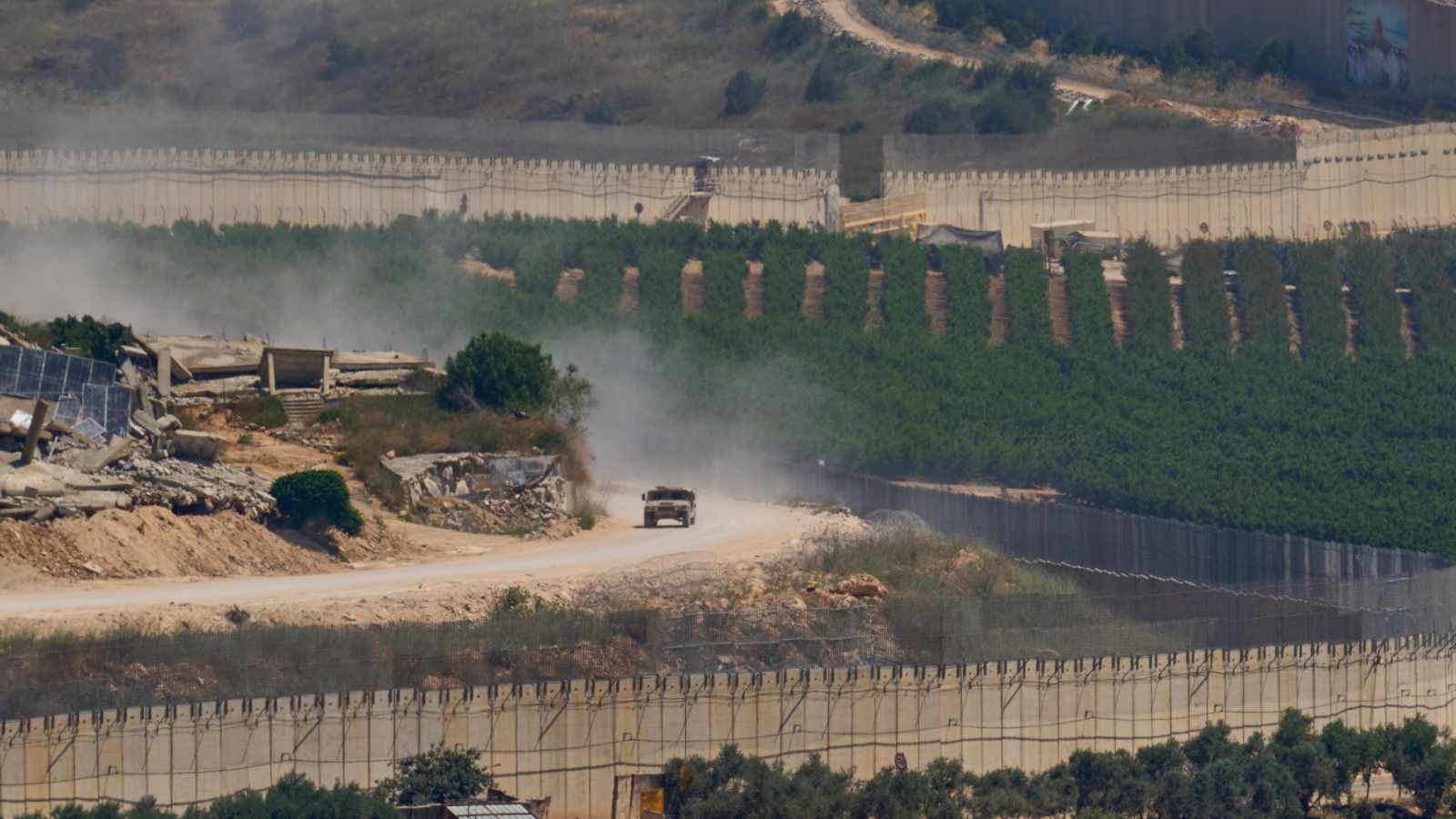
Look past the diplomatic rhetoric and examine the actual engineering on the ground. The IDF is not executing a temporary tactical raid; it is establishing a permanent buffer infrastructure.
The military strategy along the line of contact has resulted in nearly 100 percent destruction of the border villages in the western and central sectors, and over 70 percent in the eastern sector. Hundreds of thousands of residents have been permanently displaced from these areas. This is not the collateral damage of a fluid battlefield; it is the deliberate, systematic creation of a sanitized security zone designed to eliminate the threat of anti-tank guided missiles against northern Israeli border communities.
Imagine a scenario where a military spends months mapping, boring, and clearing out massive underground tunnel complexes using hundreds of tons of explosives, only to hand the keys back to a weak state authority that has a twenty-year record of letting militant proxies rearm on its doorstep. It defies basic strategic logic.
The baseline incentive structure for any Israeli government is completely hostile to a total withdrawal. No prime minister can look at the evacuated families of the Galilee and promise them safety based on the word of a Lebanese state that cannot even control its own official military units. The "security zone" is the new permanent northern border, regardless of what the international legal maps say.
The Flawed Questions Everyone Keeps Asking
The political and media commentary remains stuck in a loop, asking the wrong questions entirely.
Does Israel want to colonize southern Lebanon?
This is the standard critique from regional observers, but it misses the entire point. Territorial ambition does not require civilian colonization or formal annexation. In the modern security architecture, "occupation" has been rebranded as "long-term security architecture". Israel does not need or want the administrative headache of governing Lebanese civilian populations. What it wants, and what it is actively building, is an empty, militarized buffer zone where anything that moves without authorization is immediately neutralized.
Will international pressure force a retreat?
Commentators point to Washington's parallel negotiations with Iran and the broader regional framework as the ultimate lever to force an Israeli pullback. This ignores the profound shift in how localized security decisions are made. While global superpowers negotiate grand agreements in distant capitals, the commander on the ground faces the tactical reality of keeping troops outside the effective range of anti-tank fire. Whenever a partnership's diplomatic goals clash with immediate border security, the physical control of high ground wins every single time.
The Brutal Actionable Truth
For international analysts, corporate risk managers, and energy sector investors looking at the Eastern Mediterranean, the actionable takeaway is simple: stop planning for a "post-conflict" return to the old status quo.
The trilateral framework agreement is not a roadmap to peace; it is a legal cover for an open-ended military footprint. The "pilot programs" of minor withdrawals are designed to demonstrate nominal compliance while the core security zones remain fully garrisoned.
The downside to this realistic appraisal is obvious: it dooms the region to a permanent state of low-intensity friction, ensures the economic paralysis of Lebanon, and guarantees that the border will remain a militarized wasteland for a generation. But acknowledging that reality is infinitely better than building strategic plans on the quicksand of diplomatic theater.
The buffer zone is here to stay. The troops are not moving a millimeter. Accept the new geography of the Levant.