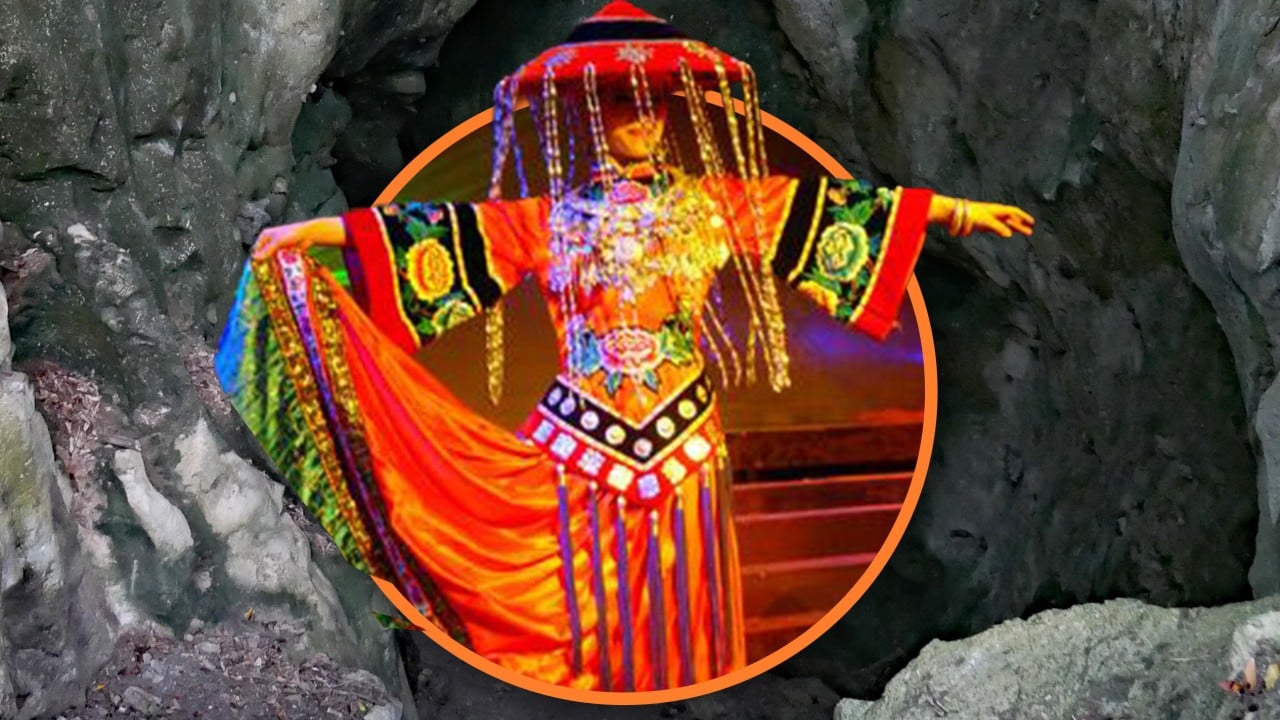
The "Cave God" (Dongshen) marriage ritual of the Xiangxi region in Western Hunan serves as a case study in how localized religious orthodoxies evolve to manage surplus population and reinforce patriarchal property rights under conditions of extreme resource scarcity. While popular narratives focus on the sensationalism of starvation and "ghostly" brides, a structural analysis reveals a sophisticated social mechanism designed to convert female mortality into community-wide psychological stability and spiritual capital. This was not a random act of superstition, but a calculated socio-economic outlet for women trapped between the failure of the traditional marriage market and the rigid demands of Confucian purity.
The Tripartite Framework of the Dongshen Ritual
The practice functioned through three intersecting pillars of control: the Escapist Psychological Anchor, the Property Right of Honor, and the Ecological Limitation of the Karst Landscape.
1. The Escapist Psychological Anchor
In the isolated, mountainous terrain of Western Hunan, the "Cave God" represented a romanticized alternative to the grueling labor of agrarian life. Young women, often facing forced marriages or the social stigma of unrequited love, were conditioned to view the cave as a liminal space. The "god" was described not as a monster, but as a handsome, noble figure. This branding was essential for self-selection; the ritual relied on the victim’s psychological compliance. By reframing a slow death by starvation as a "divine union," the community neutralized the horror of the act, transforming a localized tragedy into a public celebration of virtue.
2. The Property Right of Honor
In the Ming and Qing dynasties, female chastity carried tangible economic value. A "chaste" family could receive tax exemptions or imperial recognition. When a woman committed "Cave God marriage," she effectively locked her family's reputation into a state of permanent, unassailable purity. Since she was "married" to a deity, no mortal man could ever claim or "defile" her. This created a high-value social asset for her surviving male kin, ensuring their status in the village hierarchy without the ongoing cost of her dowry or maintenance.
3. The Ecological Limitation of the Karst Landscape
The geology of Xiangxi—defined by deep, inaccessible limestone caves—provided the physical infrastructure for this ritual. These caves were perceived as "breathing" portals to the underworld. The ritual utilized the physical isolation of the karst topography to ensure that once a woman entered the cave, her return was physically and socially impossible. The geography enforced the finality of the social contract.
The Mechanics of Systemic Starvation
The process of becoming a "Cave God bride" followed a rigorous operational sequence. It began with "falling into the cave" (luodong), a state of trance or clinical depression that local shamans (Maogula or localized Taoist practitioners) diagnosed as a divine summons.
- The Diagnosis Phase: Cultural stressors—such as the death of a betrothed or the inability to meet labor expectations—triggered a psychological withdrawal. Local authorities did not treat this as illness but as "sanctification."
- The Social Transition: The woman was treated as a bride-to-be. She was fed delicacies and dressed in fine silks, often funded by communal contributions. This redistributed the financial burden of the ritual across the village, creating collective buy-in.
- The Physical Seclusion: The bride was escorted to a remote cave. Unlike a quick execution, the "Cave God" required a slow expiration. The duration of her survival was interpreted as a measure of her sincerity and the god's favor.
This prolonged timeline served a secondary function: it allowed the family to perform a public display of grief that transitioned into pride, reinforcing the social fabric through shared emotional labor.
Quantifying the Incentive Structure
To understand why this practice persisted into the early 20th century, we must analyze the "Cost of Exit" versus the "Reward of Compliance."
| Stakeholder | Cost of Exit (Stopping the Ritual) | Reward of Compliance (Executing the Ritual) |
|---|---|---|
| The Victim | Lifetime of manual labor; social ostracization; potential domestic abuse. | Transformation into a local deity; eternal "beauty"; relief from physical pain. |
| The Family | Potential scandal; "damaged" marriageability of sisters; cost of a dowry. | Permanent status as a "holy" family; elimination of a non-productive mouth to feed. |
| The Community | Divine wrath (droughts, crop failure); disruption of established social order. | Reaffirmation of local customs; psychological closure for "unfit" individuals. |
The "Cave God" system functioned as a pressure valve for the village. In an environment where the calorie-to-work ratio was razor-thin, individuals who could not contribute to the labor pool (due to psychological distress or physical frailty) were systematically moved into the "sacred" category, where their death provided more utility to the group than their life.
The Intersection of Shamanism and State Control
The Xiangxi region was historically a "frontier" zone where the central Han government struggled to impose Confucian norms on the local Miao and Tujia populations. The Cave God cult was a hybrid result of this friction.
Centrally-mandated Confucianism demanded female chastity, while local shamanic traditions demanded appeasement of mountain spirits. The "Cave God bride" satisfied both. It met the state’s criteria for "virtuous women" (lie nü) while maintaining the local religious hierarchy. This synergy made the practice incredibly difficult to eradicate, as it was supported by both the grassroots spiritual leaders and the formal social expectations of the era.
Psychological Dissociation as a Survival Mechanism
The women who "fell into the cave" often exhibited symptoms consistent with what modern psychology identifies as a dissociative fugue or severe clinical depression. However, the cultural framework of the time provided a "narrative bridge" that allowed these individuals to interpret their own mental collapse as a divine calling.
This created a self-fulfilling prophecy. A woman, overwhelmed by the limitations of her reality, would begin to hallucinate or exhibit "holy" behavior. The community, recognizing the signs, would begin the ritual preparations. The victim, seeing no other path to dignity, would lean into the role of the bride. The lack of resistance observed by historical witnesses was not an absence of suffering, but the final stage of a totalizing psychological enclosure.
Structural Decay and the Abolition of the Cult
The collapse of the Cave God practice was not solely the result of "enlightenment" or modern education. It was precipitated by the breakdown of the isolated economic units of Western Hunan.
- Market Integration: As trade routes opened, the "cost" of a woman’s labor changed. Women became valuable in the production of tea and tung oil for export. The economic incentive shifted from "sacrificing a mouth" to "utilizing a hand."
- State Penetration: The late Qing and early Republican governments began to view these rituals as "feudal remnants" that undermined the modernizing image of the state. The legal consequences for families involved in these sacrifices finally outweighed the social prestige.
- The Secularization of Mental Health: As rudimentary medical concepts reached the mountains, "falling into the cave" was increasingly viewed as a treatable ailment rather than a supernatural event.
Strategic Realignment of Cultural Memory
Modern tourism in Xiangxi now attempts to sanitize the "Cave God" narrative, framing it as a tragic Romeo-and-Juliet style folk tale. This is a strategic misrepresentation. To view these deaths as "romantic" is to ignore the cold, structural logic of an agrarian society managing its margins.
The Cave God was a manifestation of Optimal Foraging Theory applied to human souls: when the environment cannot support the population, the culture develops a "sacred" method to reduce the population while maximizing the psychological cohesion of the survivors.
The historical reality of the Cave God brides offers a stark warning about the power of cultural narratives to mask systemic violence. When a society creates a "spiritual" solution for a "material" problem, it is almost always the most vulnerable who pay the price in the name of the divine. The strategic lesson here is clear: any system that incentivizes death over maintenance will eventually develop a sophisticated, even beautiful, mythology to justify its own cruelty.
Future analysis of localized cults must prioritize these economic drivers over the superficial "magic" of the ritual. The "magic" is merely the marketing; the "cave" is the ledger.