The screen at Gate B22 didn’t flicker. It didn’t glitch. It simply changed. One moment, it promised a direct path to Dubai, a silver thread connecting the rainy pavements of London to the heat of the Persian Gulf. The next, it wore the flat, red geometry of a "Cancelled" notification.
Consider a woman named Elena. She is hypothetical, but her exhaustion is a data point shared by tens of thousands this week. She is sitting on a linoleum floor in Istanbul, charging her phone from a terminal that has seen better decades. She isn't thinking about the geopolitical calculus of "proportional response" or the tactical radius of an F-35. She is thinking about her daughter’s wedding in Mumbai, which is starting in fourteen hours. Between her and that wedding lies a sudden, invisible wall of lead and fire. Discover more on a connected subject: this related article.
When the United States and Israel launched strikes against Iranian military targets, the impact wasn't contained to the silos or the command centers. It rippled outward at the speed of a jet engine. In an instant, the geography of the Middle East—the literal bridge between the East and the West—ceased to be a transit corridor and became a fortress.
The Geography of Fear
Airspace is not just empty blue. It is a complex grid of invisible highways, governed by treaties, safety protocols, and the cold reality of physics. When a missile enters that grid, the highways vanish. More analysis by National Geographic Travel explores comparable views on the subject.
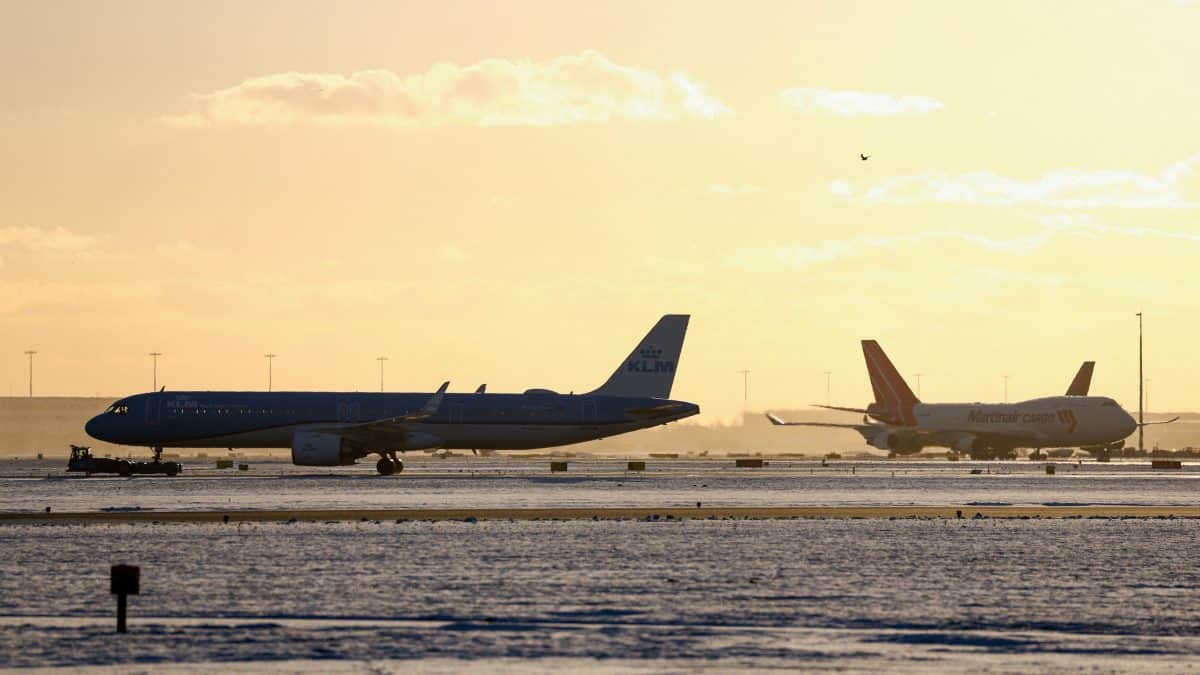
Airlines operate on margins so thin they are practically transparent. When a pilot has to bank left to avoid the Iranian border, they aren't just changing direction. They are burning tons of extra fuel. They are stretching crew hours past legal limits. They are turning a seven-hour hop into a twelve-hour endurance test. For the titans of the industry—Emirates, Qatar Airways, Lufthansa—this isn't just a logistical headache. It is a structural fracture.
The sky above Iraq, Iran, and Jordan represents the most efficient path for anyone moving from Europe to Southeast Asia. Closing it is the equivalent of a massive sinkhole swallowing the main artery of a global city. You can take the side streets, but the side streets weren't built for this kind of traffic.
The Calculus of a Middle Seat
We often view international travel as a luxury, a series of postcards and high-altitude gin and tonics. But the chaos currently gripping the Middle East reveals the terrifying fragility of our interconnectedness.
Take the "NOTAM"—a Notice to Air Missions. It is a dry, coded document. To a dispatcher, a NOTAM issued over Tehran is a scream. It means the risk of a "misidentification" event—the polite military term for shooting down a civilian airliner—has spiked. No CEO is willing to gamble a $300 million aircraft and 300 lives on the hope that a surface-to-air missile battery is being operated by someone with a cool head.
So, the planes stay down. Or they fly the long way around, skirting the edges of the conflict like a hiker walking the long way around a sleeping bear.
The cost of this detour is passed down in a brutal, immediate chain reaction. Fuel surcharges spike. Cargo holds that should be carrying life-saving medicine or high-tech components are instead packed with extra kerosene just to make the trip. The global supply chain, already limping from years of disruption, takes another hit to the solar plexus.
The Human Toll of Logistics
Back to the linoleum floor. Elena is one of the lucky ones; she has a credit card and a battery pack. Nearby, a family is trying to figure out how to feed three children in an airport where a sandwich costs more than a day's wages back home.
This is the hidden cost of war. We count the casualties in the strike zones, as we should. But we rarely count the lost moments: the missed funerals, the business deals that fall through, the immigrants who haven't seen their parents in five years and find their path blocked at the very last mile.
There is a specific kind of helplessness that comes with being stranded in a foreign transit hub during a regional war. You are a ghost in the machine. You have no vote in the conflict. You have no say in the strikes. You are simply a body that needs to move from Point A to Point B, caught in the gears of a machine that has decided Point B no longer exists for you.
The Vanishing Horizon
The aviation industry is built on the premise of a predictable world. We trust that the sky will be open. We trust that the GPS coordinates will remain valid. We trust that the "Overflight Rights" negotiated in mahogany-row boardrooms will hold.
When that trust breaks, the world gets larger. Not in a grand, exploratory way, but in a punishing, medieval way. Distance begins to mean something again. The "Global Village" starts to look more like a collection of walled gardens, separated by no-go zones that require days of travel to bypass.
The current strikes have forced a massive redirection of traffic over Saudi Arabia and Egypt. These corridors are now some of the most congested in the history of flight. Controllers are working double shifts, guiding a relentless stream of metal through narrow gaps of safety. One error, one momentary lapse in focus, and the tragedy moves from the ground to the clouds.
The Silence After the Roar
There is a haunting quiet that follows the announcement of a closed border. It’s the silence of a terminal when the last frustrated traveler has fallen asleep on their coat. It’s the silence of a cargo ship idling outside a port because the air cover it relied on is gone.
We are witnessing a decoupling. It isn't just about missiles and radar signatures. It is about the slow erosion of the idea that we can go anywhere, anytime. The Middle East has long been the pivot point of the world's map. When that pivot seizes up, the whole world feels the vibration.
It’s easy to look at the headlines and see a map with red dots and arrows. But look closer. Look at the gate agents who are bearing the brunt of a fury they didn't create. Look at the pilots staring at fuel gauges with grim calculations running through their heads. Look at the people like Elena, whose lives are measured in the distance between a "Cancelled" sign and a home they can no longer reach.
The sky is no longer a neutral space. It is a front line. And as long as the engines of war are running, the engines of our world are going to keep stalling.
A small child in an Istanbul terminal is crying because he lost his toy under a row of seats. His father is staring at a news feed, watching a video of a horizon lit by orange fire. Both are waiting for a flight that isn't coming. The toy is lost, the path is blocked, and the morning sun is rising over a world that feels much, much wider than it did yesterday.
Would you like me to look into the specific airline refund policies or alternative rail routes being established in the wake of these cancellations?