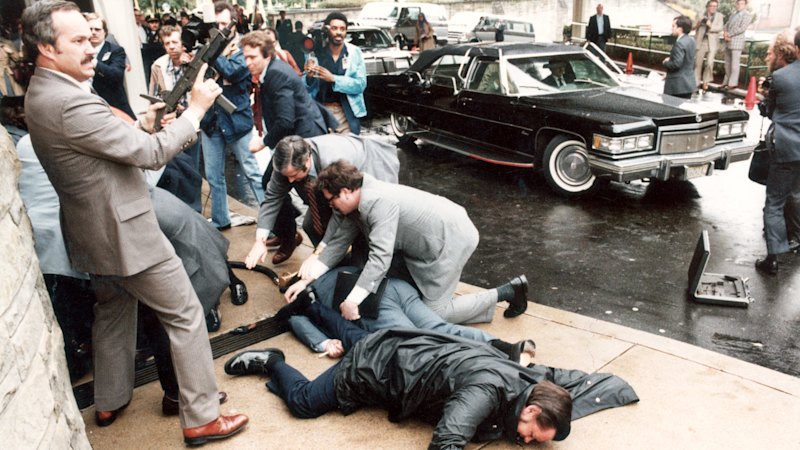
The crack of a rifle in Butler, Pennsylvania, did more than pierce the summer air; it shattered the fragile illusion of modern security. When the shots rang out at the Trump rally, the immediate instinct of the American media was to reach for the nearest historical shelf. They found the 1981 assassination attempt on Ronald Reagan. It was a convenient comparison. Both involved a charismatic leader, a young, socially isolated gunman, and a sudden eruption of violence caught on camera. But the "eerie echoes" narrative is a dangerous oversimplification that ignores how the mechanics of political violence have fundamentally evolved.
We are no longer in an era where a single disturbed individual acts in a vacuum. John Hinckley Jr. was driven by a cinematic obsession, fueled by letters and proximity. Today’s threat profile is built on an algorithmic feedback loop that Reagan’s Secret Service could never have imagined. The comparison to 1981 is a comfort blanket for a public that wants to believe the problem is still just a few "broken" men rather than a systemic failure of digital and physical oversight.
The Myth of the Historical Parallel
In 1981, the threat was linear. Hinckley had a physical trail of travel and paper. The security failure that day was one of proximity and physical screening. In the modern era, the "lone wolf" is rarely truly alone. They are the end product of a decentralized assembly line of radicalization. When we compare the Trump shooting to the Reagan shooting, we focus on the aesthetics of the event—the chaotic huddle of agents, the blood on the face, the defiant wave. This focus on the optics masks the shift from individual pathology to collective digital drift.
The Reagan shooting led to the Brady Bill and a focus on mental health reporting in gun sales. The Butler shooting exposes something far more difficult to legislate: the total collapse of the "perimeter" in an age of high-velocity information. We are looking for Hinckley in a world that produces thousands of him every hour in encrypted chat rooms and forum basements.
The Failure of the Kinetic Perimeter
Modern protection relies on the concept of the "hard shell." If you control the high ground and the entry points, you control the outcome. But the Butler incident proved that the hard shell is a relic. The Secret Service faced a failure of imagination, not just a failure of marksmen. They were prepared for a 1981 threat in a 2024 environment.
The shooter in Pennsylvania managed to access a rooftop within a clear line of sight. This wasn't a sophisticated infiltration. It was a basic breach of spatial awareness. In 1981, the security gap was a matter of feet. In Butler, it was a matter of blocks. The irony is that while our surveillance technology has grown exponentially—drones, facial recognition, signals intelligence—the fundamental task of "looking up" was neglected. We have traded basic situational awareness for high-tech theater.
The Algorithm as an Accomplice
Unlike Hinckley, who was chasing a literal star, modern actors are often chasing a digital ghost. The radicalization process is now automated. Social media platforms do not just host content; they curate a descent into obsession. When an individual begins to engage with extremist rhetoric, the platform’s primary goal is engagement. It serves more of the same. It tightens the circle.
This creates a "stochastic terrorism" environment. You don't need to give an order to a specific soldier. You simply saturate the environment with enough high-pressure rhetoric and wait for the most unstable element to crack. This is the piece of the puzzle that the Reagan-era comparisons miss. Hinckley was a fluke. The modern shooter is a statistical probability.
The Infrastructure of Neglect
We have to look at the physical decay of security standards alongside the digital rise of threats. The Secret Service has been stretched thin by an ever-expanding list of protectees and a budget that hasn't kept pace with the complexity of the mission. They are operating with 20th-century manpower against 21st-century stressors.
- Personnel Burnout: Agents are working record overtime hours, leading to a decline in peak performance.
- Technological Lag: The transition to AI-driven threat detection is slow and plagued by bureaucracy.
- Scope Creep: The agency is tasked with everything from cybercrime to dignitary protection, diluting its core focus on physical security.
When you have a tired force relying on outdated maps and local law enforcement communication that isn't synchronized, the result is a rooftop left unguarded. It is not a conspiracy; it is a predictable outcome of organizational rot.
The New Reality of Political Violence
If we continue to treat these events as historical anomalies or "eerie echoes," we will never address the root cause. The Reagan shooting was a moment of national shock that led to a brief period of unity. The Trump shooting has become a catalyst for further polarization. This is the most significant departure from the 1981 script.
The event itself is now a weaponized piece of content. Within seconds of the shots being fired, the narrative was being carved out to serve specific political ends. In 1981, the news cycle took hours to solidify. In the current environment, the "truth" of the event is decided in the comments section before the shooter is even identified. This speed prevents the kind of national reflection that followed the Reagan attempt. Instead of a sober look at security protocols, we get a frantic rush to blame the "other side."
The Illusion of Safety
We are living in a period of performative security. The TSA at the airport, the metal detectors at the stadium, the clear bag policies—these are designed to make the public feel safe, not necessarily to stop a determined actor. The Butler shooting stripped away that performance. It showed that despite the billions spent on homeland security since 2001, a twenty-year-old with a ladder and a basic rifle can still disrupt the highest levels of the American political process.
The Reagan shooting was a failure of a small team in a specific moment. The Butler shooting is a failure of a massive apparatus that has become too heavy to move and too blind to see. The comparison to 1981 isn't just wrong; it’s a distraction from the fact that our security state is built on foundations of sand.
The Hard Reset
To fix this, we must stop looking for historical parallels and start looking at the current architecture of threat. This means moving beyond the "lone wolf" trope. We need to recognize that digital radicalization is a public health crisis and that physical security requires a return to basics: clear communication, localized command structures, and a ruthless focus on the perimeter.
The Secret Service needs to be stripped of its auxiliary duties. It should not be investigating credit card fraud or counterfeit currency. Its sole mission must be the protection of the democratic process through the safety of its participants. Anything else is a dangerous diversion of resources.
The sound of gunfire in Butler didn't echo 1981. It announced the arrival of a new, more volatile era of American history. We can either adapt to the reality of the digital-age assassin or continue to be surprised when the "unthinkable" happens again. The perimeter is no longer a line on a map; it is the entire information ecosystem. If we can't secure that, no rooftop will ever be truly safe. Stop looking at the past for answers to a future that has already arrived.