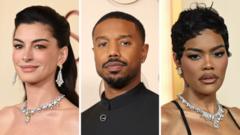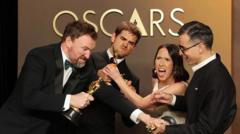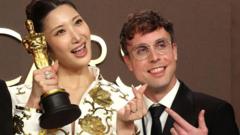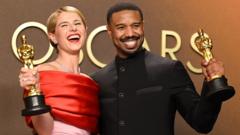
The air inside the Dolby Theatre usually feels like expensive static. It is a vacuum of rented tuxedos and practiced smiles, where the humidity is controlled to the exact percentage required to keep a million dollars’ worth of hairspray from failing. But this year, something broke the seal. You could see it in the way the light caught the tear tracks on faces that usually remain porcelain. It wasn't just a ceremony. It was a reckoning.
For years, the Academy Awards felt like a beautiful, slow-moving glacier—magnificent to look at, but largely frozen in place. Then came Jessie Buckley.
When her name was called, the room didn't just clap. It exhaled. Buckley has always carried a sort of raw, unpolished lightning in her performances. She is the actress who looks like she just walked in from a rainstorm, bringing the smell of wet pavement and real life into the sterile frame of a movie screen. Seeing her stand there, clutching that gold-plated weight, felt like a victory for every person who has ever been told they were "too much" or "too loud" or "too real."
She didn't give a speech that sounded like it had been processed through a PR machine. She spoke with a voice that wavered, not out of nerves, but out of a genuine, vibrating disbelief. She represented the fringe finally becoming the center. This wasn't about a career milestone; it was about the industry admitting that the messy, jagged edges of humanity are more valuable than a perfect, symmetrical veneer.
Across the aisle sat Michael B. Jordan.
If Buckley is the lightning, Jordan is the hearth. He has spent a decade building a body of work that balances the physical demands of a superhero with the quiet, devastating vulnerability of a man just trying to be seen. His win was a long time coming. It felt like the closing of a circle.
Watching him walk to the stage, you could see the ghosts of the characters he’s inhabited—the boys from Baltimore, the kings of Wakanda, the fighters in the ring. He carries them all in his shoulders. When he took the statue, he didn't just thank his agent. He thanked the people who stayed in their seats until the very end of the credits, the ones who find pieces of their own struggle in his eyes.
The narrative of the evening wasn't about "who won." It was about "who survived."
The film One Battle After Another became the connective tissue of the night. It is a grueling, relentless piece of cinema. It doesn't offer easy answers. It doesn't have a catchy theme song that makes you want to buy a soundtrack. It is a movie about the exhaustion of persistence.
The sweep of awards for this film signaled a shift in what we crave as an audience. We are tired of the polished lie. We are living in an era where every day feels like a series of small, grinding conflicts—with our bank accounts, with our health, with the terrifying crawl of the news cycle. One Battle After Another didn't try to distract us from that. It looked us in the eye and said, "I see you."
The director stood on stage and looked out at a sea of the most powerful people in Hollywood. He didn't talk about his vision. He talked about his mother’s hands. He talked about the way she used to scrub the floors until her knuckles bled, and how that rhythmic, painful persistence was the only "art" he ever truly understood.
The silence in the room was absolute.
In that moment, the hierarchy of the Oscars dissolved. It wasn't about the box office numbers or the campaign budgets. It was about the universal truth that life is mostly a matter of getting back up one more time than you were knocked down.
Consider the gravity of these wins in the context of the last few years. The industry has been terrified. It has been looking at empty theaters and shrinking attention spans, wondering if the "magic of the movies" was just a trick of the light that had finally been figured out.
But the night belonged to the outsiders.
It belonged to the independent spirits who filmed in the mud. It belonged to the actors who were told they were too "character-heavy" to be leads. It belonged to the stories that don't fit neatly into a thirty-second trailer.
The invisible stakes were higher than anyone admitted on the red carpet. If the big, bloated spectacles had swept the night, it would have been a sign that the heart of cinema had stopped beating, replaced by a cold, algorithmic pulse. Instead, we got Buckley’s unfiltered Joy. We got Jordan’s quiet dignity. We got a film that celebrated the grit of the human spirit.
There is a specific kind of magic that happens when a person’s private struggle is validated on a public stage. You could see it in the way the technical nominees—the sound editors, the costume designers, the people who work in the shadows—walked a little taller. They weren't just parts of a machine anymore. They were the architects of a feeling.
The true story of the night wasn't found in the tally of trophies. It was found in the spaces between the words. It was in the way Michael B. Jordan squeezed Jessie Buckley’s hand in the wings. It was in the way a veteran actress in the third row let a single tear ruin her makeup during the "In Memoriam" segment, not for the cameras, but for a friend she missed.
We watch these ceremonies because we want to believe that someone is keeping score. We want to believe that the long hours, the failed drafts, the rejected auditions, and the "one battles" actually lead somewhere.
As the house lights came up and the celebrities began their migration toward the after-parties, the air in the Dolby Theatre felt different. The static was gone. In its place was something warmer, something heavier.
The statues were still gold, and the carpet was still red, but for one night, the heart of the machine was human.
The winners didn't just take home a trophy. They took home the proof that the struggle is the point. The battle is the reward. And the story, if told with enough honesty, never truly ends.