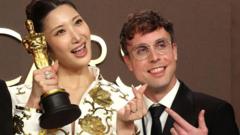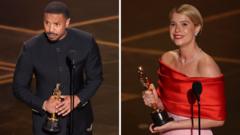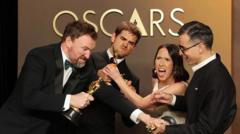
Tying for an Oscar sounds like a mathematical impossibility. When you have thousands of Academy members voting, the odds of two performances or films landing on the exact same number of votes are astronomical. Yet, it happened. It happened during one of the most high-stakes categories in recent memory, and the look of sheer confusion on the presenters' faces told the whole story. "It's a tie, I'm not joking," isn't just a funny quote. It's a reminder that the Oscars, for all their polished glamour and scripted speeches, can still produce a moment of genuine, unscripted madness.
Most people assume the Academy has some secret tie-breaker hidden in a vault in Burbank. They don't. If the numbers match, both nominees get a statue. While the recent buzz stems from a specific ceremony where two films shared the spotlight, this isn't the first time the industry has been flipped on its head by a split decision. It’s rare, it's awkward, and honestly, it’s exactly what the show needs more of.
The Night the Math Broke
When the envelope opened and the words "It's a tie" came out, the room didn't erupt in cheers immediately. There was a beat of silence. People thought it was a bit. After the La La Land and Moonlight disaster, the audience is conditioned to expect a mistake. But this wasn't a mistake. It was a statistical fluke that saw two different creative visions recognized as equals.
In this particular instance, the tie occurred in a technical category where the margin for error is razor-thin. When you're dealing with Sound Editing or Documentary Short, the voting block is smaller than the Best Picture pool. That makes a tie more likely, but no less shocking. Seeing two different teams walk onto the stage, trying to figure out who speaks first while the orchestra conductor looks on in confusion, is peak television. It breaks the "winner takes all" narrative that makes the Oscars feel like a blood sport.
How a Tie Actually Happens
The Academy of Motion Picture Arts and Sciences uses a weighted voting system for Best Picture, but for most other categories, it’s a straightforward "who got the most votes" situation. PricewaterhouseCoopers (PwC) handles the counting. They are the only ones who know the truth before those envelopes are ripped open.
If Actor A gets 1,402 votes and Actor B gets 1,402 votes, there is no second round of voting. There is no coin flip. PwC simply instructs the trophy handlers to have two statues ready at the wings. The Academy actually keeps "spare" Oscars on hand for this exact scenario, though they usually sit backstage collecting dust.
History Repeats Itself in the Best Way
To understand why people lost their minds over the recent tie, you have to look back at the most famous tie in history. 1968. Best Actress.
Barbra Streisand and Katharine Hepburn both won. Streisand was the newcomer for Funny Girl, and Hepburn was the legend for The Lion in Winter. It was the ultimate "passing of the torch" moment, except the torch got duplicated. Hepburn wasn't there to accept it, but Streisand’s "Hello, gorgeous" speech to her golden statue became iconic.
That 1968 moment set the gold standard for Oscar drama. It proved that the Academy wasn't rigged—at least not in the way people thought. If they were rigging it for ratings, they’d never let a tie happen because it feels "unfinished" to a casual viewer. But for film nerds, a tie is a validation that the race was actually as close as the critics said it was.
Other Times the Academy Doubled Down
- 1931/32 Best Actor: Wallace Beery and Fredric March shared the honors. Back then, the rules were even weirder. If you were within one vote of the winner, it was considered a tie. They changed that rule pretty quickly to require an exact match.
- 1949 Best Documentary Short: A Chance to Live and So Much for So Little both took home the prize.
- 1994 Best Live Action Short: Franz Kafka's It's a Wonderful Life and Trevor tied. This one is a cult favorite among trivia buffs.
Why We Should Stop Hating on Split Wins
Critics often argue that a tie "dilutes" the win. They say it’s like a participation trophy. That’s nonsense.
If anything, a tie is a higher honor. It means that two pieces of work were so undeniably excellent that a massive group of industry professionals couldn't find a single vote to separate them. In an era where Oscar campaigns are million-dollar marketing wars, a tie is a glitch in the matrix. It’s the one thing a high-priced PR firm can’t buy. You can buy a win through aggressive campaigning, but you can't perfectly manufacture a tie.
It also saves us from the "snub" discourse. Usually, when a favorite loses by a hair, the internet spends three days screaming about how they were robbed. When there’s a tie, everybody wins. The fans are happy, the studios are happy, and we get a weird, memorable moment that people will actually talk about the next morning.
The Logistics of a Surprise Double Win
The physical reality of a tie is a bit of a nightmare for the stage managers. Usually, there’s only one statue on the pedestal. When the presenter announces the tie, the person in the wings has to scramble.
During the recent "I'm not joking" moment, the presenters had to navigate two different sets of winners coming from different sides of the Dolby Theatre. You have two different speeches, which usually means the "wrap it up" music starts playing too early for the second person. It's clunky. It's messy. It’s great.
The Academy actually produces about 50 statues for every ceremony, even though there are only about 24 categories. They do this because they don't know how many producers will come up for Best Picture, or if a tie will occur. The losers' names aren't on the statues anyway—they get nameplates engraved at the Governor’s Ball after the show.
What This Means for Future Races
Expect more of this. As the Academy expands its membership to be more international and more diverse, the voting blocks are becoming less predictable. The old "monolith" of Oscar voting is dead. You have younger voters, international voters, and streaming-service advocates all pulling in different directions.
This fragmentation makes the "consensus pick" harder to find. We might see ties in major categories like Best Director or even Best Picture in the coming decade. If that happens, the internet might actually break.
If you're betting on the Oscars next year, don't just look at the frontrunners. Look at the categories where two people are neck-and-neck in every precursor award. If the SAG Awards go one way and the BAFTAs go another, you're in the "Tie Zone."
The best way to prep for the next ceremony is to stop looking at the Oscars as a definitive ranking of "best" and start seeing them as a chaotic snapshot of industry sentiment. Sometimes that sentiment is perfectly split down the middle. When the presenter says they aren't joking, believe them. The math doesn't lie, even when it feels like a prank.
Keep an eye on the technical categories in the upcoming awards season. Those smaller voting pools are where the lightning usually strikes. If you see two films dominating the Sound or Visual Effects guilds equally, get ready for another double-statue night.