The commercial aerospace sector operates as a duopoly at the upper echelon of seating capacity, leaving structural gaps in the 70 to 150-seat segment. Embraer has capitalized on this specific market inefficiency by exploiting a highly concentrated aerospace cluster in São José dos Campos, transforming local labor cost differentials into global market share. The core thesis governing Embraer's expansion rests on structural cost arbitrage, targeted product architecture, and tactical optimization of the regional-to-mainline transition point for commercial airlines. Understanding this operational model requires deconstructing the geographic cluster economics, the engineering trade-offs of the E-Jets E2 family, and the geopolitical positioning of its defense division.
The Cluster Economics of São José dos Campos
The concentration of aerospace engineering in São José dos Campos mimics the structural design of Toulouse, France, or Seattle, Washington, but functions under a distinct macroeconomic framework. The foundational driver of this cluster is the state-backed integration of academic research, specialized labor, and industrial co-location.
This model functions through three reinforcing mechanisms.
First, the Department of Aerospace Science and Technology (DCTA) and the Technological Institute of Aeronautics (ITA) act as a closed-loop labor pipeline. Because the institutional focus is tightly coupled with aerospace engineering, the local labor market features an exceptionally high concentration of specialized technical competencies. The geographic immobility of this talent pool creates a monopsonistic labor effect for high-tier engineering roles, allowing the primary manufacturer to retain deep institutional knowledge at lower nominal wage rates relative to North American or Western European competitors.
Second, the structural supply chain is compressed through co-location. Aerospace manufacturing suffers from extreme compounding cash-flow lag due to long component lead times and high inventory carrying costs. By anchoring a network of tier-one suppliers within the state of São Paulo, the assembly pipeline minimizes transit buffers and inventory holding costs.
Third, the state acts as a structural backstop. The historical evolution of this cluster demonstrates that while private capital drives operational execution, state-backed export financing via institutions like BNDES (National Bank for Economic and Social Development) absorbs systemic credit risks that would otherwise paralyze a manufacturer operating in an emerging economy. This financing infrastructure directly offsets the higher sovereign risk premium associated with Brazilian capital markets.
Product Architecture and the E2 Efficiency Frontier
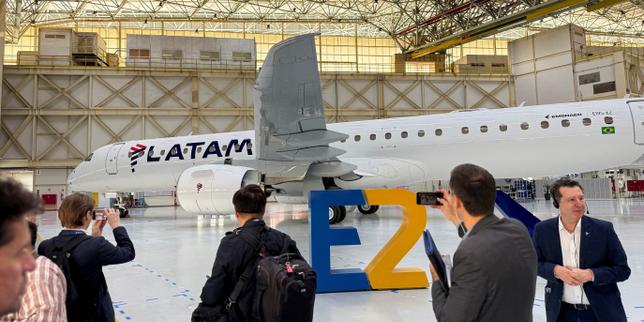
The competitive positioning of the E-Jets E2 family—specifically the E190-E2 and E195-E2—rests on optimizing the trade-offs between aerodynamic drag, maximum takeoff weight (MTOW), and engine bypass ratios. When competing against the Airbus A220 series, Embraer executed a design strategy centered on physical optimization for high-cycle, regional routes rather than long-range capability.
The architectural divergence between the E155-E2/E195-E2 and the Airbus A220-100/300 highlights distinct asset allocation strategies:
- Wing Design Optimization: Airbus utilized a clean-sheet design with a high percentage of composite materials for the A220, optimized for transcontinental range. Embraer retained a metal-aluminum alloy fuselage structure for the E2 but engineered a completely new, high-aspect-ratio gull wing. The high aspect ratio reduces induced drag during climb and cruise without incurring the massive capital expenditure and manufacturing complexity of specialized composite curing autoclaves.
- Engine Integration Dynamics: Both manufacturers selected the Pratt & Whitney GTF (Geared Turbofan) engine family. However, the E2 integration optimizes the engine diameter specifically for shorter stage lengths. The physical clearance constraints of the low-wing configuration required a distinct landing gear design that extends forward during retraction, minimizing the weight penalty while accommodating the high-bypass-ratio fan.
- Weight Penalties and Range Profiles: The A220 possesses a higher structural range capability, exceeding 3,400 nautical miles. The E195-E2 tops out near 2,600 nautical miles. By restricting the design range, Embraer eliminated dead weight from the structural airframe. On routes under 1,500 nautical miles, which constitute the vast majority of regional and intra-continental schedules, the E195-E2 operates with a lower operating empty weight per seat than its competitor, directly translating into lower fuel burn per block hour.
This engineering strategy addresses the economic constraint of scope clauses in the United States commercial aviation market. Scope clauses are labor agreements between major airlines and pilot unions that strictly limit the maximum takeoff weight (typically 86,000 lbs) and seating capacity (usually 76 seats) of aircraft flown by regional affiliates.
The first-generation E175 fits precisely within these constraints, creating a functional monopoly for Embraer in the US regional market. The E2 generation, however, exceeds these weight thresholds. The primary structural challenge for the E2 is not technological validation, but institutional compliance. Until US scope clauses undergo structural revision during union renegotiations, the E2 family must find its primary market velocity in Europe, Asia, and Latin America, where regional operations are defined by true route economics rather than artificial regulatory weight limits.
Capital Discipline and Dual-Source Supply Chains
The collapse of the proposed Boeing-Embraer joint venture in 2020 forced a fundamental pivot in the company’s capital allocation strategy. Rather than integrating into a larger global prime contractor, the firm had to re-establish structural independence while managing a highly leveraged balance sheet. The operational recovery since that fracture demonstrates the resilience of a lean integrator model.
An airframe manufacturer is essentially a system integrator that manages three primary cost functions: engine procurement, avionics integration, and structural assembly. The financial vulnerability of this model became apparent during the post-2022 global supply chain crunch. While Airbus and Boeing faced severe production bottlenecks due to casting shortages for engines and cabin interior deficits, the Brazilian assembly lines maintained a more predictable output cadence by utilizing structural dual-sourcing for non-critical elements and maintaining a highly flexible manufacturing footprint.
The industrial footprint uses a single hybrid assembly line in São José dos Campos capable of alternating between the first-generation E175, the E2 commercial variants, and the Praetor business jet families. This spatial flexibility allows production management to shift labor allocation in real time based on demand velocity. When commercial orders slowed during macroeconomic downturns, capital and labor shifted toward high-margin business aviation variants. This operational flexibility keeps fixed-cost absorption stable, preventing the severe margin degradation that typically occurs in dedicated single-product assembly facilities when demand fluctuates.
Geopolitical Arbitrage in Defense Procurement
The growth profile of the defense division, anchored by the C-390 Millennium transport aircraft, illustrates a tactical exploitation of Western procurement cycles. The global tactical airlift market has been dominated for decades by the Lockheed Martin C-130 Hercules platform. Embraer identified a structural vulnerability in this segment: the transition from turboprop propulsion to jet propulsion for tactical transport.
The C-390 utilizes two International Aero Engines V2500 turbofans, the same propulsion architecture proven over millions of flight hours on the Airbus A320ceo family. The choice of a commercial off-the-shelf engine configuration reduces lifecycle maintenance costs and ensures an active global spare parts pipeline.
The operational superiority of this approach manifests in specific performance metrics:
[Speed / Altitude Envelope]
C-390: Cruise Speed ~0.80 Mach | Maximum Altitude 36,000 ft
C-130J: Cruise Speed ~0.59 Mach | Maximum Altitude 28,000 ft
The higher altitude and speed envelope allow operators to compress transit times and execute rapid redeployments. Furthermore, the cargo hold dimensioning was specifically engineered to accommodate modern armored personnel carriers and heavy humanitarian payloads without requiring disassembly.
The strategic success of the C-390 relies on geopolitical arbitrage. As European NATO members (such as Portugal, Hungary, the Netherlands, Austria, and the Czech Republic) seek to replace aging C-130 fleets, they require platforms that offer deep integration with NATO command structures but avoid the prolonged acquisition delays and intense political overhead associated with US Foreign Military Sales (FMS) frameworks or the structural deficits of the larger Airbus A400M. By offering a platform that hits the mid-tier capability sweet spot at a lower acquisition cost, Embraer has effectively broken the traditional defense duopoly in Western tactical transport.
The Margin Frontier in Executive Aviation
The business aviation segment provides a critical buffer against the low-margin, high-volume realities of commercial aviation. The Phenom 100/300 light jets and the Praetor 500/600 mid-size jets are engineered around a high-utilization design philosophy derived directly from commercial operations.
Most legacy business jet architectures are optimized for low annual flight hours and maximum cabin customization. Embraer inverted this model by applying commercial manufacturing tolerances to executive airframes. The Phenom 300, for example, features an airframe designed for high daily utilization cycles, making it the preferred asset for fractional ownership fleets like NetJets.
The economic advantages of this commercial-grade engineering include:
- Extended Inspection Intervals: Structural maintenance inspections are spaced further apart than traditional business jet platforms, maximizing the asset's availability factor.
- Predictable Component Lifecycles: Utilizing standardized sub-assemblies across commercial and executive lines reduces the cost of specialized tooling and field support infrastructure.
- High Residual Value Retention: The secondary market highly values airframes built to commercial structural life standards, lowering the total cost of ownership for initial buyers.
The financial performance of the business unit acts as an internal capital generator. The cash flow velocity from high-margin light jet deliveries offsets the heavy working capital requirements of the commercial E2 ramp-up phase, smoothing the corporation's overall return on invested capital (ROIC) curve.
Strategic Forecast and Operational Imperatives
The mid-term trajectory indicates that Embraer will face a critical bottleneck as it scales production toward historical highs. The primary limiting factor is no longer market demand, but the structural stability of the global engine supply chain. The ongoing durability issues with the hardware components of high-bypass geared turbofans require continuous engineering modifications and retrofits. This creates an operational bottleneck where newly manufactured airframes sit on the tarmac in São José dos Campos awaiting engines, tying up immense amounts of working capital.
To navigate this constraint and preserve its structural cost advantage, management must execute a multi-front strategic play over the next twenty-four to thirty-six months.
First, the commercial division must aggressively target market expansion in the Asia-Pacific region, specifically focusing on India and Southeast Asia. These regions feature highly fragmented secondary hub systems where mainline 180-seat aircraft operate with sub-optimal load factors. Securing large-scale orders from Indian low-cost carriers will provide the volume backlog necessary to achieve true economies of scale on the E195-E2 line, insulating the firm against the stagnation caused by the US scope clause gridlock.
Second, the industrial apparatus must finalize its transition toward a fully digitized supply chain tracking architecture. By integrating tier-one and tier-two suppliers into a shared real-time inventory ledger, the manufacturing system can dynamically throttle assembly speeds based on component availability, eliminating the whip-effect that disrupts production cadence when a single supplier misses a delivery window.
Finally, the defense division must leverage its recent NATO sales momentum to secure a footprint in the Indo-Pacific theater. Establishing maintenance, repair, and overhaul (MRO) hubs in partner nations will transform the defense unit from a cyclical equipment vendor into a long-term services provider, locking in high-margin lifecycle revenue streams that will stabilize corporate earnings through the end of the decade.