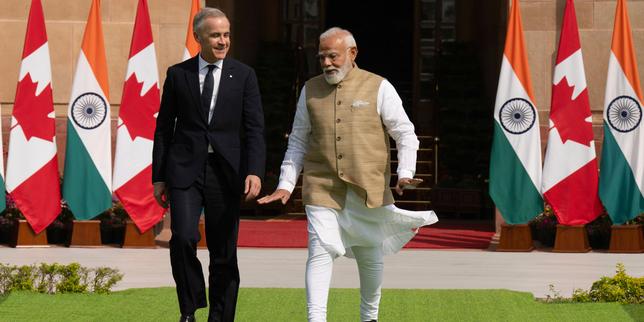
Ottawa is currently betting the house on a massive pivot toward the Indian market, hoping to offset a cooling relationship with China and a dependence on the American consumer. This movement, often described in official circles as a new era of cooperation, is less a romantic honeymoon and more a calculated, high-risk maneuver to salvage Canada’s standing in the Indo-Pacific. While the trade potential is undeniable, the path is littered with diplomatic landmines and structural barriers that both governments frequently gloss over in press releases.
The logic behind the push is simple. India represents the world’s fastest-growing major economy, a massive demographic dividend, and an insatiable appetite for the very commodities Canada has in abundance: lentils, potash, uranium, and energy. For a Canadian economy that has felt stagnant, the allure of 1.4 billion people is a powerful siren song. However, the reality on the ground suggests that the "honeymoon" period is already being tested by deep-seated geopolitical tensions and a protectionist streak in New Delhi that refuses to budge.
The Indo-Pacific Strategy Meets Reality
Canada’s formal Indo-Pacific Strategy, launched with significant fanfare, explicitly labels India as a critical partner. This was a necessary admission. For years, Canada remained on the sidelines while peers like Australia and the United Kingdom aggressively pursued Comprehensive Economic Partnership Agreements (CEPAs) with the Modi government. Canada is playing catch-up, and it is doing so from a position of relative weakness.
The trade relationship has historically been lopsided. Canada’s exports to India are dominated by raw materials, while India increasingly sends high-value services and pharmaceuticals back. To level this, Canadian negotiators are pushing for an Early Progress Trade Agreement (EPTA). This is essentially a "diet" version of a full trade deal, focusing on easy wins like reducing tariffs on Canadian fruit and pulses. The problem is that India rarely settles for "easy." New Delhi’s trade policy is notoriously transactional; they want increased visa quotas for Indian students and workers in exchange for every ton of Canadian potash.
The Elephant in the Room
You cannot discuss the economic relationship without addressing the toxic diplomatic atmosphere that surfaced in late 2023. The allegations involving extraterritorial activities on Canadian soil did more than just pause trade talks; they shattered the illusion that business and politics could operate in separate silos. When the Canadian government paused EPTA negotiations, it sent a clear signal to the private sector that the "India opportunity" comes with a side of sovereign risk.
Investors hate uncertainty. Large pension funds like the CPP Investment Board and Ontario Teachers’ have billions of dollars parked in Indian infrastructure and renewable energy. These are long-term plays. If the diplomatic rift widens, these assets become political pawns. We have seen this movie before with China. The Canadian business community is now forced to weigh the benefits of Indian growth against the possibility of sudden regulatory freezes or "spontaneous" inspections of Canadian-owned facilities.
Supply Chains and the Lentil Factor
Agriculture remains the backbone of this bilateral trade. Canada is the world’s largest producer of lentils, and India is its biggest customer. This should be a match made in heaven. Instead, it has been a roller coaster of shifting tariffs and sudden import bans.
India uses its agricultural tariffs as a thermostat to control domestic inflation and keep its own farmers happy. One month, the tariff is zero; the next, it is 30%. This volatility makes it impossible for Canadian farmers in Saskatchewan to plan their crop rotations with any confidence. A true economic partnership would require India to provide a stable, long-term predictable framework for food imports. So far, New Delhi has shown zero appetite for such a commitment, preferring to keep its options open to protect its domestic voting bloc.
The Talent Pipeline as an Economic Engine
The most significant export from India to Canada isn't a physical product; it is people. International students from India have become a cornerstone of the Canadian post-secondary education model. In many ways, Canadian colleges have become dependent on Indian tuition fees to balance their books. This creates a unique economic tether.
These students eventually enter the Canadian workforce, filling gaps in the tech sector, healthcare, and construction. However, this pipeline is fragile. Recent changes to Canadian study permit caps and the increasing cost of living in cities like Toronto and Vancouver are making Canada look less attractive compared to Australia or the US. If the flow of Indian talent slows down, the "economic honeymoon" will end not with a bang, but with a labor shortage that could stifle Canadian innovation for a generation.
Energy and the Missed Opportunities
Canada’s failure to build infrastructure to export Liquefied Natural Gas (LNG) to the world's most energy-hungry region is a masterclass in self-sabotage. India is desperate to transition away from coal, and Canadian LNG is the cleanest bridge fuel available. Yet, while the US and Qatar sign long-term supply deals with Indian utilities, Canada remains stuck in a cycle of regulatory delays and internal bickering over pipelines.
By the time Canada is ready to export at scale, the window of opportunity in India may have narrowed. India is investing heavily in green hydrogen and domestic solar. If Canada cannot provide energy security now, it will find itself irrelevant in the Indian energy market by the 2030s.
Structural Hurdles in the Indian Market
Doing business in India is not for the faint of heart. The country’s "Ease of Doing Business" rankings have improved, but the subnational level remains a bureaucratic labyrinth. Each of India's 28 states operates with its own set of rules, tax incentives, and political hurdles. A Canadian company successful in Karnataka might find itself completely lost in Uttar Pradesh.
The legal system is another deterrent. Contract enforcement in India can take years, sometimes decades. For a Canadian mid-sized enterprise, one bad legal dispute in an Indian court could mean bankruptcy. This is why the trade relationship remains dominated by giants—the Manulifes and Magnas of the world—who have the legal departments and the capital to weather the storm. Small and medium-sized Canadian businesses are largely staying home, and until that changes, the "honeymoon" is restricted to the elite.
The Geopolitical Chessboard
Canada is not the only suitor at the table. The US, Japan, and the EU are all courting India as a bulwark against Chinese influence. This gives India immense leverage. They know they are the "pretty girl at the dance," and they are playing their suitors against one another.
Canada lacks the military weight of the US or the industrial scale of the EU. To win in India, Canada must offer something unique. That "something" used to be a reputation for stability and a rules-based approach. But in a world where India is increasingly assertive about its own national interests, Canada’s insistence on "progressive trade" values—including labor and environmental chapters—is often viewed in New Delhi as Western sermonizing.
Redefining Success
If Canada wants this relationship to work, it needs to drop the "honeymoon" rhetoric and adopt a more cold-blooded, pragmatic approach. This means moving beyond pulses and potash and into high-tech sectors like aerospace, cybersecurity, and fintech where Canadian expertise matches Indian ambition.
Success will not be measured by the signing of a grand treaty that looks good on camera but does little for the GDP. It will be measured by the number of Canadian tech firms integrated into Indian supply chains and the stability of the regulatory environment for Canadian pension funds.
The current trajectory is promising but precarious. Any further diplomatic missteps will not just pause talks; they will push India further into the arms of Canada’s competitors. The window is open, but the draft is getting cold.
Would you like me to analyze the specific sectors where Canadian fintech firms are currently gaining traction in the Indian market?