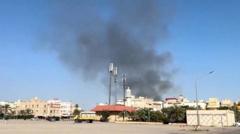
Six American service members are dead in Kuwait. Their lives were ended not in a high-intensity infantry engagement or a sweeping desert maneuver, but in a triple-wide trailer at the Shuaiba port. This facility, categorized by the Pentagon as a fortified tactical operations center, became an open grave when an Iranian munition pierced the overhead canopy of a space clearly never designed for the realities of modern, drone-centric warfare.
This is not merely a tragedy of war. It is an indictment of a military strategy that has failed to adapt to the reality of cheap, lethal, and ubiquitous loitering munitions. For years, observers have warned that the reliance on legacy defensive structures in the Persian Gulf was a liability. Now, that liability has been settled in blood.
The incident occurred during the early hours of a Sunday that saw the region’s long-standing tensions erupt into full-scale conflict. As part of Operation Epic Fury, U.S. and Israeli forces launched an unprecedented air campaign against Iran. Iran responded with a flurry of retaliatory strikes across the Gulf. While the military apparatus claims to have intercepted the vast majority of these projectiles, the reality remains that a single weapon found a gap. Defense Secretary Pete Hegseth referred to this munition as a "squirter"—an incoming threat that managed to bypass air defenses. The term is dismissive, almost clinical. To the families of the six individuals assigned to the 1st Theater Sustainment Command, there is nothing clinical about the loss.
The tactical failure here is glaring. The center in question was shielded by T-walls, twelve-foot-tall, steel-reinforced concrete slabs. In the era of the improvised explosive device or heavy mortar fire, these walls were the standard for protection. They were designed to block lateral blasts and shrapnel. However, these walls offer zero protection against an overhead strike. A kamikaze drone, such as the Shahed-136, does not need to bypass a concrete wall; it simply flies over it. The military’s own officials have now begun to whisper about the inadequacy of this structure. It begs the question of why, in a theater of operations known to be within range of Iranian precision munitions, such a vulnerable office space was permitted to host high-value command functions.
This is a recurring theme in the history of American military basing. We build for the last war, not the next one. After decades in Iraq and Afghanistan, the military infrastructure in the Gulf was designed around the assumption that the enemy would use ground-launched explosives. We built perimeter defenses, check-points, and reinforced entry control points. We did not build for the reality of a state-level adversary using thousands of autonomous drones to saturate air defense networks.
The air defense systems themselves are the other half of this equation. The military maintains that they have "incredible" air defenders, yet the systems are clearly not designed to stop the sheer volume of threats that Iran can generate in a single wave. When a battery is overwhelmed, or when the cost-exchange ratio becomes unsustainable, the defense fails. We are seeing a mismatch between expensive, sophisticated interception systems and inexpensive, disposable weaponry. Every time a million-dollar missile is fired to intercept a five-thousand-dollar drone, the economic and operational logic of the conflict shifts. Eventually, the math simply does not support the defense.
There is also the question of the warning systems. The survivors and sources with knowledge of the strike report no sirens. No alerts. Just an impact that shattered a trailer and ignited a fire that would prove impossible to extinguish in time to save those inside. This suggests a failure of early warning intelligence or a system so bogged down by incoming data that it could not distinguish the "squirter" from the noise of the regional aerial saturation. If a base is under fire, there should be a protocol for evacuation. The fact that dozens of personnel were sitting in a makeshift office suggests a lack of situational awareness that borders on negligence.
This lack of preparation is further compounded by the broader context of Operation Epic Fury. The strategic objectives articulated by the White House are ambitious, including the total destruction of Iranian missile capabilities and their navy. Such an operation requires a level of regional support and secure staging that is increasingly tenuous as civilian ports like Shuaiba are drawn into the direct line of fire. When a host nation like Kuwait is effectively forced into the fight—as evidenced by the chaotic friendly fire incident that saw three F-15 jets downed by local air defenses—the entire logistics chain begins to fray.
The reliance on Kuwaiti infrastructure, while necessary, creates a massive surface area for Iranian retaliation. As the conflict intensifies, the risk to American personnel stationed in these Gulf nations increases exponentially. The decision to order the evacuation of non-emergency government personnel from half a dozen countries, including Kuwait and the UAE, is a recognition of this reality. It is a tacit admission that the safety of U.S. service members can no longer be guaranteed in these environments.
Furthermore, we must address the nature of the unit involved. The 1st Theater Sustainment Command is not a front-line combat unit in the traditional sense. Its mission is to support the logistics of the entire theater. When logistics hubs are hit, the ability of the broader force to project power is compromised. The death of these soldiers is a heavy blow to the unit’s readiness, but it also sends a signal to the Iranian command: the rear echelon is no longer a safe haven.
The political fallout from this event will be significant. The administration is already bracing for more casualties. President Trump’s rhetoric, while emphasizing the righteousness of the mission, has been blunt about the expectation of further loss. This sets a dangerous precedent. If the American public is told to expect casualties as a routine cost of this operation, the threshold for public scrutiny of these tactical decisions will be lowered. We risk entering a long, grinding war where the loss of life is treated as an unfortunate, inevitable byproduct of a broader, ill-defined strategic aim.
The technical analysis of the strike site reveals a terrifyingly simple geometry of destruction. A triple-wide trailer, essentially an office structure, was targeted at the center of its roof. This indicates a high level of guidance and precision. It was not a random shot. It was a calculated strike against a soft target. The fire that followed the impact, blackening the walls and blowing them outward, suggests that the drones were carrying high-yield, incendiary payloads specifically intended to maximize structural and human damage.
The military will eventually conduct a thorough review, or perhaps they will sweep the findings under a label of classified operational necessity. We have seen this before. Reports will be drafted, internal memos will be circulated, and there will be talk of hardening future facilities with better materials, more T-walls, and hardened shelters. But these are superficial fixes for a deeper problem. The problem is the assumption that American forces can operate in the heart of the Middle East, while engaging in full-scale hostilities against a regional power, without fundamentally altering how we protect our personnel.
We are currently operating in a world where the advantage of distance and the security of a fortified base have been negated by the low cost of aerial weaponization. The drone has done to the base what the tank did to the trench. It has rendered the traditional concept of a "secure rear" obsolete. If we do not internalize this lesson, the loss in Kuwait will be the first of many.
The service members lost this week were not just statistics in a briefing. They were logisticians, support staff, and technicians who were caught in a gap between the war our leadership wants to fight and the war that is actually being fought. They were the victims of a failure to understand the tactical shift occurring in front of our eyes.
As the war continues, we must look closer at the reality of our deployments. We should be asking why we are putting our people in such vulnerable positions in the first place, and if the strategic value of these forward-operating logistics hubs justifies the massive, and often unnecessary, risk to the lives of our troops. The military will likely continue to emphasize the "noble mission," but that nobility is cold comfort to the families receiving the news of their loved ones’ deaths.
If this war is to continue for weeks or months, as the administration suggests, the current approach to force protection cannot endure. We have already reached a point where the risks have outpaced our ability to mitigate them. We need an honest accounting of what happened at Shuaiba, not just from a casualty perspective, but from a strategic one. We need to know who approved the use of that facility, who signed off on its level of protection, and why the standard of "fortified" was so dangerously misunderstood.
The military has been here before, learning the hard way about the vulnerabilities of their own systems under fire. From the barracks bombing in Beirut in 1983 to the Khobar Towers in 1996, the history of U.S. military operations in the Middle East is marked by moments where complacency in the face of unconventional threats leads to tragedy. Every time, we promised to learn. Every time, we promised to change. And yet, here we are, forty years later, mourning the loss of six Americans in a trailer at a port in Kuwait.
The reality of 2026 is that our enemies are watching, they are adapting, and they are learning to exploit the gaps in our operational security. They are not fighting the war we want to fight; they are fighting the war that gives them the highest probability of success at the lowest cost. If we refuse to adapt, if we continue to rely on the same outdated structures and the same assumptions about our own security, we will continue to lose the people we are tasked with protecting. The tactical failure at Shuaiba is not a glitch in the system; it is the system failing to understand the environment in which it operates.
There is no room for error when the cost of a mistake is measured in human lives. The military must move beyond the reactive cycle of building more walls after the fact. It must instead move toward a proactive strategy that accepts that every inch of space in the Gulf is a potential battlefield. Until then, the risk remains absolute. We are currently asking our service members to perform their duties in an environment that is far more lethal than the architects of this war are willing to admit.
We will soon see if the Pentagon’s review of this incident will lead to genuine change or if it will be another exercise in damage control, designed to protect the image of the command rather than the lives of those in the field. But the damage is done. Six families have been destroyed, and the question remains for the rest of the force: who is next, and what could have been done to stop it?
The answers to these questions will not be found in the press briefings or the official statements of the Joint Chiefs. They will be found in the charred remains of a trailer in Kuwait, and the silence of the commanders who let it happen. The war with Iran is a direct, brutal conflict, and it demands a higher level of operational discipline than what was displayed on that Sunday morning. We are out of time for excuses. We are out of time for promises. We need to rethink how we protect our own, because the enemy has clearly moved on to a more effective way of killing us. The failure at Shuaiba is a warning that cannot be ignored. The next strike may not be a "squirter." It may be a deluge. And if we are not ready, the cost will be far higher than we have already paid.