The air in the Texas Capitol often feels heavy with the scent of old leather and the weight of decisions that outlive the people who make them. It is a place where "Texas First" isn't just a bumper sticker; it’s a theological stance. But lately, a different kind of tension has been vibrating through the marble hallways. It is the tension of a party caught between a fierce loyalty to a leader and the haunting, jagged memories of the desert sands of the Middle East.
Texas Republicans are standing at a crossroads. Behind them lies the wreckage of two decades of "nation-building." In front of them stands Donald Trump, whose rhetoric regarding Iran has shifted from surgical strikes to existential warnings. To understand why this matters, you have to look past the press releases. You have to look at the kitchen tables in Killeen, Abilene, and San Antonio.
Texas sends more of its sons and daughters to war than almost any other state. When Washington talks about "surgical escalations" or "maximum pressure," Texas hears the sound of transport planes warming up at Fort Hood. The support for Trump’s hardline stance on Tehran is vocal, loud, and seemingly unified. Yet, underneath the surface of the televised rallies, a quiet, persistent tremor of anxiety is spreading.
The fear has a name. Quagmire.
The Shadow of the Desert
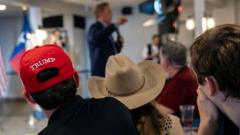
Consider a hypothetical veteran named Elias. He’s a composite of the men you meet in the VFW halls from El Paso to Tyler. Elias wears a red hat. He believes the 2015 nuclear deal was a disaster that funded the very roadside bombs that tore through his unit in 2007. He wants a strong commander-in-chief. He wants Iran to feel the squeeze.
But Elias also has a son who just turned eighteen.
When Elias hears talk of a "regime change" or "decisive kinetic action," his pulse quickens—not with patriotic fervor, but with a visceral, physical memory of the heat in Fallujah. He represents the core of the Texas Republican dilemma. They want the strength, but they are terrified of the bill that comes due.
The political reality in Austin reflects this internal struggle. High-ranking GOP officials in Texas have been quick to echo the President’s "America First" doctrine. They argue that an emboldened Iran is a direct threat to global energy markets—a sector that effectively acts as the heartbeat of the Texas economy. If the Strait of Hormuz is choked off, the Permian Basin feels the ripples instantly. Economic security and national security are, in this context, two sides of the same coin minted in Midland.
However, the "America First" movement contains a paradox. It was built on the promise of ending "stupid wars." It was built on the idea that the United States should stop acting as the world’s policeman. Now, as the rhetoric toward Tehran sharpens, Texas lawmakers are forced to reconcile their support for a populist president with their constituents' deep-seated exhaustion with Middle Eastern entanglements.
The Invisible Stakes of the Energy Belt
The stakes aren't just measured in troop movements. They are measured in barrels.
Texas isn't just a state; it’s an energy superpower. When tensions rise in the Persian Gulf, the price of crude oil dances. For many in the Texas GOP, a hard line against Iran is seen as a way to protect the American energy dominance that has flourished over the last decade. They view the Iranian regime not just as a rogue state, but as a competitor that uses instability as a weapon.
But even the oil men are wary.
Instability is a double-edged sword. While high prices might look good on a spreadsheet in Houston for a month, a full-scale regional war would disrupt the very global infrastructure that allows Texas to export its abundance. There is a delicate, almost invisible thread connecting a ranch in West Texas to a tanker in the Gulf of Oman. If that thread snaps, the "Texas Miracle" could face its most significant challenge since the 1980s.
The nuance often lost in national reporting is that Texas Republicans aren't a monolith. There is a brewing ideological rift between the "Old Guard" hawks—the heirs to the Bush era who see American intervention as a moral and strategic necessity—and the "New Guard" populists who view any involvement overseas with extreme skepticism.
The Old Guard wants to see Iran neutralized to preserve the world order.
The New Guard wants to see Iran neutralized so we can finally come home and stay there.
The problem? No one can agree on what "neutralized" actually looks like.
The Architecture of a Quagmire
How does a "limited strike" turn into a decade-long occupation? It’s a question that haunts the halls of the Texas GOP. They have seen this movie before.
The concern among the more cautious members of the party is that there is no clear "Exit" sign in the current strategy. If the United States engages in a direct military confrontation with Iran, the ripple effects would be catastrophic. We aren't talking about a desert insurgency; we are talking about a sophisticated state actor with deep pockets and a network of proxies stretching from Lebanon to Yemen.
It starts with a drone. Then a tanker. Then a "targeted" missile strike.
Suddenly, the "maximum pressure" campaign evolves into a "stabilization" mission.
Then comes the surge.
One Texas lawmaker, speaking off the record, described the situation as "walking on a frozen lake in late March." You want to get to the other side—to a world where Iran is no longer a threat—but you can hear the ice cracking under every step. You don't want to turn back because you’ve already come so far, but you know that one wrong move sends you into the dark, freezing water.
The tension is exacerbated by the upcoming election cycles. In Texas, the GOP cannot afford to lose the support of the suburban voters who are increasingly wary of international instability. At the same time, they cannot alienate the base that demands a show of strength. It is a political tightrope suspended over a canyon of historical failure.
The Human Cost of Policy
Beyond the rhetoric of "maximum pressure" lies the reality of the people who live in the crosshairs. Not just the soldiers, but the families.
In towns like Copperas Cove, the war isn't a headline. It’s the empty chair at the graduation ceremony. It’s the nervous silence when a car drives slowly down the street at 6:00 AM. Texas Republicans are deeply aware of this. Their brand is built on honoring the military, which makes the prospect of sending those same men and women back into a "quagmire" feel like a betrayal of the highest order.
This is why you see prominent Texas figures—men who would normally be the first to call for a show of force—suddenly speaking the language of restraint. They are trying to thread a needle that might not have an eye. They are backing the President’s right to defend American interests while simultaneously praying he doesn't use the authority they are giving him.
It is a gamble of historic proportions.
The logic being used is that "strength prevents war." The idea is that by being so aggressive, so unpredictable, and so overwhelmingly powerful, the Iranian regime will be forced to the table. It’s a high-stakes game of poker where the chips are human lives and the table is the entire Middle East.
But what happens if the other side doesn't fold?
The Resonance of the Lone Star
Texas has always seen itself as the frontier. It is a place defined by its ability to stand alone and fight. But even the fiercest fighters know that you don't pick a fight you aren't prepared to finish.
The "quagmire" isn't just a political term in the Lone Star State. It’s a ghost. It’s the ghost of the friends who didn't come back from Iraq. It’s the ghost of the trillions of dollars spent on sand and wind. It’s the ghost of a foreign policy that forgot why it started fighting in the first place.
As the rhetoric continues to escalate, the silence from certain corners of the Texas GOP is deafening. They are waiting. They are watching the horizon, looking for a sign that this time will be different. They want to believe in the victory, but they can't stop looking at the cost.
The sun sets over the Austin skyline, casting long, dark shadows across the granite monuments to heroes past. In the quiet of the evening, the bravado of the afternoon's speeches feels thin. The reality remains: Texas is ready to lead, and Texas is ready to fight. But for the first time in a generation, Texas is also asking: At what price?
The answer isn't in a policy paper. It isn't in a tweet. It’s in the eyes of the young men and women boarding buses at recruitment centers in Dallas and Houston, heading toward a future that looks hauntingly like the past.
There is a storm coming, and everyone in Texas can feel the pressure dropping. They are backing their leader, holding their breath, and hoping the ice holds.
Imagine the sound of a single pair of boots on a gravel road in the middle of the night. That is the sound of the policy being made today. It is the sound of one person walking toward a conflict they didn't start, for a reason they are trying to understand, in a land they will never call home.
That is the true face of the quagmire.