The salt air in Old Havana has a way of eating everything. It gnaws at the pastel plaster of the colonial buildings, pits the chrome of the 1950s Chevrolets, and settles in the lungs of the men waiting by the Terminal Sierra Maestra. For a brief window of time, that air smelled like diesel and opportunity. White leviathans—cruise ships carrying thousands of Americans—would dock, and for a few hours, the city would breathe.
Now, the silence is heavy. It is a quiet enforced by the strokes of a pen in Washington D.C., and it has transformed the Florida Straits from a bridge back into a moat.
When the Trump administration moved to dismantle the "thaw" of the previous era, the rhetoric focused on the high-level chess board of geopolitics. The goal was stated with clinical precision: squeeze the Cuban government, starve the military-run conglomerates of hard currency, and force a collapse of the Communist Party leadership. But trade statistics are cold things. They don’t capture the look on a private restaurateur's face when the reservations vanish overnight.
Consider a man we will call Alejandro. He is not a government official. He doesn’t care about the intricacies of the Helms-Burton Act or the ideological purity of the revolution. He cares about eggs. Specifically, he cares about how many eggs he can buy for his paladar, a small, family-run restaurant tucked into a crumbling third-floor walk-up. During the brief opening, Alejandro’s tables were full of tourists from Des Moines and Dusseldorf. He was buying new linens. He was dreaming of a second stove.
When the administration banned "people-to-people" group educational travel and prohibited U.S. cruise ships from docking, Alejandro’s ledger didn't just dip. It bled.
The policy shift wasn't just a slight tap on the brakes; it was a floor-it-in-reverse maneuver. By activating Title III of the Libertad Act, the U.S. allowed its citizens to sue companies—including foreign ones—that "traffic" in property confiscated by the Cuban government decades ago. This was the "nuclear option" of trade diplomacy. It sent a shockwave through the international banking system. Suddenly, a Spanish hotel chain or a French spirits company had to weigh the profit of a Havana venture against the risk of being frozen out of the American financial system.
Most chose the exit.
The result is a collapse of trade that feels like a slow-motion shipwreck. In the halls of the White House, this is viewed as "maximum pressure." On the streets of Havana, it is a return to the "Special Period" of the 1990s, a time of bicycles and blackouts. The logic of the embargo has always been that if the people suffer enough, they will rise up. Yet, history suggests that when a kitchen table goes bare, the person sitting at it isn't thinking about democratic transitions. They are thinking about where the next bag of powdered milk is coming from.
There is a profound irony in the way these sanctions function. The stated intent is to weaken the grip of the Communist Party, but in many ways, the isolation reinforces the state’s role as the sole provider. When private enterprise—the cuentapropistas—is starved of American dollars, the only entity left with any resources is the government itself. The very people the U.S. claimed to be empowering are the ones being hit first by the collateral damage of the trade war.
Imagine the supply chain as a delicate web of threads. One thread is a shipment of American poultry—one of the few things still legally traded under humanitarian exemptions. Another thread is the remittance money sent by a daughter in Miami to her grandmother in Matanzas. The Trump-era restrictions slashed at both. By capping remittances and restricting the channels through which they could be sent, the policy targeted the literal lifeline of the Cuban family.
Money is a form of speech. By silencing it, the administration didn't just stop trade; it stopped a conversation between two peoples that had only just begun to get interesting.
The numbers reflect a stark reality. Foreign investment has cratered. The Cuban economy, already hobbled by its own internal inefficiencies and a lack of reform, has contracted significantly. The "maximum pressure" campaign has succeeded in making life harder, but it has not yet achieved its political endgame. Instead, it has created a vacuum. And in the world of global power, a vacuum is never empty for long. As American influence recedes, other actors—Russia and China—are more than happy to step onto the island, trading oil and infrastructure for a strategic foothold ninety miles from Key West.
We often talk about trade in terms of containers and tariffs, but trade is actually about trust. It is the belief that the rules today will be the rules tomorrow. By unilaterally tearing up the travel and trade agreements of the mid-2010s, the U.S. didn't just hurt Cuba; it signaled to the rest of the world that American policy is a pendulum, not a compass.
The human cost is visible in the lines at the bakeries. It is visible in the rafters of boats being surreptitiously built in coastal thickets. It is visible in the empty chairs at Alejandro’s restaurant. He still opens every morning. He still polishes the glasses. But the horizon is empty.
The great ships are gone. The tourists are gone. The "thaw" has frozen over, leaving behind a landscape of rusted dreams and a people caught once again in the crossfire of an ancient grudge.
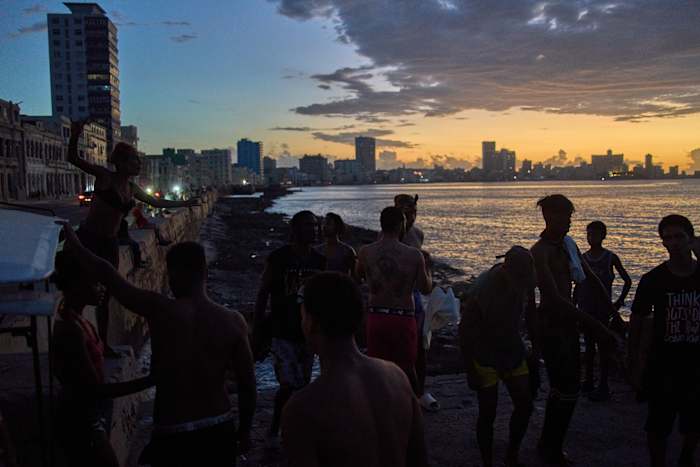
The sun sets over the Malecón, painting the spray of the waves in hues of gold and violet. It is a beautiful sight, provided you aren't waiting for something that is never coming. The water remains the same—vast, deep, and increasingly impassable.
The policy of escalation is a gamble that the breaking point is near. But for the people of Havana, the breaking point is a familiar neighbor. They have lived on the edge for sixty years. They know how to fix a car with a lawnmower engine and how to stretch a pound of rice for a week. They are masters of survival in a world that has decided to ignore them.
The docks stay empty. The salt continues to eat the walls. And across the water, the architects of the pressure campaign wait for a collapse that hasn't arrived, while the people they intended to save are the ones left holding the bill for a trade war they never asked for.
The invisible stakes of this collapse aren't found in the speeches given in Miami or the briefings in the Oval Office. They are found in the silence of a city that was briefly told it could join the world, only to have the door slammed shut before it could even get through the frame.
Alejandro closes his door and turns off the single light bulb in his kitchen. Outside, the waves continue to hit the sea wall, rhythmic and indifferent to the whims of presidents.