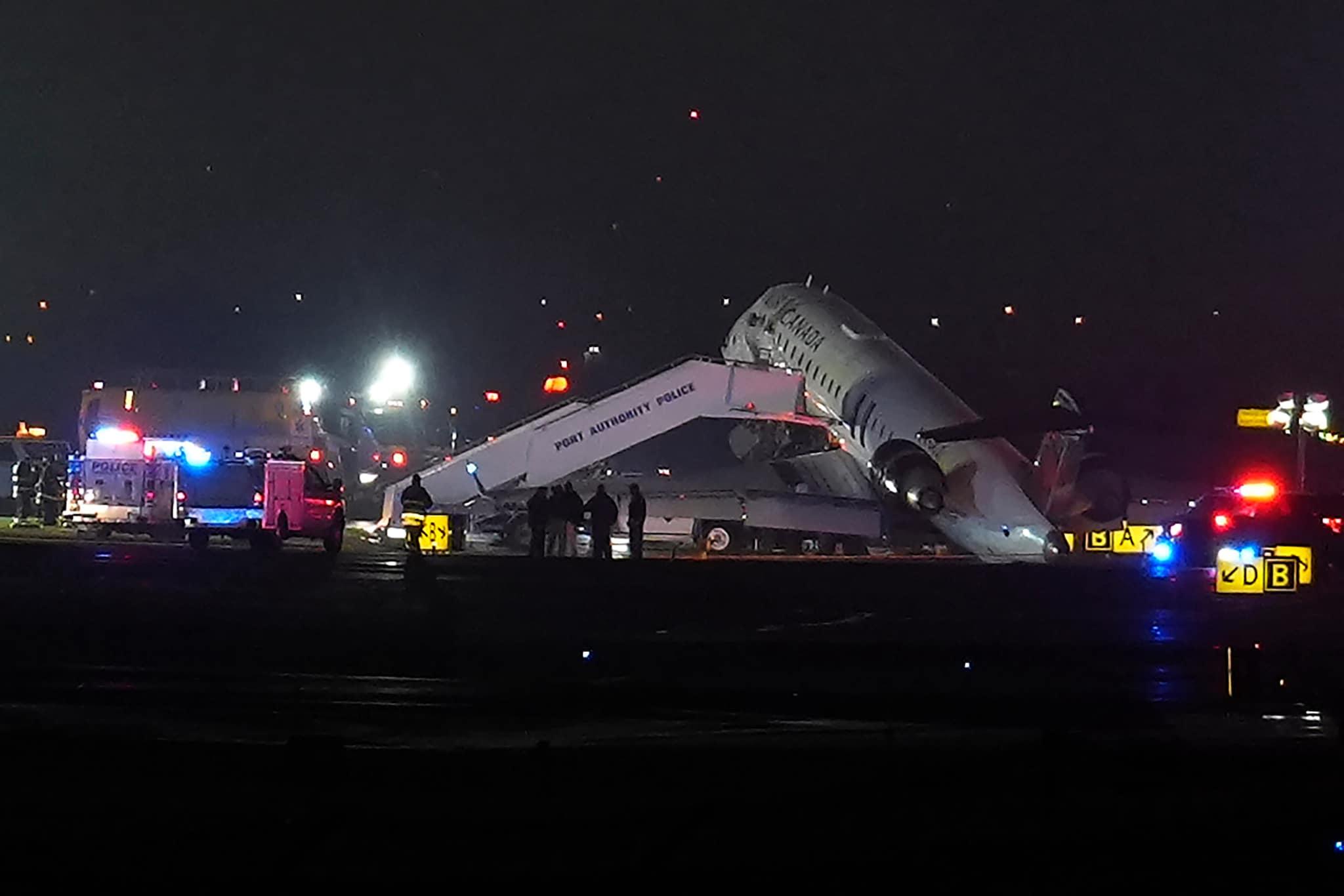
The National Transportation Safety Board (NTSB) report on the near-disaster involving an Air Canada flight at LaGuardia Airport exposes a terrifying reality. Aviation safety isn't just failing because of human error; it is failing because the very technologies designed to act as a safety net are being outpaced by the density of modern tarmac traffic. We have spent billions on high-precision ground radar and cockpit alerts, yet two planes nearly turned a routine Tuesday into a national tragedy because of a "confluence of technical latency." That is the clinical way of saying the machines were too slow to stop the humans from making a mistake.
The incident centered on a breakdown in situational awareness that should have been impossible in 2026. An Air Canada narrow-body jet, cleared for takeoff, began its roll while another aircraft was still clearing the active runway. On paper, the Airport Surface Detection Equipment, Model X (ASDE-X) and the newer ASSC (Airport Surface Surveillance Capability) are supposed to trigger an immediate auditory and visual alarm the moment a collision risk is detected. At LaGuardia, the alarm did sound. The problem is that it sounded exactly four seconds after the pilot had already slammed on the brakes based on visual cues. For another look, check out: this related article.
Safety technology is currently chasing the tail of the problem. If the pilot hadn't looked up, the hardware would have been a forensic recording of a catastrophe rather than a preventative tool. This reveals the core crisis in aviation infrastructure: we are relying on "warning" systems when we actually need "intervention" systems.
The Fatal Lag in Ground Surveillance Systems
To understand why LaGuardia remains one of the most difficult patches of pavement in the world, you have to look at the geometry of the airport. It is cramped. It is built on "made land." It operates with a density that leaves zero margin for error. Similar coverage regarding this has been shared by National Geographic Travel.
The NTSB’s investigation highlighted a specific technical failure in the multi-lateration sensors that feed data into the tower’s display. These sensors calculate a plane’s position by measuring the time it takes for a transponder signal to reach multiple ground stations. In a vacuum, this happens at the speed of light. In the cluttered, high-frequency environment of a New York City airport, signal "multipath" (bouncing off hangars or other planes) can create a "ghost" image or a slight delay in the system's processing of a plane’s true position.
- The Identification Gap: The system needs several consecutive "good" pings to confirm a conflict before it triggers a red-level alert to the controller.
- The Human-Machine Handshake: Once the computer identifies the threat, it must relay that to the controller, who then must process the information and speak the command to the pilot.
- The Execution Phase: The pilot must hear, process, and physically move the controls.
In the Air Canada case, the total time from the start of the "unsafe condition" to the moment the planes would have collided was less than twelve seconds. If the technology takes six seconds to "verify" the threat, and the human chain takes another five to react, the safety margin is effectively one second. That isn't a safety net. It’s a scoreboard.
The Myth of the Automated Tarmac
For years, the industry has touted ADS-B (Automatic Dependent Surveillance-Broadcast) as the silver bullet. This technology allows planes to broadcast their own GPS position to everyone around them. It was supposed to make ground radar obsolete. However, the LaGuardia investigation shows that while the Air Canada jet was broadcasting its position perfectly, the ground-based logic used by the tower to "predict" a collision was still using outdated algorithms that prioritize avoiding "false positives" over speed.
Controllers hate false alarms. If a system screams every time a plane gets within 100 feet of another in a tight turn, the controllers eventually tune it out. This is known as alarm fatigue. To prevent this, engineers tuned the LaGuardia sensors to be "conservative." They traded speed for accuracy. In doing so, they created a window of time where a plane can be on a collision course, but the computer is still "thinking" about whether it’s sure enough to yell.
The industry is currently trapped in a loop. We are adding more sensors, more data points, and more complexity, but we are not addressing the fundamental latency of the human-in-the-loop system. We are essentially putting a faster engine in a car with a broken steering column.
Why Cockpit Alerts Failed the Crew
It wasn’t just the ground systems that lagged. The Air Canada flight deck was equipped with the latest surface-alerting software. This software is designed to give the pilots a "Runway Occupied" warning directly in their headsets.
On that afternoon, the cockpit remained silent until the last possible moment. The NTSB found that the software logic required the "target" aircraft (the one still on the runway) to be moving at a certain speed or positioned at a specific angle to be flagged as a threat. Because the other aircraft was moving slowly while exiting, the Air Canada computer didn't register it as a "collision threat" until the distance closed to a critical threshold.
We are teaching computers to think like lawyers—looking for specific criteria to be met before they act—when we need them to think like bodyguards.
The Infrastructure Problem
The physical layout of our aging airports is a factor no one wants to talk about because fixing it costs billions. Modern airports are designed with "high-speed turnoffs" and "perimeter taxiways" that keep landing aircraft entirely away from departing aircraft. LaGuardia is a relic. It is a series of intersecting lines where every takeoff is a choreographed dance with a landing.
When you force 2026 traffic volume through 1950s dirt and concrete, you are relying entirely on the "tech layer" to prevent metal from hitting metal. The Air Canada incident proves that the tech layer is porous.
- Runway Incursion Mitigation (RIM): The FAA has identified dozens of locations at LaGuardia as "hot spots," yet the pace of physical construction to simplify these intersections is glacial.
- Frequency Congestion: At peak times, the radio airwaves are so crowded that a controller may have to wait three seconds for a "gap" just to tell a pilot to stop. Three seconds is the difference between a close call and a tail-strike.
Beyond Human Capacity
We are approaching the limit of what a human air traffic controller can manage using current visual and auditory tools. The NTSB report suggests that the controller in the Air Canada incident was "performing within established norms," which is a polite way of saying the human did their job, but the job has become impossible.
The controller was monitoring multiple frequencies, watching ground radar, and looking out the window. By the time the computer verified the error, the controller was already mid-sentence with another aircraft.
If we want to prevent the next collision, we have to move toward Automated Conflict Resolution. This is controversial. It means giving the computer the authority to bypass the controller and send an "ABORT TAKEOFF" command directly to the aircraft's flight management system. The technology to do this exists today. The political will and the regulatory framework do not.
The airline industry is terrified of a "command override" where a computer accidentally stops a plane at a dangerous speed because of a sensor glitch. But as the LaGuardia incident shows, the alternative is relying on a system that waits until the disaster is inevitable before it dares to speak up.
The Immediate Fix
The NTSB has recommended a series of "low-latency" updates to the ASDE-X logic, but these are patches on a sinking ship. The real fix requires three concrete shifts in how we handle airport ground safety:
- Direct-to-Cockpit Data Links: Information from ground sensors must reach the pilot's Primary Flight Display (PFD) without going through the tower's voice frequency first.
- Predictive AI Modeling: Instead of waiting for a plane to be in an "unsafe" position, the systems must use real-time telemetry to predict where a plane will be in 10 seconds. If the math shows an intersection, the alarm triggers now, not later.
- Mandatory Surface-Safety HUDs: Heads-Up Displays (HUDs) that highlight "occupied" runways in red on the pilot's windshield would eliminate the need for pilots to "search" for a threat in low-visibility or high-glare conditions.
Air Canada flight 759 almost hit four planes on a taxiway in San Francisco a few years ago. Now, another Air Canada flight nearly collided with a jet at LaGuardia. The common thread isn't the airline; it's a global aviation system that is operating at 110% capacity with safety tools that are stuck at 90% reliability.
We are currently living on borrowed time provided by the quick reflexes of pilots who are increasingly forced to act as the last line of defense against their own navigation tools. The NTSB report is a warning that the "fail-safes" have already failed. The only reason we aren't talking about a tragedy is because a human being looked out a window and saw what the computer couldn't quite confirm in time.
Next time, the sun might be in their eyes.
Demand a full audit of the ASDE-X alarm logic at your local hub before the next "latency" issue becomes a casualty count.