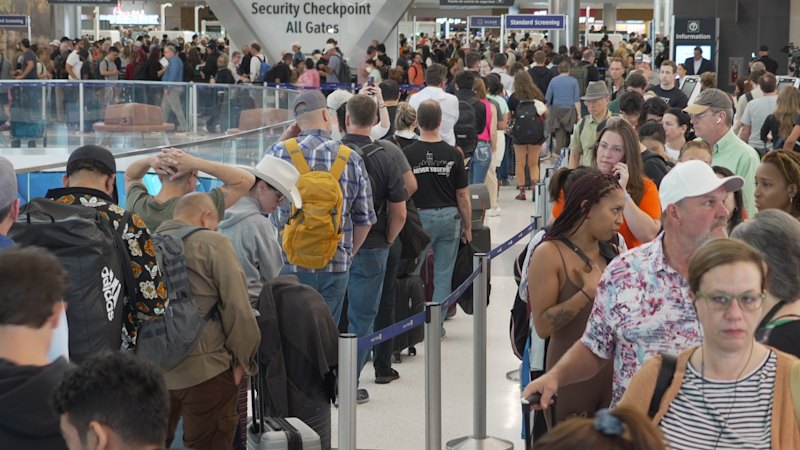
The American aviation system is currently a ghost of its former self. While headlines focus on the visual spectacle of four-hour security lines and terminal floors turned into makeshift campsites, the actual rot is much deeper than a simple staffing shortage. We are witnessing the systemic failure of a critical infrastructure that was already stretched to its breaking point long before the current shutdown began. Passengers aren’t just waiting for flights; they are participating in the slow-motion disintegration of a trillion-dollar industry that prioritized stock buybacks and lean scheduling over basic operational resiliency.
The immediate cause is obvious: a federal shutdown has stripped the gears of the Transportation Security Administration (TSA) and the Federal Aviation Administration (FAA). But to blame the current chaos solely on a political stalemate is to ignore the decade of precarious choices that made this collapse inevitable. When the people who operate the x-ray machines and manage the complex geometry of our airspace stop receiving paychecks, the thin veneer of "efficiency" evaporates instantly. What remains is a dangerous, disorganized mess that threatens not just your vacation, but the economic stability of the country.
The Mathematical Impossibility of the Modern Terminal
The math does not work. For years, major hubs like Hartsfield-Jackson in Atlanta and O’Hare in Chicago have operated at roughly 95% capacity during peak hours. In any complex system, when you run that close to the red line, there is no margin for error.
The current shutdown removed the margin. TSA agents, many of whom live paycheck to paycheck on modest government salaries, are calling out in record numbers. This isn't necessarily a coordinated "blue flu" strike; it is a practical reality. If you cannot afford the gas to get to the airport or the childcare required while you work a ten-hour shift, you stay home.
When a security checkpoint designed to handle 3,000 passengers an hour loses half its staff, the queue doesn't just double. It compounds. Every additional minute a passenger spends shuffling forward increases the density of the crowd, creating a "crush point" that forces airport police to divert traffic, which in turn slows down the check-in counters. It is a cascading failure. We are seeing terminals where the line for the "Pre-Check" lane—a service passengers paid for to avoid this exact scenario—wraps around the parking garage.
Behind the Glass The Air Traffic Control Crisis
While the lines at the terminal are what make the evening news, the real danger is happening in the darkened rooms of Air Traffic Control (ATC) centers. This is where the industry’s "dirty little secret" becomes a matter of life and death. Even before the current shutdown, the FAA was grappling with a 30-year low in fully certified controller staffing.
Controllers are required by law to be focused, rested, and precise. Now, they are working 60-hour weeks without a guarantee of back pay. Fatigue is a silent killer in aviation. When a controller is stressed about their mortgage, they are more prone to "operational errors"—aviation speak for two planes getting too close to each other.
The system survives on the goodwill and professionalism of these individuals, but professionalism doesn't pay the rent. If a major TRACON (Terminal Radar Approach Control) facility loses enough personnel to "safety-related absences," the FAA has no choice but to implement Ground Stops. This means planes stay on the tarmac in San Francisco because there aren't enough eyes in the sky over New York to safely guide them in. It is a logistical chokehold that can paralyze the entire national airspace in under ninety minutes.
The Myth of Airline Preparedness
Airlines like to position themselves as victims of government incompetence, but they are complicit in this gridlock. Since the industry was deregulated, carriers have moved toward a "hub-and-spoke" model that maximizes profit but minimizes flexibility.
By funneling thousands of passengers through a few massive junctions, they have created single points of failure. If the Newark hub goes down due to a staffing shortage, the "spokes" in Ohio, Maine, and Florida feel the impact immediately. Airlines have also spent the last several years reducing "buffer" aircraft. In the past, a carrier might keep a spare Boeing 737 and a standby crew ready to go in case of an emergency. Today, that aircraft is considered "wasted capital." Every plane is scheduled to be in the air as much as possible to satisfy shareholders.
When the shutdown causes a three-hour delay, there is no "backup" flight. The passenger is simply told the next available seat is in three days. This is the result of a deliberate business strategy that values lean operations over consumer protection. The airlines gambled that the system would always function perfectly. They lost.
The Economic Toll of a Grounded Nation
The ripple effects of a crippled aviation sector extend far beyond frustrated tourists. Air travel is the circulatory system of the American economy. High-value freight, medical supplies, and "just-in-time" manufacturing components all move in the bellies of passenger planes.
When a flight is canceled, it isn't just a seat that goes empty. It is a contract that doesn't get signed, a technician who doesn't arrive to fix a broken assembly line, and a shipment of temperature-sensitive pharmaceuticals that spoils on a hot tarmac. Economists estimate that the aviation industry contributes more than $1.8 trillion to the U.S. GDP. Even a 10% reduction in efficiency due to shutdown-related delays translates to billions of dollars in lost productivity every week.
Small businesses near airports—hotels, restaurants, and shuttle services—are seeing their revenue evaporate. These businesses rely on the predictable flow of human traffic. When the flow stops, the local economy starves.
Safety Standards Under the Microscope
We must address the uncomfortable question: Is it still safe to fly?
The short answer is yes, because the system is designed with multiple layers of redundancy. However, those layers are thinning. Safety inspectors at the FAA, the people responsible for auditing airline maintenance records and inspecting aircraft, are largely furloughed during a shutdown.
This means we are currently operating on an "honor system." While major airlines have their own internal safety protocols, the federal oversight that ensures every bolt is tightened and every software patch is installed is currently absent. For a few weeks, this might be manageable. For months? It is a recipe for a catastrophic mechanical failure. The industry is currently coasting on the momentum of previous inspections, but that momentum is fading.
The Workforce Exodus
Perhaps the most lasting damage of this crisis is the destruction of the aviation career path. Why would a young person spend years training to be an air traffic controller or a TSA officer when they know their livelihood can be used as a political bargaining chip?
We are seeing a massive "brain drain." Experienced controllers and safety inspectors are eyeing early retirement or moving to the private sector. The talent pipeline is drying up. Even if the shutdown ended tomorrow, the damage to morale and recruitment will take a decade to repair. We are effectively burning our future capacity to solve a present-day political dispute.
A Systemic Redesign is the Only Way Out
Patching the current hole with a temporary funding bill is a band-aid on a gunshot wound. To prevent the "four-hour wait" from becoming a permanent fixture of American life, the aviation system needs a fundamental overhaul.
- Decouple Aviation Funding from General Politics: Many other countries, including Canada, have privatized or independent air traffic control systems that are funded by user fees rather than government appropriations. This keeps the planes moving regardless of what is happening in the capital.
- Mandate Minimum Staffing Buffers: Federal law should require airlines and the TSA to maintain a "resiliency reserve" of personnel and equipment that cannot be touched for daily operations.
- Invest in Tier-Two Airports: We must move away from the "mega-hub" model. By investing in smaller, regional airports, we can distribute the load and ensure that a failure in one city doesn't bring down the entire country.
The current chaos is not an accident; it is a predictable outcome of a system that has been stripped of its dignity and its resources. If you find yourself standing in a line that stretches out the airport doors and into the street, understand that you are not just looking at a delay. You are looking at the end of an era of reliable travel.
Start looking for alternative routes now. If your trip isn't essential, cancel it. The system is no longer built to handle you.