The shift from human-centric infantry assaults to remote-operated and autonomous ground systems represents a fundamental change in the cost-benefit analysis of territorial acquisition. In the current conflict in Ukraine, the deployment of Unmanned Ground Vehicles (UGVs) to seize Russian positions indicates that the traditional "force ratio" requirement for offensive operations—historically cited as 3:1—is being recalibrated by the introduction of non-biological mass. This evolution is not merely a tactical adjustment; it is a structural response to the high lethality of the modern transparent battlefield, where any concentration of human personnel is detected and neutralized within minutes.
The Triad of Robotic Assault Doctrine
To understand how robots are capturing fortified positions, one must analyze the operation through three distinct functional layers. Ukraine's current methodology relies on the synchronization of these layers to mitigate the inherent vulnerabilities of remote hardware. You might also find this similar coverage interesting: The Geopolitical Logistics of Sub-Orbital Espionage: Deconstructing the Iran-China Satellite Pipeline.
- Suppression and Electronic Masking: Before a UGV moves, the electromagnetic spectrum must be contested. This involves the use of Electronic Warfare (EW) to create localized corridors where the robot’s command link is protected while the defender’s reconnaissance drones are blinded.
- Kinetic Softening via FPV Clusters: Logic dictates that a slow-moving UGV cannot survive a direct engagement with an alert defender. Therefore, the "assault" begins with a saturation of First-Person View (FPV) kamikaze drones. This phase is designed to force defenders into deep cover, destroying their heavy weapons and sensors.
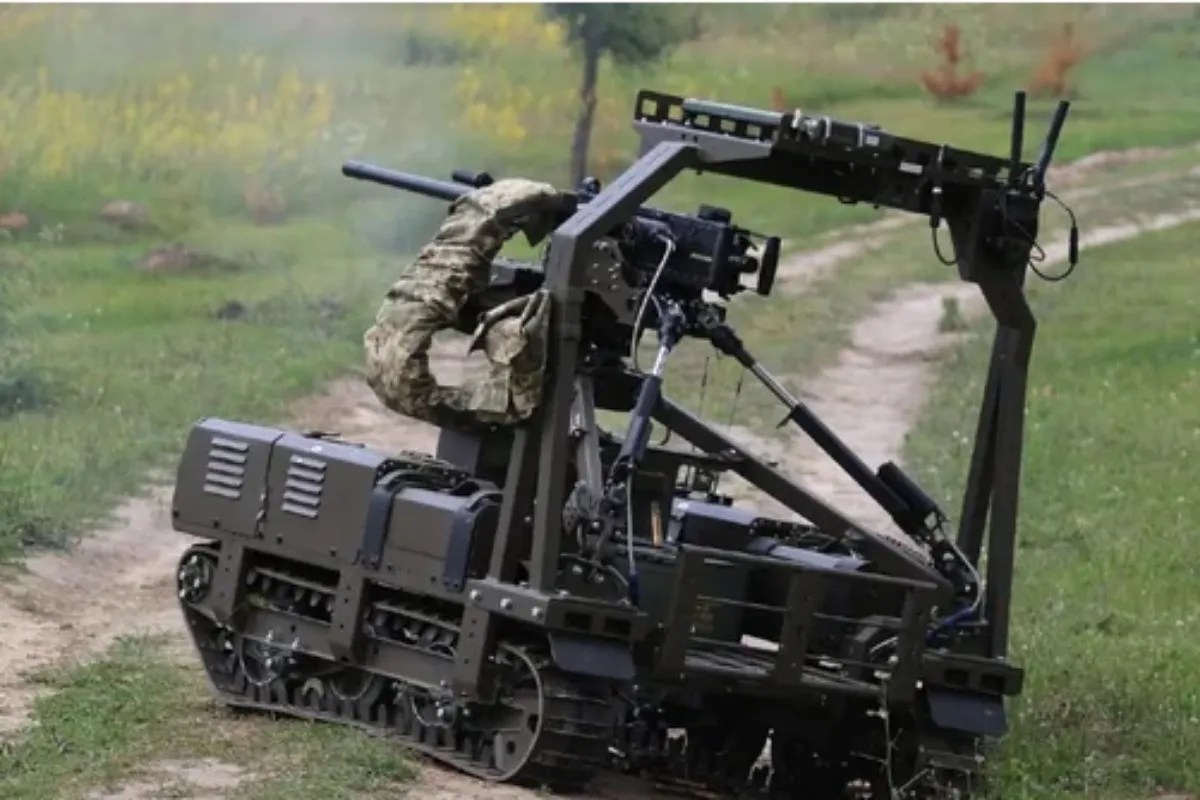
- Mechanical Occupation: The UGV serves as the physical anchor. It enters the trench or position to perform tasks that were previously the sole domain of infantry: clearing dugouts with mounted machine guns, laying mines to prevent counter-attacks, or acting as a mobile shield for a small follow-on team of human "moppers."
The Cost Function of Human vs Machine Material
The transition toward robotic assaults is driven by a stark economic reality. The "Value of a Statistical Life" (VSL) in a high-intensity conflict is infinite in terms of political capital and high in terms of training investment. Conversely, a medium-class UGV equipped with a PKT machine gun and basic optical sensors represents a fixed, recoverable cost.
The attrition math favors the machine for three reasons: As discussed in recent reports by Wired, the implications are widespread.
- Asymmetric Training Requirements: Training a proficient stormtrooper takes months and carries a high failure rate. Programming or remotely piloting a UGV requires a technician who remains outside the "kill zone," ensuring that the most valuable asset—the experience of the operator—is preserved even if the hardware is lost.
- Logistical Shrinkage: A robot does not require CASEVAC (Casualty Evacuation) protocols, food, water, or psychological support. Removing these requirements simplifies the "tail" of an assault unit, allowing for a leaner, more aggressive forward footprint.
- Persistence in Lethal Zones: Humans suffer from combat fatigue and the physiological "freeze" response. A UGV can maintain a fixed line of sight on a bunker entrance for 48 hours without a lapse in concentration, effectively "pinning" the enemy through mechanical endurance.
Structural Bottlenecks in Autonomous Warfare
While the replacement of soldiers with robots sounds definitive, several technical and environmental bottlenecks prevent total mechanization. The effectiveness of these systems is currently capped by specific physical and digital constraints.
The Connectivity Tether
Most UGVs used in trench captures are still tethered to an operator via radio frequency. This creates a single point of failure: the signal. In a dense EW environment, a robot that loses its link becomes a static piece of scrap metal. Unlike an aerial drone, which can often regain a signal by climbing, a ground vehicle is trapped by terrain. The solution being tested involves "fiber-optic" control—reeling out a physical wire to remain immune to jamming—but this severely limits the vehicle's range and maneuverability around obstacles.
Terrain Friction and Navigation
The "geometry of the trench" is a natural enemy of the robot. Modern trenches are designed with traverses (zig-zags) to contain blast fragments. These tight angles are difficult for wheeled or even tracked UGVs to navigate without high-level autonomous pathfinding. Currently, most robotic successes occur in "linear" capture scenarios, such as seizing an outer treeline or a simplified outpost, rather than complex, multi-level bunker systems.
Sensor Degradation
Mud, dust, and smoke—the constant companions of the battlefield—quickly blind optical sensors. While a human can wipe their eyes or use peripheral intuition, a robot requires sophisticated self-cleaning lenses or multi-modal sensing (Lidar and Thermal) to remain functional. This increases the unit cost, pushing it closer to the point where the machine is no longer "expendable."
The Tactical Reclassification of Infantry
The role of the Ukrainian soldier is shifting from "assaulting element" to "system administrator." In these robotic-led captures, the infantry follows the machine at a distance of 200 to 400 meters. Their primary function is not to trade fire with the enemy, but to provide overwatch for the UGV and to occupy the space once the machine has neutralized immediate threats.
This creates a new hierarchy of battlefield survival:
- Level 1 (Disposable): FPV Drones and Loitering Munitions.
- Level 2 (Semi-Disposable): UGVs (The "Iron Soldiers").
- Level 3 (Protected): Human operators and specialists.
The tactical advantage here is psychological as much as it is kinetic. Russian defenders, facing a machine that does not fear death and cannot be suppressed by small arms fire, face a "hopelessness gradient." Traditional suppression tactics (firing in the general direction of the enemy to keep their heads down) do not work against a camera lens.
Strategic Pathfinding for Modern Commanders
To scale the success of robotic trench captures, military organizations must move beyond the "bespoke" model of UGV deployment. The next phase of this evolution involves three specific strategic shifts.
First, the integration of localized mesh networks is mandatory. Each UGV should act as a signal repeater for the next, allowing a swarm to penetrate deep into EW-heavy zones. Second, the development of modular payloads—where a single chassis can switch from a machine gun to a heavy mortar or a casualty-drag system in minutes—is required to maintain operational tempo. Finally, the "human-in-the-loop" must be moved to "human-on-the-loop." The robot must be capable of navigating the final 50 meters of a trench autonomously, using computer vision to identify and engage targets, with the operator only providing the "consent to fire."
The capture of Russian posts via robots is not a sign that the soldier is obsolete; it is a sign that the soldier’s proximity to the point of impact is no longer a requirement for victory. The side that masters the mass production of these mid-tier autonomous systems will dictate the pace of territorial control in the 21st century. High-intensity conflict is transitioning into a competition of industrial throughput and algorithmic reliability, where the primary objective is to make the enemy's human presence economically and biologically unsustainable.
The immediate move for any modern force is the decentralization of UGV command. By embedding robotic pilots at the platoon level rather than keeping them in specialized units, the "sensor-to-shooter" loop is tightened, allowing for real-time exploitation of the mechanical breakthroughs seen on the Ukrainian front.