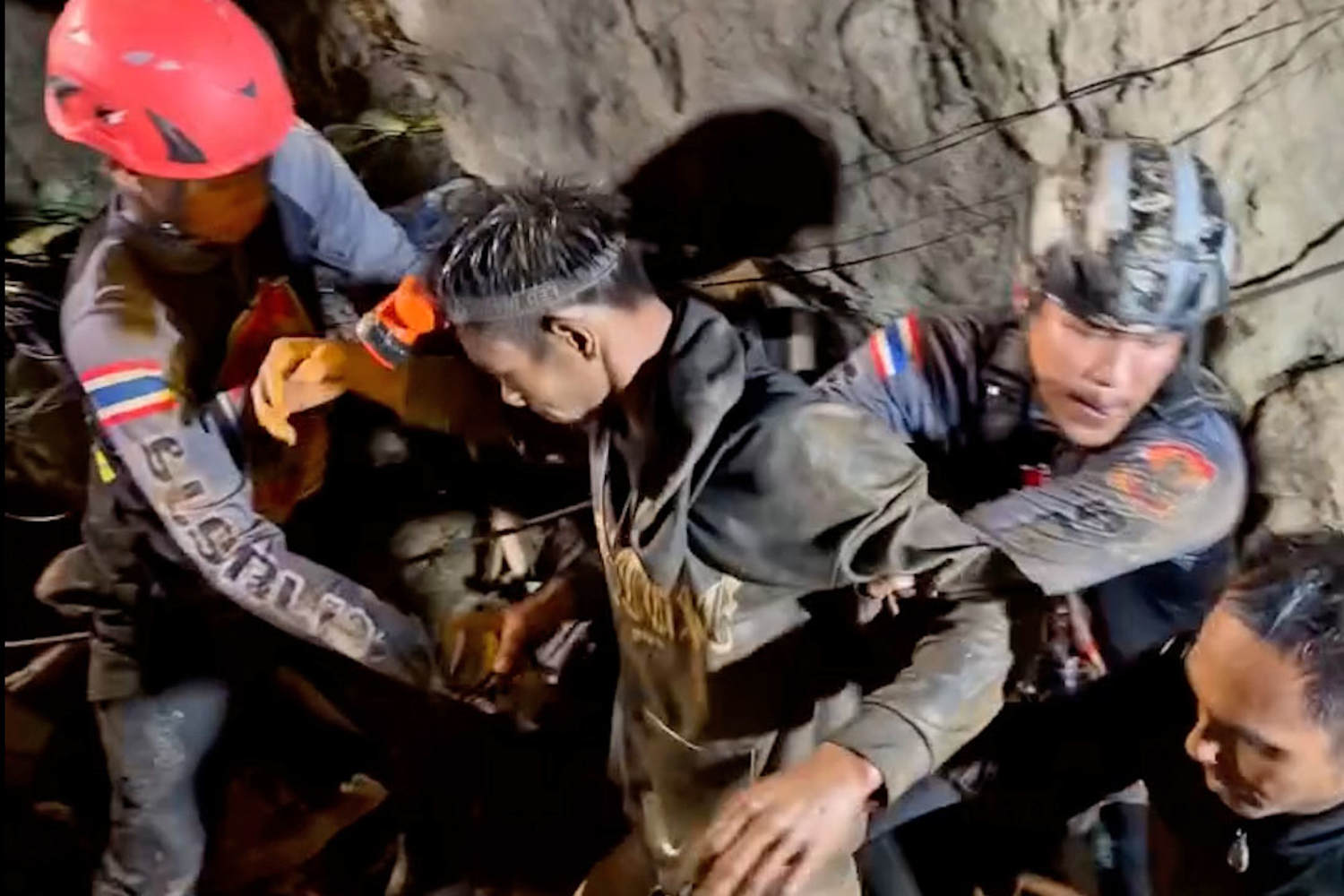
Subterranean rescue operations executed in flooded karst systems represent the absolute limit of high-risk logistics, physical endurance, and specialized engineering. The isolation of five artisanal gold miners inside a flooded cave network in the Longcheng district of Xaisomboun province, Laos, exposes the critical friction points inherent to deep-cave extraction. While mainstream narratives focus on the emotional arc of survival, an analytical breakdown of the operation reveals a matrix of severe environmental bottlenecks, human physiological decay, and complex geopolitical coordination.
The incident began between May 19 and May 20, 2026, when seven local men entered an unmapped, steep-conduit cave network to prospect for valuable mineral deposits—a high-risk economic activity driven by regional poverty. Intense localized rainfall triggered a flash flood, rapidly filling the low-lying structural sumps and sealing the primary exit conduit. One individual managed to escape the initial inundation to alert authorities. Following an eight-day search executed by an international coalition, five survivors were located alive on an isolated, elevated breakdown pile approximately 300 meters from the cave entrance. Two individuals remain unaccounted for.
Locating the survivors changes the operational mandate from a search configuration to an extraction framework. Executing this phase requires managing three independent risk variables: hydraulic instability, spatial restriction, and the physiological deterioration of the human assets.
The Three Pillars of Subterranean Extraction Failure
The execution of a successful cave rescue depends on neutralizing three interconnected environmental and structural bottlenecks. Failure to manage any single pillar introduces a catastrophic failure mode to the entire system.
                  [SUBTERRANEAN EXTRACTION MATRIX]
                                 |
         +-----------------------+-----------------------+
         |                       |                       |
         v                       v                       v
[HYDRAULIC INSTABILITY]   [SPATIAL RESTRICTION]   [PHYSIOLOGICAL DECAY]
 - Hydrostatic Head        - 60cm Squeeze Points   - Hypercapnia (CO2)
 - Silt Ingress (0% Vis)   - Tank Doffing Mandate  - Refeeding Syndrome
 - Inflow vs Pump Rate     - Tortuous Geometry     - Hypothermia/Infection
1. Hydraulic Instability and Fluid Dynamics
The primary constraint governing the operational timeline is the volume of water within the cave conduits. Karst topography acts as a natural drainage funnel. When heavy rains fall on the mountainous jungle terrain overhead, the water does not merely run off; it percolates rapidly through fractures or pours directly into open shafts.
This creates a high hydro-dynamic volatility. The inflow rate from persistent precipitation routinely outpaces the maximum volumetric discharge capacity of mechanical water pumps deployed at the staging areas. This variance forced technical teams to rapidly retreat during early phases of the operation to avoid getting trapped themselves.
Furthermore, the floodwaters are not static, clear fluid. The hydraulic energy carries heavy loads of sand, gravel, and clay sediment into the system. This creates a dual bottleneck:
- Zero-Visibility Diving: Silt suspension reduces underwater visibility to absolute zero. Divers cannot utilize visual cues or instruments; they navigate and assess passage structure entirely through tactile feedback—feeling along the guide lines, rock faces, and floor with arms and legs.
- Conduit Occlusion: Moving sediment settles in low-velocity zones within the tunnels, structurally narrowing or entirely blocking previously passable submerged bottlenecks.
2. Spatial Restrictions and Geometrical Friction
The structural architecture of the Xaisomboun network introduces profound mechanical challenges. The cave entrance requires a steep, 2.5-mile foot trek through dense jungle terrain, eliminating the possibility of deploying heavy machinery directly to the primary access point. The entry portal itself is a narrow, vertical fissure capable of admitting only one operator at a time.
Deep within the internal conduit system, the passage dimensions scale down to restrictive choke points as narrow as 60 centimeters (24 inches) in diameter. This spatial threshold creates severe mechanical constraints:
- Equipment Decoupling: Standard side-mount or back-mount SCUBA configurations cannot pass through a 60cm aperture while worn by a diver. Operators must execute "tank doffing"—removing their life-support cylinders underwater, pushing the tanks through the constriction ahead of them, and shimmying their shoulders through the rock matrix before donning the equipment on the other side.
- Physical Exhaustion Cycles: Navigating tortuous, jagged passages requires continuous, high-exertion crawling, climbing, and pulling against water currents. The physical friction results in high systemic fatigue; a single round-trip journey to the terminal chamber requires approximately four hours of continuous physical exertion to cover a linear distance of just a few hundred meters.
3. Physiological Decay and Environmental Toxicity
The microclimate of an isolated subterranean chamber introduces acute metabolic and environmental threats to trapped personnel over time.
[Time Elapsed (Days 1-10)]
  |--> Caloric/Hydration Deficit --> Glycogen Depletion --> Muscle Atrophy
  |--> Atmospheric Degradation  --> CO2 Accumulation  --> Respiratory Acidosis
  |--> Saturated Microclimate   --> Hypothermia        --> Immunosuppression
The initial survival of the five men was enabled by an elevated rock shelf that remained above the static water level. However, their physical reserves are heavily depleted after more than a week of complete caloric deprivation and severe dehydration. While emergency divers have stabilized immediate hydration using oral rehydration salts and soft, high-calorie food matrices, the survivors remain in a state of severe physical fragility.
The more critical, immediate threat is atmospheric degradation. The terminal chamber is a confined, unventilated space. As the five survivors consume oxygen, they exhale carbon dioxide ($CO_2$). Without a continuous exchange of fresh air, the ambient $CO_2$ concentration rises. Elevated atmospheric $CO_2$ triggers hypercapnia, leading to headaches, disorientation, increased respiratory rates, and eventual respiratory acidosis. This atmospheric toxicity explains why rescuers noted the men appeared highly disoriented upon initial contact.
Comparative Risk Profiles of Extraction Methodologies
The rescue coordination team must choose between two distinct tactical pathways. There is no risk-free option; the selection represents a calculated trade-off between environmental predictability and human physiological limits.
| Vector | Strategy A: Scheduled Dive Extraction | Strategy B: Controlled In-Situ Attrition |
|---|---|---|
| Operational Mechanism | Fit survivors with specialized positive-pressure full-face masks and manually guide them through the submerged conduits via a continuous chain of divers. | Maintain the survivors in the chamber by pumping in food, medical supplies, and fresh air while waiting weeks for the seasonal monsoon rains to subside and lower the water table naturally. |
| Primary Risk Mode | Panic-induced drowning or barotrauma. A non-diver experiencing a panic response inside a zero-visibility, 60cm choke point will compromise both their own life-support and that of the escort diver. | Atmospheric collapse or sudden flash flooding. A sudden, massive downpour could completely submerge the remaining dry rock ledge, drowning the survivors before divers can intervene. |
| Logistical Burden | High demand for elite, specialized cave-diving personnel and precise underwater life-support infrastructure. | Extreme long-term supply chain maintenance through a highly volatile, four-hour subterranean transport corridor. |
| Physiological Impact | Acute psychological and physical stress over a compressed, highly intense timeframe (minutes to hours). | Chronic physical degradation, muscle wasting, and increased susceptibility to fungal or bacterial infections in a 100% humid environment. |
Structural Bottlenecks in International Resource Deployment
The operational footprint of this mission relies on a highly specialized international coalition. Local Lao rescue organizations, such as the Rescue Volunteer for People, provided initial localized response and structural intelligence. However, the extreme technical demands of deep-sump cave diving required the integration of external assets, including personnel from Thailand, Finland, Malaysia, Japan, and European nations.
This multi-national framework introduces severe coordination bottlenecks. First, the lack of a pre-existing, unified command structure across different national entities slows down real-time decision-making. Second, linguistic barriers complicate the transmission of precise technical data during high-stress operations inside the cave.
Most critically, bureaucratic and legal friction slows down deployment. Expert divers on-site have noted significant delays in acquiring formal government authorizations to execute high-risk maneuvers. In a highly volatile rescue environment, the absence of a pre-negotiated legal framework regarding operational liability creates a structural drag on tactical execution, slowing down the implementation of aggressive extraction strategies.
The Strategic Play
The operational window for a safe extraction is narrowing rapidly. Based on the physical constraints of the Xaisomboun karst network and the deteriorating physiological status of the survivors, a strategy of waiting for the dry season is functionally unviable. The risk of sudden catastrophic inundation from the next major weather system outclasses the calculated risks of a proactive dive extraction.
The coordination team must immediately execute a staged, proactive dive extraction using a highly controlled, single-asset framework.
- Atmospheric Stabilization: Prior to moving any asset, an air line or an open-circuit oxygen flush system must be advanced to the terminal chamber to reverse the $CO_2$ buildup and stabilize the survivors' cognitive functions.
- Sequential Proof-of-Concept: Survivors must not be extracted simultaneously. The team must execute a single test run with the strongest, most stable individual utilizing a positive-pressure full-face mask. This mask maintains a higher pressure inside the lens than the surrounding water, preventing water ingress even if the seal is partially compromised or if the individual experiences anxiety.
- Phased Nutritional Rehabilitation: Rescuers must strictly meter caloric intake during the pre-extraction phase to avoid refeeding syndrome—a fatal metabolic shift that occurs when carbohydrates are introduced too rapidly to severely malnourished individuals.
- Active Sump Management: High-capacity water pumps must remain operational at maximum output to suppress the water line by even nominal margins, reducing the absolute linear distance of the required submerged dives.
Hopes of recovering the final two missing miners are statistically low; search operations across 95% of the accessible tunnel system have yielded no alternative dry sanctuaries. Survival requires dry space and breathable air. The operational priority must now shift completely to preserving the five living assets before environmental volatility closes the window permanently.
This video provides an operational overview of the physical parameters and international teams mobilized on-site to navigate the flooded conduits: Rescuers race to free five people trapped in flooded cave in Laos.