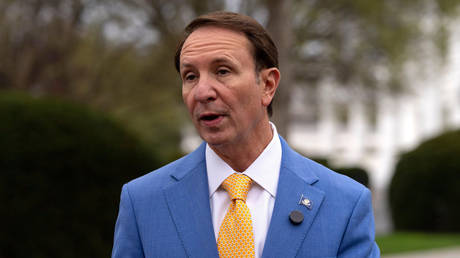
The United States wants its military footprint back on Greenland, and it is not asking for permission. When Washington's special envoy Jeff Landry landed in Nuuk, the message to local authorities was direct and uncompromising. The White House views the world’s largest island as a matter of absolute national security, a view reinforced by continuous pressure from Washington to reactivate shuttered Cold War assets and construct new military bases.
This aggressive push has triggered immediate backlash. Local politicians boycotted the opening of a new U.S. consulate, while demonstrations erupted in the capital with citizens asserting that their democracy is not for sale. Yet, behind the public friction lies a calculated geopolitical reality. Washington is moving to secure the Arctic before rival powers lock it down.
The Cold War Infrastructure Revival
American interest in Greenland is driven by geographic reality rather than real estate ambition. The island sits directly beneath the shortest flight paths for ballistic missiles traveling between Moscow and North American targets. During the peak of the Cold War, the U.S. maintained seventeen active military installations across the territory. Today, only one fully functional outpost remains, the Pituffik Space Base, formerly known as Thule.
Washington now intends to reverse this decades-long retreat. Plans under review by U.S. Northern Command involve evaluating deep-water ports and expanding existing airfields. The explicit objective is to re-establish long-range maritime surveillance and track foreign naval activity moving through the critical Greenland-Iceland-UK gap.
The Pentagon is targeting three distinct areas in the southern region of the island for new defense infrastructure. Re-populating abandoned outposts requires massive logistical updates, from runway extensions capable of handling heavy military transports to advanced radar arrays designed to detect hypersonic threats. For Washington, these upgrades are vital to national safety. For locals, the sudden influx of American hardware looks like an occupation by stealth.
Resource Control and the New Arctic Trade Routes
The geopolitical struggle extends beyond radar lines and missile silos. Climate shifts are transforming the Arctic, accelerating the melt of polar ice sheets and exposing vast, previously inaccessible wealth. Greenland holds some of the world's largest untapped reserves of rare earth elements, minerals essential for manufacturing everything from advanced guidance systems to electric vehicle batteries.
┌────────────────────────────────────────────────────────┐
│               ARCTIC STRATEGIC CONVERGENCE             │
├───────────────────────────┬────────────────────────────┤
│      MILITARY ASSETS      │     RESOURCE SECTOR        │
├───────────────────────────┼────────────────────────────┤
│ • Pituffik Space Base     │ • Neodymium & Praseodymium │
│ • 3 Proposed Southern Bases│ • Deep-Water Port Access   │
│ • GIUK Gap Surveillance   │ • Ice-Free Maritime Lanes  │
└───────────────────────────┴────────────────────────────┘
Control over these resources is a primary economic objective. Currently, processing capabilities for rare earth elements are overwhelmingly concentrated in China. By embedding itself into Greenlandic infrastructure, the U.S. seeks to secure an alternative supply chain that bypasses Beijing entirely.
Concurrently, new northern shipping lanes are opening. These trans-Arctic routes shave weeks off traditional transit times between Asia and Europe, avoiding vulnerable chokepoints like the Malacca Strait or the Suez Canal. The nation that controls the infrastructure along these icy perimeters will dictate the terms of global maritime trade in the latter half of this century.
The Sovereign Pushback in Nuuk
Local leadership is resisting Washington's approach. Prime Minister Jens-Frederik Nielsen criticized the aggressive American rhetoric, labeling the unilateral demands as disrespectful to Greenlandic self-determination. The tension spiked further following reports of uninvited U.S. officials arriving alongside specialized personnel, a move local health ministers decried as treating the population like experimental subjects in a high-stakes geopolitical game.
Greenland operates under an extended self-governance framework within the Kingdom of Denmark. While Copenhagen formally retains control over foreign policy and defense, a 1951 bilateral treaty updated in 2004 dictates that any American military expansion must involve prior notification and consultation with local authorities.
Washington's current strategy appears to test the limits of that treaty. By leveraging economic carrots, such as targeted investments and diplomatic presence through the Nuuk consulate, the U.S. is attempting to isolate Greenlandic opposition. The local population remains highly skeptical, organizing street protests under the unifying message that cooperation cannot be forced through intimidation.
The Threat of Third Party Influence
The White House defends its aggressive posturing by pointing directly to the ambitions of external competitors. Russian military units have systematically reopened dozens of Soviet-era Arctic bases, deploying specialized cold-weather missile systems and expanding submarine patrols throughout the northern seas.
Simultaneously, Beijing has declared itself a near-Arctic state. Chinese state-owned enterprises have repeatedly attempted to finance major infrastructure projects in Greenland, including the construction of commercial airports and mining facilities.
  U.S. Security Perimeter
          │
          ▼
   [Greenland Outposts] ◄─────► [Copenhagen Oversight]
          ▲
          │
  Foreign Competitors (Russia / China Encroachment)
American planners argue that a security vacuum on the island invites foreign intervention. Former diplomatic officials have explicitly stated that Denmark lacks the conventional military capacity to defend the vast island territory on its own. In the eyes of the Pentagon, an American footprint is the only viable counterweight to total administrative vulnerability.
A Broken Diplomatic Mechanism
The current friction highlights a breakdown in diplomatic communication. The creation of a tripartite task force involving Washington, Copenhagen, and Nuuk was intended to smooth over security disputes. Instead, the mechanism has been bypassed by high-profile visits and public declarations that catch local leaders off guard.
The U.S. position assumes that financial leverage and security guarantees will ultimately override local sovereignty concerns. This calculation underestimes the domestic political pressure inside Greenland, where preservation of autonomy outweighs the immediate economic benefits of foreign military investment.
The deployment of heavy equipment, the expansion of deep-water berths, and the installation of long-range surveillance gear will move forward regardless of regional boycotts. Washington considers the Arctic too important to let local political resistance halt its military planning. The strategy is set, the funding is aligned, and the footprint is expanding.