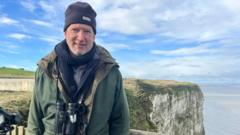
The wind at Bempton is not a breeze; it is a physical weight. It slams into the chalk face of the East Yorkshire coast with a violence that should, by all rights, scour the cliffs clean of any living thing. Stand at the edge and the salt spray stings your eyes until they water, blurring the line where the North Sea ends and the gray English sky begins. If you lean forward, just a fraction too far, the roar of the ocean four hundred feet below becomes a siren song of absolute finality.
For decades, we nearly let that silence win.
Bempton Cliffs is the only mainland breeding colony for gannets in England. It is a skyscraper of biology, a vertical city where half a million seabirds scream, fight, and mate on ledges no wider than a paperback book. But for a long time, the story of Bempton wasn’t about the beauty of the birds. It was about the audacity of the people who thought they owned them.
The Men on the Ropes
A century ago, the cliffs were a workplace. Imagine a man, let’s call him Thomas, strapped into a harness made of rotting hemp and questionable grit. His job was to "clifftop"—to be lowered over the precipice by a team of three men at the top, dangling over the abyss to harvest eggs. This wasn't a hobby. It was an industry. Thousands of eggs were hauled up in baskets to be sold for food or used in the refining of sugar.
The birds were a resource to be mined, no different from the coal in the pits further inland.
The toll was staggering. When you treat a living ecosystem like a pantry that never needs restocking, the shelves eventually go bare. By the mid-20th century, the screaming city on the cliffs was becoming a ghost town. The Kittiwakes were thinning. The Puffins, those awkward, colorful clowns of the air, were vanishing into the Atlantic. The narrative of Bempton was one of managed decline—a slow-motion shrug as we watched a miracle disappear because we couldn't figure out how to value something we didn't eat.
The Shift in the Wind
The turning point didn't happen because of a single grand gesture. It happened because the human perspective shifted from "What can I take?" to "What must I protect?"
The Royal Society for the Protection of Birds (RSPB) took over the management of the cliffs, but a deed of ownership is just paper. The real battle was fought in the hearts of the locals and the minds of the visitors. We had to learn to see the Gannet not as a source of yolk, but as a marvel of engineering.
A Gannet hits the water at sixty miles per hour. If you or I did that, our neck would snap and our lungs would collapse. The Gannet, however, has evolved internal airbags in its face and chest to cushion the blow. Its eyes are positioned for binocular vision, allowing it to calculate the refraction of light on water with the precision of a high-end computer.
Consider the sheer willpower required for a Puffin to fly. They aren't built for the air; they are built for the sea. To stay airborne, they have to beat their wings up to four hundred times a minute. It is a frantic, desperate, beautiful struggle. When you stand on the viewing platform today and see that flash of orange beak, you aren't just looking at a bird. You are looking at a survivor of an era that tried to wipe it out.
The Invisible Threat
Winning the battle for Bempton wasn't just about stopping the egg collectors. The new enemies were invisible. Overfishing of sandeels—the primary food source for these colonies—meant that even if the nests were safe, the chicks were starving. Then came the plastic. Then came the warming currents.
The success at Bempton is a testament to the power of the "buffer zone." By creating a protected space where the birds are undisturbed during their most vulnerable months, we gave them a fighting chance against the global pressures they face out at sea. The numbers began to climb. The Gannet colony, once a precarious handful of pairs, swelled into the tens of thousands.
But Bempton is more than a success story for ornithologists. It is a mirror for us.
The Human Need for the Wild
I remember standing on the cliff edge next to an old man who had traveled three hundred miles just to see the Albatross. For a few years, a lone Black-browed Albatross—a bird that belongs in the Southern Ocean, thousands of miles away—decided to make Bempton its home. It was a glitch in the matrix, a lost wanderer.
The man was crying. Not because the bird was beautiful, though it was, but because he felt the weight of its solitude. We see ourselves in these birds. We see our own fragility in the Puffin’s frantic wings and our own aspirations in the Gannet’s soaring glide.
If we had lost Bempton, we wouldn't have just lost a few species of birds. We would have lost a piece of our own capacity for wonder. We would have accepted a world that is quieter, duller, and more predictable.
The battle was won because we decided that some things are worth more than their weight in sugar or gold. We decided that a vertical city of half a million souls was worth the effort of restraint.
Now, the cliffs are louder than ever. The smell of guano is pungent, a sharp, ammonia tang that hits the back of your throat. It is the smell of life. It is the sound of victory.
The wind still tries to push you off the edge. The sea still hungers for the chalk. But the birds are still there, clinging to the ledges, defying the gravity that once claimed so many of their ancestors. They are the living proof that when we step back, nature steps forward.
The sky is white with wings. The air is thick with the sound of a thousand conversations. We saved the birds, but in the end, they were the ones who reminded us how to be human.


