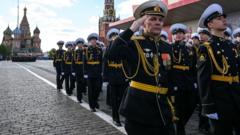
The narrative is as predictable as it is lazy. Every year, when the dust settles over the cobblestones of Red Square, the same headlines circulate through the echo chambers of London and D.C. "Russia is running out of tanks." "Putin is afraid of drones." "The parade was a sign of weakness." It is a comforting story for a Western audience that wants to believe a logistical pivot is a psychological collapse.
It is also wrong.
By framing the downsized Moscow Victory Day parade as a desperate reaction to Ukrainian threats or equipment shortages, analysts are missing the actual tactical and political realignment happening behind the Kremlin walls. The "scale-back" isn't an admission of defeat; it is a calculated pivot toward a long-war posture that prioritizes cold efficiency over the performative vanity of the 2010s.
The Myth of the Empty Garage
The most common refrain is that Russia didn't show off its T-14 Armata or its mass of T-90Ms because those tanks are either burning in a field or don't exist. This stems from a fundamental misunderstanding of what a military parade is for.
In the high-growth years of the mid-2000s, the parade was a sales pitch. It was an arms bazaar disguised as a holiday. Russia needed to signal to India, China, and the Middle East that its defense industry was a peer competitor to NATO. They rolled out prototypes that weren't even in serial production just to inflate the order books.
Today, the sales pitch is over. The Russian defense industry has shifted to a "mobilization economy." When you are in a high-intensity attrition conflict, you don't pull a battalion of frontline-ready T-90Ms off the railhead to spend three weeks practicing synchronized driving in Moscow. You send them to the Donbas.
Reducing the parade isn't about not having the gear; it’s about the optics of utility. Rolling out five hundred vehicles while the state is demanding "everything for the front" creates a cognitive dissonance that even the most loyal domestic audience wouldn't swallow. The scaled-down ceremony is a message to the Russian public: We are serious. We are frugal. We are at war.
Security Theater vs. Strategic Reality
The "Ukraine threat" is the ultimate red herring. Yes, the risk of a drone strike is real. Yes, the optics of a small drone hitting a turret on live TV would be a PR disaster. But if the Kremlin truly feared for the safety of its leadership, they wouldn't hold the event at all.
Blaming "security concerns" is a convenient geopolitical shield. It allows Moscow to:
- Validate their narrative that they are the victims of "terrorist" aggression.
- Justify the cancellation of regional parades where local dissent or logistical failures might be harder to control.
- Save face while shifting resources.
The media falls for the bait every time. They focus on the absence of the "immortal regiment" marches, citing fear of drones. In reality, these marches were becoming a liability for a different reason. When you have a massive public gathering of people holding photos of dead soldiers, you risk the crowd realizing exactly how large the current casualty count has become. The "threat from Ukraine" provides the perfect excuse to shut down a potential site of domestic unrest before it even starts.
The One Tank Theory
Everyone laughed at the lone T-34 leading the procession. It was the meme heard 'round the world. "Russia is down to its last WWII tank."
This is peak Western projection. The T-34 is the holy relic of Russian secular religion. In the Russian psyche, that single tank carries more weight than a hundred modern T-72s. By featuring the T-34 in isolation, the Kremlin isn't showing weakness; they are leaning into the Great Patriotic War mythology. They are telling their people that, just like in 1941, they are standing alone against a "unified West" and that they are prepared to fight with whatever is left until the end.
It’s an appeal to martyrdom, not a display of inventory. If you think the Russian government couldn't find ten more tanks in a country that produces thousands of armored vehicles a year, you are letting your wishful thinking override your intelligence. They chose the lone tank because the imagery of the "solitary defender" fits the current propaganda cycle perfectly.
Logistics Is Not a Feeling
Military analysts love to talk about "morale" because it’s hard to measure and easy to speculate on. They look at a shorter parade and see "low morale."
I’ve spent years looking at defense procurement and logistical chains. Morale doesn't win wars of attrition; industrial throughput does. While the West focuses on the length of the parade, they are ignoring the fact that Russian factory shifts have moved to 24/7 cycles.
The "lazy consensus" argues that the lack of aircraft in the flyover proves the Russian Air Force is depleted. Or, more likely, it proves that putting high-value assets into a low-altitude, predictable flight path over a city during an active conflict is a risk with zero tactical upside.
We need to stop treating the Victory Day parade as a scoreboard. It isn't a live-streamed version of the Global Firepower Index. It is a psychological operations (PSYOP) tool. In 2021, the tool was used to project "Global Power." In 2024 and beyond, it is being used to project "Total National Focus."
The Danger of Our Own Propaganda
The real risk here isn't Russia’s "weakness." It’s our own inability to see the enemy clearly because we are too busy laughing at their parade.
When we tell ourselves that Russia is "scaling back" out of fear, we underestimate their staying power. We mistake a shift in branding for a shift in capability. We assume that because the show is smaller, the threat is smaller.
History is littered with the corpses of empires that thought their rivals were "running out of steam" because they stopped putting on a good show. The Kremlin has traded the parade for the production line. If we keep focusing on the absence of tanks on the pavement while ignoring the presence of tanks on the front, we aren't just misreading the news. We are losing the war.
Stop looking at the street. Start looking at the factories. The parade is a distraction; the silence from the T-14s is the real warning.