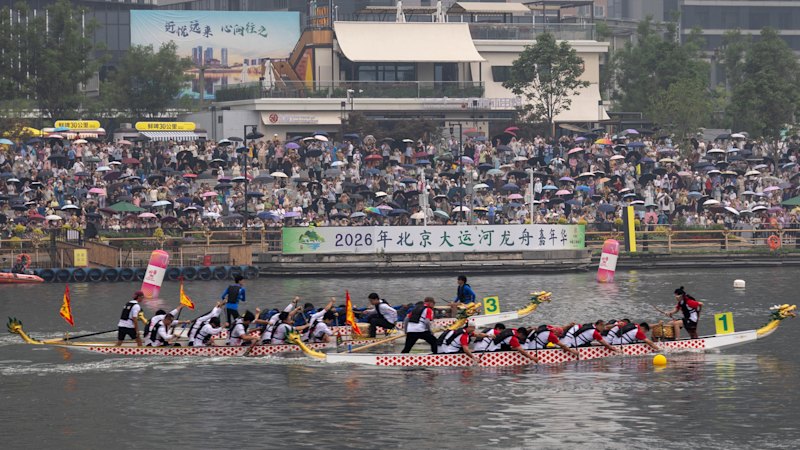
Beijing has transformed the Dragon Boat Festival from a traditional mid-summer folk custom into a powerful instrument of state-directed nationalism. While casual observers see only racing crews and sticky rice dumplings, the ruling apparatus views the holiday as a strategic asset to enforce cultural conformity, project geopolitical claims, and stimulate an anxious consumer economy. This state-sponsored reimagining of ancient lore serves a modern political agenda. By systematically elevating specific historical narratives while suppressing others, the government has turned a weekend of recreation into a mandatory demonstration of civil loyalty.
The Invention of the Perfect Patriot
The modern celebration centers almost exclusively on Qu Yuan, a third-century BCE poet and minister of the Chu state who drowned himself in the Miluo River to protest government corruption and the imminent conquest of his homeland. State media relentlessly hammers this narrative home every June. The message is unambiguous. True love for one's country requires absolute sacrifice, even when the state itself is flawed. Recently making news in related news: Why Trump Wants to Rename ICE and Why It Won't Work.
This hyper-focus on Qu Yuan is a deliberate twentieth-century political construction. Historically, the festival, occurring on the fifth day of the fifth lunar month, was primarily a seasonal occult ritual aimed at warding off epidemic diseases, poisonous pests, and evil spirits during the treacherous transition into high summer. Early records from the Han dynasty associate the day with various regional figures, including Wu Zixu, a tragic general from the Wu state, and Cao E, a daughter celebrated for filial piety.
By filtering out these competing narratives, the contemporary propaganda apparatus has streamlined the holiday's meaning. The complex tapestry of ancient regional folklore has been flattened into a mono-thematic lesson in state obedience. Qu Yuan is no longer just a historical poet. He has been repurposed as the archetypal citizen who conflates the cultural homeland with the ruling political regime. More details regarding the matter are covered by NPR.
Dragon Boats as Geopolitical Projections
The racing of long, dragon-headed canoes is no longer confined to local rivers or domestic entertainment. It has become an exportable diplomatic tool used to claim cultural hegemony over the broader Chinese diaspora and assert presence in contested regions.
Beijing aggressively finances international dragon boat regattas through organizations like the International Dragon Boat Federation and various overseas cultural centers. These events are not merely sports. They serve as soft-power operations designed to bind ethnic Chinese populations worldwide to the mainland's political orbit. When a diaspora team competes under the gaze of Chinese diplomats, the event tacitly reinforces the notion that cultural identity is inseparable from allegiance to the modern state entity in Beijing.
Furthermore, the domestic staging of these races has taken on a distinctly militaristic tone. State television broadcasts high-definition coverage of races featuring teams from the paramilitary People's Armed Police and state-owned enterprises. The synchronized, rhythmic paddling is presented as a visual metaphor for the collective discipline required under the current leadership. The individual disappears into the machine. Success is defined entirely by absolute synchronization with the drumbeat of the state.
The Economic Mandate of the Rice Dumpling
Beyond ideology, the festival carries a heavy economic burden. In an era of slowing domestic growth and shifting consumer confidence, traditional holidays are aggressively leveraged by local governments to engineer spikes in short-term retail spending.
The humble zongzi—the leaf-wrapped sticky rice dumpling traditionally eaten during the festival—has been industrialized into a multi-billion-yuan commercial engine. Luxury brands, state-owned hotel chains, and tech giants participate in an annual arms race of extravagant packaging and exotic fillings, pushing prices to absurd premiums. Local authorities issue millions of yuan in targeted consumer vouchers specifically timed for the holiday weekend to create a facade of robust economic vitality.
Yet this forced commercialization masks deeper systemic anxieties. Travel data reveals a troubling trend. While the total number of domestic trips during the holiday often sets nominal records, overall tourism spending per capita remains stubbornly flat or declining. Citizens are taking shorter, cheaper trips—a phenomenon colloquially known as "revenge saving" masked as leisure. The state media celebrates packed train stations as proof of national prosperity, but the balance sheets of local hospitality businesses tell a far more fragile story of a public reluctant to spend on high-ticket items.
Cultural Erasure in the Borderlands
The state's imposition of a unified, Han-centric festival narrative has profound implications for China's ethnic minority regions. In places like Xinjiang, Tibet, and Inner Mongolia, the promotion of the Dragon Boat Festival is used as an assimilation tool to dilute indigenous cultural practices.
Schools and community centers in these peripheral regions are required to hold zongzi-making workshops and Qu Yuan poetry readings. These state-mandated activities displace local seasonal traditions and festivals. Participation is rarely genuinely voluntary. Local cadres monitor attendance, and failure to enthusiasm for these explicitly Han customs is frequently interpreted as a lack of political loyalty or a sign of latent separatism.
By framing the Dragon Boat Festival as a universal national obligation, the central government attempts to manufacture a homogeneous "Chinese race" out of a vast multi-ethnic empire. The ancient practice of warding off summer pests has been repurposed into a mechanism for scrubbing away cultural diversity that the capital deems inconvenient or potentially subversive.
The Cracks in the Narrative
The state's grip on the festival's meaning is not entirely absolute. Beneath the polished veneer of official broadcasts, a quiet resistance manifests among younger generations who reject the heavy-handed patriotic messaging.
On social media platforms, younger citizens frequently critique the commercial exploitation of the holiday and the exhausting social expectations attached to it. Some users subversively highlight Qu Yuan’s status as an exile who was ultimately destroyed by his own government, using his story to criticize contemporary bureaucratic overreach and the lack of political expression. They read between the lines of the official propaganda. Instead of celebrating unquestioning sacrifice, they empathize with the poet’s profound alienation from an oppressive system.
This generational divide exposes the fundamental limitation of state-directed cultural engineering. You can mandate the consumption of rice dumplings, and you can fill the rivers with government-sponsored boats, but you cannot entirely control how individuals interpret the tragedy of a man who chose death over compliance with a corrupt court.