The Mediterranean does not look like a graveyard. On a bright afternoon, the water reflects a blinding, postcard blue that tricks the eye into thinking of holidays and postcards. But if you stand on the rocky limestone cliffs of Lampedusa, where the sharp scent of wild rosemary cuts through the salt air, the silence feels different. It carries a weight. For years, this tiny speck of Italian rock, closer to North Africa than to Sicily, has been the involuntary gatekeeper of Europe. It is the place where geography collides brutally with human desperation.
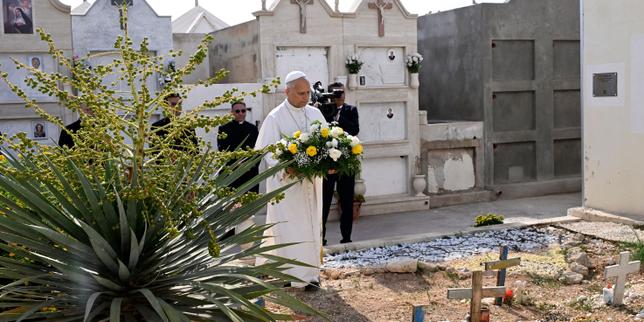
A few days ago, a white figure stood against that blue horizon. Pope Leo XIV arrived on the island not with the grand pageantry of a state visit, but with the quiet gravity of a man attending a perpetual funeral. He walked down to the water's edge, cast a wreath of yellow and white flowers into the waves, and watched them drift away.
It was a simple gesture. Yet, it shattered the clinical, bureaucratic language that usually surrounds the migrant crisis. For a few hours, the discussion shifted away from border quotas, maritime laws, and Frontex budgets. Instead, it focused on the cold reality of the seabed beneath those waves, littered with the remnants of lives that ended in terror.
Consider a young woman named Miriam. She is a hypothetical composite of the dozens of stories told by survivors in the island’s overcrowded reception center, but her reality is entirely accurate. Miriam does not leave her home because she wants to gamble her life on a deflating rubber dinghy. She leaves because the alternative is a slow, certain erasure by conflict or starvation. She pays a smuggler her family’s life savings. She sits on a crowded tube of PVC with ninety other people, the fumes of cheap gasoline burning her throat, watching the shore disappear. When the engine sputters out in the middle of the night, the Mediterranean changes from a path to freedom into a suffocating dark expanse.
When we read the morning news, Miriam becomes a digit. She is part of a statistic: "three hundred missing at sea." But when Leo XIV stood on the pier, he forced the world to look at the human face behind the arithmetic.
The heart of the crisis lies in how we choose to see these events. For a long time, the dominant narrative in European capitals has been one of crisis management. A boat arrives; emergency services deploy. A boat sinks; coast guards search. Politicians argue about who bears the financial burden, fences are reinforced, and the cycle repeats. It is a reactive, fragmented approach that treats a deep human movement as a series of isolated security emergencies.
The Pope challenged this logic directly during his address on the island. He called for Europe to move past temporary fixes and instead look at the situation organically.
To understand what an organic approach means, we have to look at the global system the same way a doctor looks at a human body. If a patient is bleeding from a wound, you do not simply wipe away the blood and declare the problem solved. You find the source of the injury. You treat the infection. You strengthen the body from within.
Europe’s current strategy has been to build higher walls while ignoring the forces driving people toward them. Wars, economic collapse, and changing climates are not abstract global trends. They are the daily realities pushing thousands of fathers, mothers, and children into the hands of human traffickers. By treating the migration crisis as a border control issue rather than a systemic global challenge, the international community has spent billions of euros managing the symptoms while the underlying illness deepens.
The numbers back this up. Year after year, despite increased naval patrols, sophisticated aerial surveillance, and political agreements with North African transit countries, the boats keep coming. The desire to survive is a powerful force. It cannot be deterred by a policy document or a razor-wire fence. When a house is burning, the people inside will jump out of the window, regardless of how high the drop is.
During his visit, Leo XIV did not offer a detailed legislative framework. He is a religious leader, not a policymaker. But he did something more fundamental: he challenged the moral architecture of the continent. He spoke of the "globalization of indifference," a condition where the suffering of others becomes a background noise we acknowledge but ultimately ignore. It is the numbness that sets in when we swipe past images of overturned boats on our phones while drinking our morning coffee.
The real problem lies in the disconnect between our values and our actions. Europe often prides itself on being the cradle of human rights, a region built on the principles of dignity, liberty, and solidarity. Yet, the waters surrounding the continent have become some of the most dangerous migration routes in the world. This contradiction creates a quiet erosion of the collective conscience. Every time a society decides that certain lives are worth less protection than others based on their place of birth, something vital within that society breaks.
Implementing an organic solution requires a massive shift in perspective. It means recognizing that the destiny of Europe is inextricably linked to the stability of its neighbors. It demands long-term investment in the countries of origin to create conditions where migration is a choice, not a desperate bid for survival. It requires the establishment of safe, legal pathways for those seeking asylum, dismantling the economic model of the human smugglers who profit off human misery.
This is not a matter of naive idealism. It is a hard-nosed, practical necessity. The current approach is failing everyone involved. It strains the resources of frontline communities like Lampedusa, creates political instability within European nations, and costs thousands of lives every year. Continuing down the same path while expecting a different result is the definition of policy failure.
The afternoon sun began to dip below the horizon as the Pope concluded his visit, casting long, sharp shadows across the limestone port. The flowers he had thrown into the sea were long gone, carried away by the strong currents that run between Europe and Africa. The island returned to its uneasy quiet, the residents knowing that tomorrow, or the day after, another distress call would crackle over the maritime radio bands.
We are left with a choice that extends far beyond the borders of Italy or the shores of the Mediterranean. We can continue to view migration through the narrow lens of fear and security, turning our backs to the sea and hoping the problem vanishes into the horizon. Or we can listen to the whispers of Lampedusa and recognize that the people in those boats are not an invading force, but a reflection of our shared humanity, testing whether the values we claim to hold dear can survive the reality of a changing world.