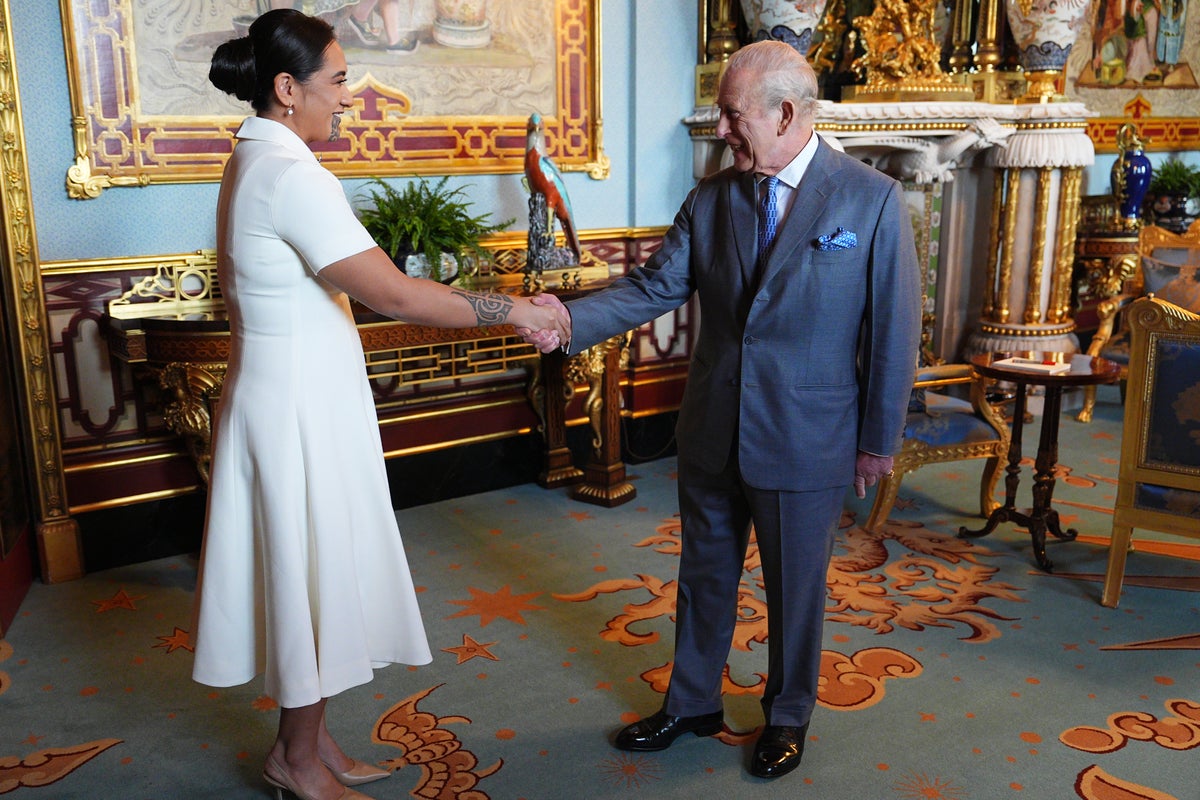
When Ngā Wai hono i te po, the newly crowned Māori Queen, sat down with King Charles III at Buckingham Palace, the official communiqués did their usual heavy lifting. Words like "heartfelt," "warm," and "historic" flooded the press releases. But diplomacy is a theater where the most important scripts are left unread. Behind the smiles and the carefully timed photographs lies a profound constitutional tension that neither London nor Wellington wants to openly acknowledge. The meeting was not just a courtesy call between two hereditary leaders. It was a quiet collision of two incompatible views of sovereignty at a time when New Zealand’s founding constitutional document is facing its greatest threat in a generation.
To understand the weight of this meeting, one must look past the gilded mirrors of the palace and focus on the political wildfire currently burning across New Zealand. The coalition government in Wellington is actively attempting to redefine the Treaty of Waitangi, the 1840 agreement signed between the British Crown and Māori chiefs. For the young Māori Queen, who inherited the throne after the passing of her father, King Tūheitia, this audience with Charles was a direct appeal to the living embodiment of that original treaty partner. It was an institutional chess move, circumventing the New Zealand Parliament to remind the King of his family's historical obligations. You might also find this related coverage insightful: Territorial Fluidity and Resource Extraction The Economic Mechanics of the Aegean Maritime Impasse.
The Fiction of the Unified Crown
New Zealand politics operates on a convenient legal fiction. That fiction dictates that the Crown is a single, indivisible entity represented by the Governor-General on the advice of the elected government. When King Charles speaks on New Zealand matters, he speaks through the mouth of Wellington.
The Kīngitanga, the Māori King Movement, has never fully accepted this neat bureaucratic arrangement. Founded in 1858 to halt the loss of land and establish a political bulwark against colonial encroachment, the movement always viewed its relationship as a direct, covenantal bond with the British monarch, not the politicians who happened to win an election in a colony. As highlighted in detailed coverage by NBC News, the effects are significant.
By traveling to London so early in her reign, Ngā Wai hono i te po highlighted this exact fault line. Her presence posed a silent, uncomfortable question. What happens when the advice the King receives from his constitutional ministers directly violates the spirit of the treaty his great-great-great-grandmother, Queen Victoria, entered into?
British officials are terrified of this question. The palace cannot intervene in the domestic politics of a sovereign Commonwealth realm. To do so would trigger a constitutional crisis that could dismantle the monarchy’s remaining global footprint. Charles knows this. The Māori Queen knows this. The meeting, therefore, was an exercise in high-stakes symbolism, where the mere act of sitting in the same room was an expression of leverage.
The Radical Shift in Wellington
While London played host, the real pressure was being generated thousands of miles away. The current political climate in New Zealand is the most racially charged it has been since the 1970s. The introduction of the Treaty Principles Bill, championed by the minor libertarian partner in the coalition government, aims to legally redefine how the Treaty of Waitangi is interpreted.
For decades, the legal system has operated on the "principles" of the treaty. These principles include partnership, active protection, and redress. They have allowed for a flawed but functioning process of land return, financial settlements, and cultural revitalization. The new legislative push seeks to strip away these specific indigenous rights, replacing them with a generalized concept of equality that critics say erases the unique status of Māori as Tangata Whenua, the people of the land.
This is the background noise that accompanied the Queen to Buckingham Palace. Her father’s final months were defined by a call for unified resistance against these policy shifts. He mobilized thousands of people across the country, urging Māori to protect their identity and autonomy. By stepping into this role at just 27 years old, Ngā Wai hono i te po inherited a political battleground, not a ceremonial retirement home. Her trip to London was her first major counter-offensive.
The Failure of British Diplomacy
British media coverage of the event was embarrassingly thin, treating the visit as an exotic footnote in the royal diary. This superficiality misses the systemic shift occurring within the Commonwealth. The British state has long treated indigenous grievances in former colonies as domestic matters to be handled by local governments. This hands-off approach is becoming untenable.
As indigenous movements gain economic power and global media savvy, they are increasingly targeting the British monarchy's soft power. They are forcing a reckoning with history. Charles has shown a willingness to acknowledge the "painful aspects" of Britain’s colonial past, but acknowledgment costs nothing. Concrete action is a different matter entirely.
The palace operates on the assumption that time cures all colonial wounds. It does not. By maintaining a strict policy of non-interference, the King risks turning the Crown into an irrelevant relic in the eyes of indigenous populations who once viewed it as a protector. If the Crown cannot or will not speak up when its own treaties are systematically dismantled, then the value of the monarchy to indigenous peoples drops to zero.
The Leverage of the New Generation
Ngā Wai hono i te po represents a generational pivot for the Kīngitanga. She is highly educated, fluent in her language, and entirely unburdened by the deference that older generations sometimes showed to British institutional power. Her strategy is not based on pleading for intervention. It is based on exposing contradictions.
During her time in London, the subtext was clear. If the New Zealand government continues to erode Māori rights, the indigenous leadership will look past Wellington to the international community, using the historical status of the Crown as their legal and moral launchpad. This creates a massive diplomatic headache for the New Zealand government, which prides itself on its international reputation as a progressive, human-rights-respecting nation.
The meeting at Buckingham Palace was not a cozy chat between two old family businesses. It was an ideological standoff wrapped in velvet protocol. King Charles, bound by the constitutional handcuffs of his office, could offer nothing more than polite assurances and tea. The Māori Queen, representing a constituency that is rapidly losing faith in the colonial legal framework, left the palace having delivered a quiet ultimatum. The Crown’s honor is on the line in the South Pacific, and the current strategy of polite silence is running out of track.