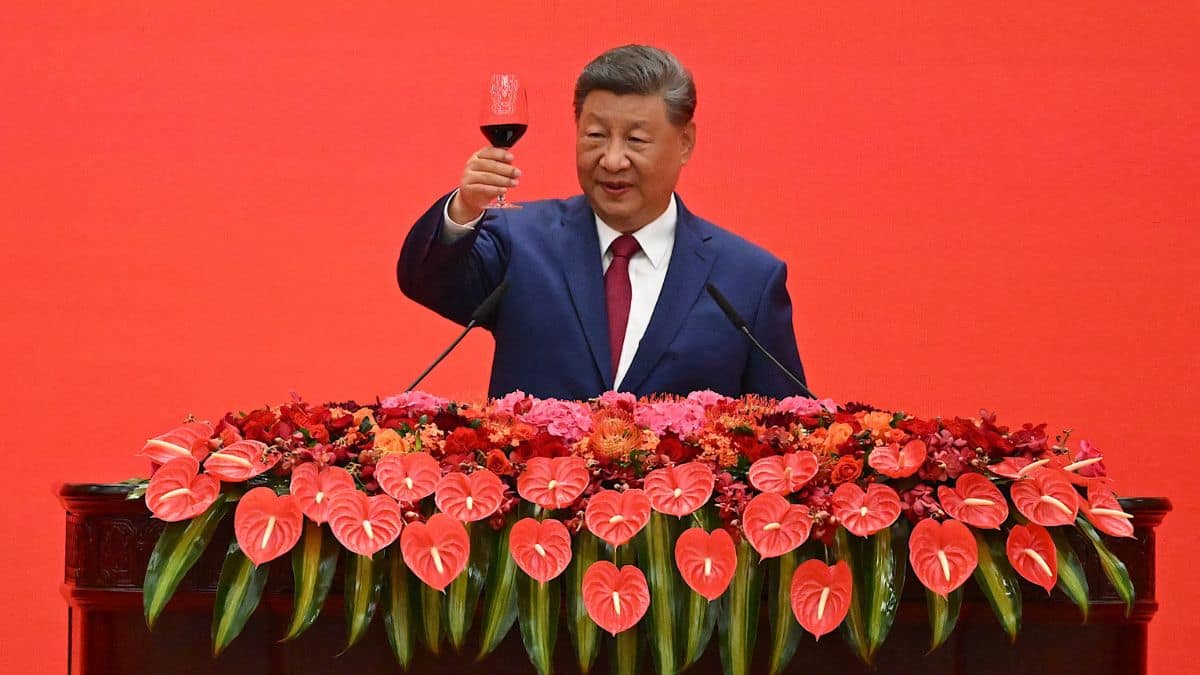
Western media loves the "rubber stamp" narrative because it’s easy. It fits neatly into a spreadsheet. It allows pundits to sip lattes while claiming that the Lianghui—the "Two Sessions" of the National People’s Congress (NPC) and the Chinese People’s Political Consultative Conference (CPPCC)—is nothing more than a choreographed piece of political theater.
They are wrong.
Calling the Two Sessions a rubber stamp is like calling a product launch at Apple a mere "slide presentation." Sure, the votes are predetermined. Yes, the applause is timed. But if you think the event is about the vote, you’ve already lost the game. The Two Sessions isn't where decisions are made; it’s where the internal stresses of a 1.4 billion-person economy are stress-tested, codified, and signaled to a global market that is increasingly deaf to nuance.
The Consensus Fallacy
The "lazy consensus" suggests that Xi Jinping walks into the Great Hall of the People, snaps his fingers, and the economy bends to his will.
If that were true, China wouldn't be grappling with a property debt crisis that has wiped out trillions in paper wealth. If total control were as absolute as the headlines suggest, the transition from a "growth at all costs" model to "high-quality development" would have been a weekend project, not a grueling, multi-year slog that has terrified international investors.
The Two Sessions is actually a signaling mechanism. It is the moment where the central government tells the provincial barons exactly how much pain they are expected to endure in the name of national stability. When the GDP target is announced—likely hovering around 5%—the story isn't the number. The story is the fiscal deficit ratio.
If the CCP sets a deficit target of 3% but allows for trillions in special-purpose bonds, they aren't "rubber-stamping" a plan. They are navigating a razor-thin margin between hyper-inflationary stimulus and a deflationary death spiral.
The False Narrative of Defense vs. Economy
The competitor pieces will tell you that China is "pivoting" to a war footing because defense spending is outstripping social programs. This is a fundamental misunderstanding of how the CCP views the "New Three" industries: electric vehicles (EVs), lithium-ion batteries, and solar products.
In the West, we separate "defense" and "economy." In Beijing, they are the same thing.
- Energy Security is Defense: Every solar panel installed in Xinjiang reduces the strategic leverage of the U.S. Navy in the Strait of Malacca.
- Semiconductor Sovereignty is Defense: When the NPC discusses "Self-Reliance in Science and Technology," they aren't talking about Silicon Valley-style innovation. They are talking about survival.
- Data as a Factor of Production: This is a term you’ll hear ad nauseam this week. It sounds like boring bureaucracy. It is actually a radical attempt to treat data like land or labor—a state-controlled resource used to optimize the industrial internet.
I’ve seen analysts ignore these "boring" policy papers to focus on the military budget's percentage growth. That is a rookie mistake. The real escalation isn't in the number of hulls in the water; it’s in the total integration of the civilian industrial base into a "Fortress China" architecture.
The Property Trap: Why There Is No Bailout
Stop asking when the "Big Bazooka" stimulus is coming. It isn't.
The People Also Ask: Will China save Evergrande or Country Garden? The Answer: No. The Two Sessions will reinforce the mantra that "housing is for living, not for speculation." Western investors are waiting for a 2008-style TARP program. They won't get it. Beijing has decided that the moral hazard of bailing out billionaire developers is worse than the slow-motion collapse of the property sector.
The contrarian truth? China is intentionally shrinking the footprint of real estate in its GDP. They are cannibalizing their biggest growth engine to feed the high-tech manufacturing sector. It is a brutal, high-stakes organ transplant being performed while the patient is running a marathon.
The "Overcapacity" Smoke Screen
You will hear a lot about "overcapacity" this week—the idea that China is dumping cheap EVs and steel on the world because its domestic consumers are too broke to buy them.
This isn't a "failure" of Chinese consumption. It is a deliberate feature of their industrial policy.
China isn't trying to build a consumer utopia modeled after the United States. They don't want a nation of shoppers fueled by credit card debt. They want a nation of engineers fueled by state-directed R&D. When the Two Sessions delegates talk about "New Productive Forces," they are signaling a shift away from the "Old Productive Forces" (apartments and bridges) toward a monopoly on the green energy supply chain.
If you are a CEO in Detroit or Wolfsburg, the "Two Sessions" isn't a political curiosity. It is the announcement of your obsolescence.
Why the "Rubber Stamp" Label is Dangerous
When you dismiss an institution as a "rubber stamp," you stop paying attention to the mechanics.
- The Petition System: Thousands of "suggestions" are funneled into the Two Sessions from local levels. Most are ignored, but the ones that make it into the final work reports represent the CCP’s "internal polling."
- The Provincial Hunger Games: Governors use this week to lobby for "Special Economic Zone" status or high-tech subsidies. It is a hyper-competitive market for state capital.
- The Regulatory Hammer: Remember the sudden crackdown on Jack Ma and the ed-tech sector? The seeds for those moves were planted in the rhetoric of previous Two Sessions.
Ignore the unanimous votes. Watch the personnel shifts. The "Two Sessions" is often the debutante ball for the next generation of technocrats who will run the central bank and the regulatory commissions.
The Math of the "New Normal"
Let’s look at the actual physics of the Chinese economy. If $G$ is growth, $I$ is investment, $C$ is consumption, and $NX$ is net exports:
$$G = C + I + G + (X - M)$$
The West is screaming for China to increase $C$. Beijing is doubled down on $I$ in "strategic" sectors. They are betting that they can out-invest the world in robotics and AI to the point where $C$ becomes irrelevant because they own the global means of production.
It is a terrifying gamble. If the rest of the world closes its borders to Chinese "overcapacity," the whole tower collapses. But the Two Sessions will show no sign of retreat.
The Actionable Reality for Global Business
If you are waiting for China to "return to normal," you are holding a ticket for a train that left the station in 2019.
The "normal" of 8% growth and easy property wins is dead. The "New Normal" is a disciplined, state-led mobilization toward technological decoupling.
- Stop Tracking GDP: Start tracking "Total Factor Productivity." That is the only metric the leadership actually cares about.
- Follow the "Little Giants": The government is obsessed with "Little Giant" companies—specialized SMEs that dominate niche tech markets. These are the real winners of the Two Sessions, not the massive internet conglomerates of the last decade.
- Hedge for "Fortress China": Assume that any technology you sell in China will be localized or replaced within five years. The Two Sessions is the annual progress report on that replacement.
The Great Hall of the People isn't a theater for the bored; it’s a war room for an economic transformation that the rest of the world is woefully unprepared to counter.
The votes are 2,900 to 0. But the silence in the room isn't peace—it's the sound of a vacuum being created by a state that has decided it no longer needs your permission to reshape the global order.
Stop looking at the stamp. Look at the ink. It’s permanent.