The air in the room usually smells of floor wax and expensive cologne, but when the leaders of the world’s two largest economies sit down, the atmosphere thickens with something else entirely. It is the scent of static.
On one side, you have a man who views the world as a series of zero-sum transactions, a builder who treats every border like a lease agreement. On the other, a strategist who thinks in decades, leading a nation that views its return to global dominance not as an ambition, but as a historical correction. When Donald Trump and Xi Jinping meet, the mahogany table between them isn't just furniture. It is a fault line.
The upcoming summit is being billed by the suits in DC and Beijing as a "limited trade-focused agenda." That phrase is a lie. Or, at the very least, it is a polite mask. You don’t bring together the architects of the 21st century just to argue over the price of soybeans and semiconductors. You bring them together because the gears of global stability are grinding, and everyone is waiting to see if they will mesh or shatter.
The Farmer in the Crosshairs
Consider a man named Elias. He isn't in the room. He’s likely on a tractor in Iowa or Nebraska, watching the horizon for rain that never comes quite when he needs it. To the bureaucrats, Elias is a data point. He is part of the "agricultural export sector." But to Elias, the "limited trade agenda" is the difference between keeping the farm that has been in his family for three generations or watching a bank representative hammer a "For Sale" sign into the dirt.
When China stops buying American soy to make a political point, Elias feels it in his marrow. When the U.S. imposes tariffs on Chinese steel, the cost of his new harvester spikes by twenty percent.
The summit is sold as a high-level chess match, but for the people on the ground, it is a game of dodgeball where they are the only ones without a place to hide. The "limited" nature of this meeting is a tactical choice. By narrowing the focus to trade, both leaders are trying to avoid the messy, radioactive topics like territorial waters or ideological supremacy. They are trying to find a version of peace that fits on a balance sheet.
The Ghost in the Silicon
Across the Pacific, in a cramped apartment in Shenzhen, a young engineer stays up late. She works for a firm that designs the very chips the U.S. is trying to keep out of Chinese hands. In her world, the trade war isn't about "national security" in the abstract. It is about whether she has a job next month.
The tragedy of the modern superpower rivalry is that we have spent forty years weaving our lives together so tightly that pulling a single thread causes the whole garment to unravel. Your smartphone is a miracle of cooperation. The glass might come from Kentucky, the processor from a design firm in the UK, the assembly from a factory in Guangdong, and the software from a campus in California.
When Trump and Xi sit down to discuss "trade," they are essentially discussing how much of that garment they are willing to tear. The irony is thick. Both men lead nations that are deeply, almost pathologically, dependent on the other. Yet, both must return home and tell their people that they stood firm, that they didn't blink, and that they are winning.
The Art of the Small Win
Why a "limited" agenda? Because a grand bargain is impossible right now. Trust has been eroded to the point where even a handshake feels like a risk.
Think of it like a failing marriage where the couple agrees to only talk about the grocery list. If they talk about the kids, they’ll scream. If they talk about the infidelity, they’ll head for the lawyers. So, they talk about the milk. They talk about the bread. They find common ground in the mundane because the alternative is a total collapse that neither can afford.
Trade is the milk and bread of international diplomacy.
The U.S. wants China to buy more stuff—specifically energy and farm goods—to narrow a trade deficit that has become a political albatross for the Trump administration. China wants the U.S. to back off the tech bans and the soul-crushing tariffs that are slowing its once-unstoppable growth. These are tangible, math-based problems. They have numbers attached to them. Numbers can be split. Values cannot.
The Invisible Stakes
If you look at the official briefing papers, you won’t see the word "fear." But fear is the primary driver of every syllable spoken in that room.
There is the American fear of displacement—the haunting suspicion that the American Century is over and that the future belongs to a system that doesn't share its values. Then there is the Chinese fear of containment—the belief that the West is a fading bully trying to trip a rising star before it can take its rightful place at the head of the table.
These fears are the gravity that pulls every trade negotiation toward the Earth.
When Trump leans across the table, he isn't just thinking about trade deficits. He is thinking about the rallies in Ohio where he promised to bring the factories back. He is thinking about his legacy as the man who "fixed" the world's most lopsided relationship.
When Xi looks back, he isn't just calculating GDP growth. He is thinking about the "Century of Humiliation" and his vow that China will never again be dictated to by foreign powers. He is thinking about the internal stability of a nation of 1.4 billion people who have been promised a "Chinese Dream" that requires constant economic fuel.
The Fragility of the Moment
We often mistake these summits for shows of strength. They aren't. They are expressions of profound fragility.
A truly strong nation doesn't need to bark about tariffs every Tuesday. A truly secure leader doesn't need to purge his ranks or tighten his grip on every piece of data. The very fact that this meeting is so carefully curated, so "limited," proves how thin the ice has become.
One wrong word, one poorly timed tweet, or one aggressive maneuver in the South China Sea could turn this "trade focus" into a cold war that lasts a century. The stakes aren't just the price of an iPhone or a bushel of corn. The stakes are the fundamental architecture of the world our children will inherit.
If they succeed in this limited agenda, we get a reprieve. The markets will rally. Elias will get a slightly better price for his crops. The engineer in Shenzhen will breathe a sigh of relief. We will buy ourselves another six months of uneasy quiet.
But if they fail?
If the "limited" agenda proves to be too much for two egos that fill every room they enter? Then the static in the air becomes a storm.
We forget that history isn't a straight line. It is a series of moments where powerful people sat in comfortable chairs and made decisions about people they will never meet. They move the pieces on the board, and the rest of us feel the vibration under our feet.
As the motorcades pull up and the cameras flash, the world holds its breath, hoping that for just one afternoon, the math of trade is enough to hold back the tide of history.
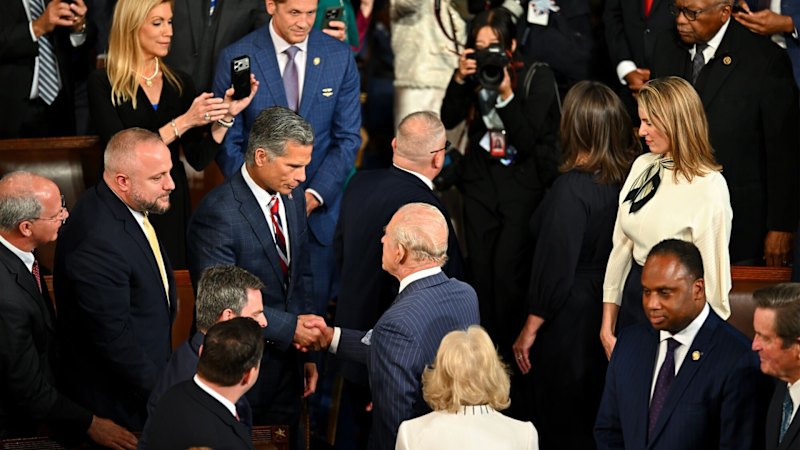
The two men stand. They reach out. The shutters of a thousand cameras click in unison, capturing a moment of forced civility. Outside the room, the rest of us are left to wonder if the bridge they are building is made of stone or of paper.
Somewhere in Iowa, Elias turns off his tractor and looks at his phone, waiting for a headline that tells him if he still has a future. He doesn't care about the geopolitics or the grand strategies. He just wants to know if the two men in the expensive chairs remembered that he exists.