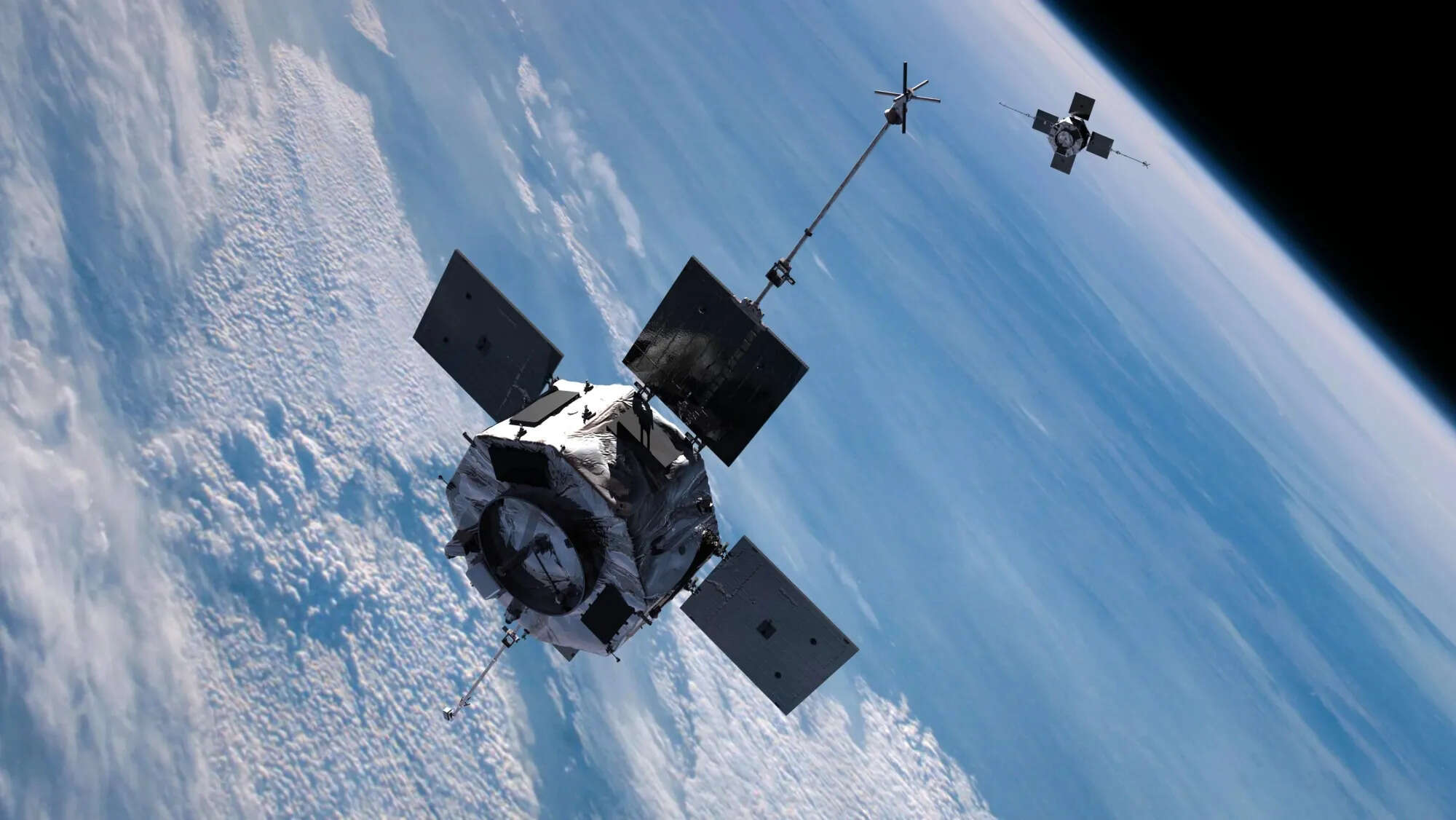
You’ve probably seen the headlines about a 600-kilogram NASA satellite "crashing" to Earth. It sounds like a scene from a disaster movie. A massive hunk of titanium and fuel cells screaming through the sky, destined for someone’s backyard. But here’s the reality: you can stop worrying. NASA designed the Van Allen Probe A to die a very specific, very fiery death. It isn't a "crash" in the way we usually think about it. It’s a controlled, atmospheric cremation.
NASA launched the Van Allen Probes back in 2012. Their job was tough. They spent seven years flying through the most intense radiation belts surrounding our planet. These belts are essentially two giant donuts of high-energy particles trapped by Earth’s magnetic field. If you’ve ever wondered why your GPS works or why satellites don't just fry instantly, it’s because we studied these belts to build better shielding. Probe A was a workhorse, but its time is finally up.
Why Probe A is Falling Now
Satellites don't stay up forever unless they’re in very high orbits. Low Earth Orbit (LEO) is messy. Even at several hundred miles up, there’s a tiny bit of atmosphere. This creates drag. Think of it like a constant, invisible wind pushing against the satellite. Over years, that wind slows the craft down. When it slows down, gravity wins. It pulls the object closer and closer to the surface.
NASA officially decommissioned the Van Allen Probes in 2019. They didn't just let them drift. They used the remaining fuel to perform a series of maneuvers. This lowered the "perigee"—the lowest point of the orbit—to ensure the craft would naturally reenter the atmosphere within a reasonable timeframe. It’s part of a global effort to reduce space junk. We can't just leave 1,300-pound dead batteries floating where they might hit a functional weather satellite or the International Space Station.
The Physics of the Fiery Reentry
When Probe A hits the upper layers of the atmosphere, it’s traveling at roughly 17,000 miles per hour. That’s fast. At those speeds, the air doesn't just move out of the way. It compresses violently. This compression creates intense heat—thousands of degrees Fahrenheit.
Most people think the satellite stays in one piece until it hits the ground. That’s wrong. The reentry process is more like a sequence of failures.
- First, the solar panels and antennas rip off. They’re thin and fragile.
- Then, the main bus—the "body" of the satellite—starts to melt.
- The friction becomes so intense that the metal literally vaporizes.
Aluminum melts at about 1,220°F. Steel is higher, around 2,500°F. Spacecraft are built with a mix of these materials. By the time the craft reaches the lower atmosphere, about 90% to 95% of its mass is gone. It turned into glowing plasma and dust. What’s left? Maybe a few small chunks of high-melting-point materials like titanium or stainless steel.
Where Will the Pieces Land
Space is big, but the ocean is bigger. NASA and the European Space Agency (ESA) don't just "guess" where things land. They use sophisticated tracking. However, because Probe A is an "uncontrolled" reentry—meaning it has no engine left to steer it at the final moment—the exact landing spot has a wide margin of error.
The odds of a piece of Van Allen Probe A hitting a person are astronomically low. You have a better chance of being struck by lightning while winning the lottery. Most debris from these events ends up at the bottom of the Pacific Ocean, often in a region called Point Nemo. That’s the "spacecraft cemetery," the furthest point from any land on Earth.
Why We Should Care About the Van Allen Probes
We shouldn't just focus on the "crash." We should focus on what this machine told us. Before these probes, we thought the radiation belts were relatively stable. We were wrong. They change constantly. They expand and shrink based on solar activity.
The Van Allen Probes discovered a third, temporary radiation belt that appears during solar storms. This changed how we think about space weather. If a massive solar flare hits Earth, it can knock out power grids and fry communication satellites. Because of Probe A, we have better models to predict these events. We can "harden" our infrastructure. It saved billions of dollars in potential damage before it even started its descent.
The Problem of Orbital Crowding
While Probe A is handled, it highlights a growing issue. Space is getting crowded. Companies like SpaceX and Amazon are launching thousands of small satellites. We’re reaching a point where "natural decay" might not be fast enough.
If we don't manage these reentries properly, we risk the Kessler Syndrome. That’s a theoretical scenario where the density of objects in LEO is high enough that a single collision starts a chain reaction. One satellite hits another, creating thousands of pieces of shrapnel, which then hit other satellites. Eventually, Earth is surrounded by a cloud of junk that makes space travel impossible for generations.
NASA’s decision to de-orbit Probe A was the responsible move. It’s a clean exit for a legendary mission.
What to Look for in the Sky
If you’re in the right part of the world at the right time, you might see a reentry. It doesn't look like a shooting star. Shooting stars (meteors) are incredibly fast and over in a blink. A satellite reentry is slower. It looks like a bright, glowing ball of fire with a long tail, often breaking into multiple distinct points of light as the craft disintegrates. It can last for 30 seconds or even a minute.
If you happen to find a piece of charred metal in your field that looks like it fell from the sky, don't touch it. While the Van Allen Probes didn't carry nuclear material, satellite components can have jagged edges or toxic chemical residues from hydrazine fuel. Call local authorities. They’ll get in touch with NASA.
Check the latest tracking data from the North American Aerospace Defense Command (NORAD). They monitor every piece of space junk larger than a softball. You can use websites like Space-Track or Heavens-Above to see the predicted decay path of Van Allen Probe A in real-time. Watching a piece of human history turn into a fireball is a rare chance to see the cycle of exploration come to a close. Get a tracking app, check the reentry windows for your latitude, and keep your eyes on the horizon.