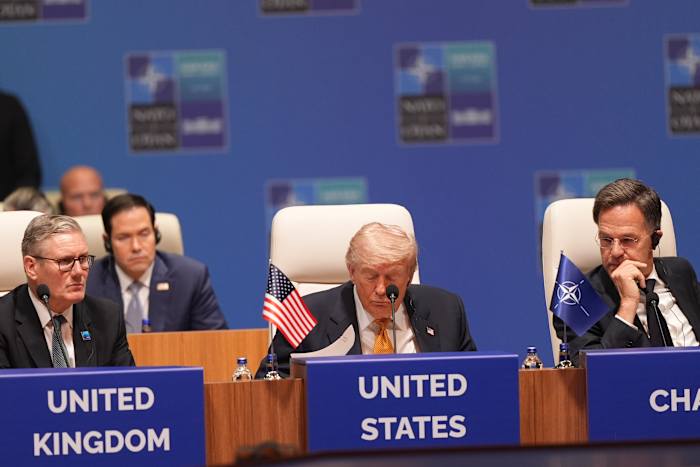
The structural integrity of multilateral alliances does not depend on diplomatic sentimentality, but on the alignment of transactional incentives and clear defense-burden distribution. The July 2026 NATO summit in Ankara demonstrated this reality, as public rhetorical friction gave way to concrete, quantifiable strategic shifts. While superficial commentary focused on the contrast between early executive grievances and subsequent declarations of intra-alliance unity, a rigorous analysis reveals an underlying framework driven by burden-shifting, domestic economic isolationism, and the outsourcing of military production.
The summit produced a dual-track outcome: the reaffirmation of collective defense commitments alongside an explicit reorganization of fiscal and operational accountability. By examining the mechanisms behind these agreements, we can map the true trajectory of Western security architecture.
The Strategic Balance Sheet: Quantifying the Shift in NATO Burden-Sharing
The core tension within the alliance rests on an asymmetrical cost function. Historically, the United States has subsidized European security, a structural imbalance that has become politically unsustainable in Washington. In response, European allies and Canada altered this equation by committing to a $300 billion increase in collective defense expenditures over a two-year period, alongside a newly codified target for national defense budgets to reach 3.5% of Gross Domestic Product (GDP) by 2035.
This fiscal realignment reflects a calculated pivot by NATO leadership to frame alliance participation not as an ongoing American liability, but as a mechanism for collective cost-internalization. The monetization of this strategy is evident in three distinct funding tracks formalized in the summit declaration:
- The European Defense Procurement Surge: Allies announced more than $50 billion in new defense procurements, shifting capital directly into regional military capitalization.
- The Multilateral Deep Strike Missile Initiative: A 12-country commitment was established to jointly develop deep-strike missile systems with operational ranges spanning 300 kilometers to more than 2,000 kilometers, establishing independent deterrent capability.
- The Ukraine Aid Capital Reallocation: A €70 billion ($80 billion) military assistance package was secured for Ukraine for 2026, with a baseline commitment to match these levels in 2027.
The structure of the Ukraine funding mechanism illustrates the evolving parameters of American participation. The total comprises €30 billion annually via an European Union loan framework and €40 billion from non-U.S. NATO allies. Because the current U.S. administration has effectively halted direct domestic spending on Ukraine’s war efforts, the financial burden has been entirely assumed by European capital markets and treasuries. Consequently, the alliance has successfully decoupling its eastern European security operations from the immediate volatility of U.S. congressional appropriations.
The Economics of Localized Deterrence: The Patriot Offshoring Model
The decision to issue a domestic manufacturing license to Ukraine for the production of Patriot air defense systems introduces a fundamental shift in defense supply chain economics. The Patriot system is characterized by long production lead times, high capital costs, and intense global demand. By moving from an export-based supply model to an outsourced domestic manufacturing framework, the strategy changes the operational landscape in two distinct ways.
[Traditional Model] -> U.S. Appropriations -> Domestic Prime Contractors -> Shipping Bottlenecks -> Ukraine Deployment
[Offshored Model]   -> U.S. Intellectual Property IP Licensing -> Ukrainian Localized Production -> Immediate Tactical Deployment
The first outcome is a mitigation of supply chain friction. Bureaucratic bottlenecks and transport vulnerabilities inherent in shipping finished defense products across borders are bypassed by transferring intellectual property and technical manufacturing processes directly to the theater of conflict.
The second outcome is a financial reduction of direct U.S. fiscal liabilities. By empowering Ukraine to manufacture high-demand systems locally, the U.S. limits its role to technology transfer rather than ongoing equipment provisioning, allowing Washington to preserve its own strategic stockpiles.
However, this decentralized production model contains clear systemic limitations. Establishing high-tech aerospace and missile manufacturing capabilities within an active conflict zone carries severe operational risks. The facilities themselves become high-value targets for preemptive strikes, and the timeline required for Ukraine to achieve industrial scale may not meet immediate tactical requirements.
Tactical Isolationism and Transactional Bilateralism
The friction observed early in the Ankara summit highlights a deliberate operational philosophy that treats multilateral treaties as flexible transactional arrangements. This was demonstrated by the enforcement of asymmetric economic penalties against individual alliance members deemed non-compliant with defense spending baselines.
The executive directive to halt all trade and tourism with Spain serves as a direct case study. By isolating Madrid over its rejection of the 3.5% GDP defense spending target and its denial of airspace usage for out-of-area military operations, Washington demonstrated a willingness to disrupt commercial relationships to enforce defense spending minimums. The subsequent softening of rhetoric toward Madrid following closed-door sessions underscores the utility of economic coercion as a tool for rapid policy realignment.
Concurrently, the summit demonstrated how strategic assets are used to reward geopolitical alignment, independent of traditional institutional frameworks. The unilateral announcement that the United States is prepared to lift sanctions on Turkey and restore its eligibility for the F-35 fighter program illustrates this dynamic. By bypassing long-standing institutional objections regarding Ankara's prior acquisition of Russian missile hardware, the move rewards Turkey’s alignment on regional energy corridors and black sea security.
Operational Expansion and Out-of-Area Mandates
The timing of the U.S. retaliatory strikes against Iranian targets, executed immediately after the conclusion of the NATO leaders' dinner, serves as a stark reminder of the widening divergence between American global priorities and NATO's traditional geographic boundaries. The U.S. executive branch has consistently critiqued European allies for failing to secure maritime trade routes through the Strait of Hormuz, viewed by Washington as a shared global economic responsibility.
The subsequent statements by NATO leadership refusing to rule out an expanded operational role in conflicts outside of Europe signal a fundamental evolution of the alliance’s mandate. Historically, NATO has resisted entanglement in Middle Eastern theaters, given the logistical and political fallout from the conclusion of operations in Afghanistan.
By signaling a potential willingness to pivot toward out-of-area contingencies involving Iran, the alliance is attempting to preserve the American security umbrella by adapting to Washington's shifting threat matrix. The strategic play here is clear: European leaders understand that maintaining the validity of the Article 5 mutual defense clause requires a willingness to co-sign American operations in theaters that directly impact global supply chains.
The Strategic Play
To navigate this highly transactional defense environment, corporate and sovereign strategists must discard long-term assumptions regarding institutional stability and pivot toward a framework of localized self-sufficiency.
European nation-states must accelerate the domestic capitalization of their defense industrial bases, prioritizing the acquisition of production licenses over finished hardware imports. The 3.5% GDP defense benchmark must be treated as a baseline condition for economic stability rather than a distant fiscal target, as failure to comply will increasingly result in direct economic and trade retaliation from Washington.
Simultaneously, global defense contractors must reconfigure their corporate strategies around regional technology transfers and joint ventures, optimizing for localized production nodes that can survive the systemic shift toward isolationist trade policies. Multilateral protection is no longer guaranteed by treaty text alone; it must be purchased through verifiable domestic defense expenditures and infrastructure alignment.
For an in-depth analytical perspective on how these shifting defense requirements are reshaping regional manufacturing hubs across eastern Europe, see this Analysis of European Defense Infrastructure which outlines the operational realities of shifting production capabilities closer to active frontlines.