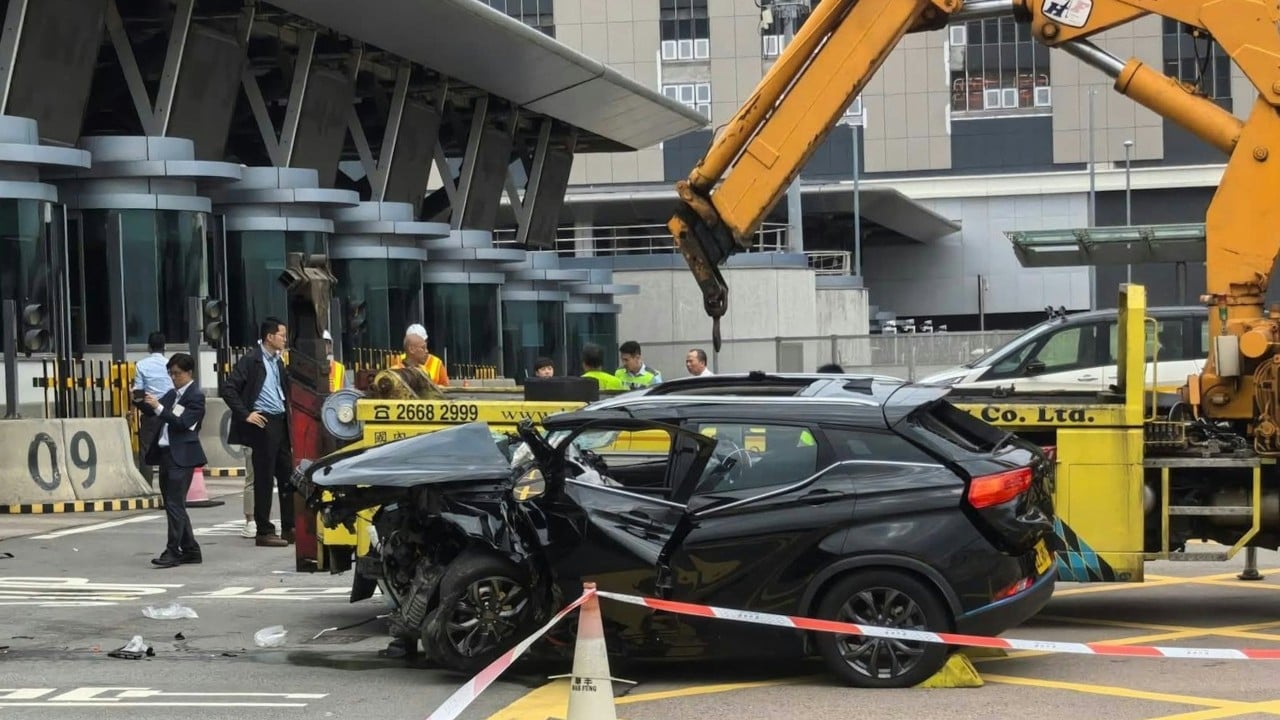
A routine trip across the border turned into a nightmare this morning. A 54-year-old woman is dead after a devastating collision at the Heung Yuen Wai Control Point, and her husband is currently in police custody. This isn't just another traffic report. It’s a wake-up call about the physical and psychological pressures of cross-border driving in Hong Kong.
Around 10:00 AM, a private car reportedly slammed into a concrete pillar near the passenger drop-off area of the border checkpoint. The impact was severe. The front of the vehicle was crushed beyond recognition. Rescuers found the female passenger unconscious and trapped in the wreckage. While paramedics rushed her to Prince of Wales Hospital in Shatin, she was pronounced dead shortly after arrival. Her 59-year-old husband, the driver, survived with minor injuries but was promptly arrested on suspicion of dangerous driving causing death.
The chaos at Heung Yuen Wai
If you've been to the Heung Yuen Wai Control Point lately, you know it’s a high-stakes environment. It’s the first land boundary control point in Hong Kong with direct access for both private cars and pedestrians. Since its full commissioning for passenger clearance, the volume of traffic has surged. People are in a rush. They’re navigating complex lanes, dealing with customs stress, and often driving long distances before they even reach the gate.
The specific spot of the crash—the drop-off zone—is notoriously hectic. You have cars merging, passengers unloading luggage, and drivers trying to find their bearings. One split second of distraction is all it takes. In this case, the car hit a structural pillar with enough force to kill. This suggests speed or a total loss of control was involved. It's a grim reminder that even in "slow" zones like checkpoints, the stakes are life and death.
Why border checkpoints are surprisingly dangerous
Driving at a border isn't like driving on the highway. It’s a series of stop-and-go movements punctuated by sudden bursts of acceleration. You're constantly checking mirrors for pedestrians and other vehicles darting in and out of lanes.
Psychologically, drivers are often at their limit here. Maybe they're worried about the time. Maybe they're stressed about the paperwork or the cargo they're carrying. Fatigue plays a massive role too. If you've been driving for hours through Guangdong to get to the Hong Kong side, your reaction times aren't what they should be.
Local police are now investigating whether mechanical failure or human error caused the car to veer into the pillar. They've cordoned off the area, and the crumpled vehicle has been towed for a forensic examination. But the immediate takeaway is clear. We're seeing more of these accidents because the infrastructure is struggling to keep up with the sheer density of human impatience.
The legal fallout of dangerous driving causing death
In Hong Kong, "Dangerous Driving Causing Death" is one of the most serious charges a motorist can face. Under the Road Traffic Ordinance (Cap. 374), the courts don't look at whether you intended to hurt someone. They look at whether your driving fell far below what would be expected of a competent and careful driver.
If convicted, the driver faces a maximum fine of $50,000 and imprisonment for up to 10 years. They also face a mandatory disqualification from driving for at least five years. For a husband who just lost his wife, the legal consequences are secondary to the emotional trauma, but the law doesn't make exceptions for grief.
We see this pattern often. A driver makes a risky maneuver to save two minutes. They think they're in control. They aren't. When a death occurs, the police have no choice but to make an arrest to secure evidence and start the formal inquiry.
Staying safe when crossing the border
You can't control how other people drive at Heung Yuen Wai, but you can control your own bubble. The biggest mistake people make at checkpoints is treating the drop-off zone like a parking lot. It isn't. It's an active roadway with unique hazards.
- Kill the distractions. Put the phone away before you even enter the checkpoint perimeter. Don't look at your travel documents while the car is in motion.
- Watch for the pillars. Many newer checkpoints use heavy concrete supports that aren't always padded or highly visible in certain lighting.
- Don't rush the drop-off. It’s better to wait thirty seconds for a clear spot than to squeeze into a tight space near pedestrian traffic.
- Check your vehicle. Mechanical failures, like brake issues or tire blowouts, are magnified in tight, crowded spaces.
The investigation into this specific tragedy will take weeks. Experts will analyze the skid marks—or lack thereof—and check the car’s internal computer data. For now, the Heung Yuen Wai Control Point remains a scene of mourning. If you're heading toward the border this week, expect delays and heightened police presence. More importantly, take a breath. No border crossing is worth a life.
Check your mirrors. Slow down. Stay focused.