The human wrist is a marvel of biological engineering. It contains eight tiny carpal bones, a complex web of tendons, and nerves that transmit electrical impulses from the brain in milliseconds. For a surgeon, this intricate machinery is everything. It is the conduit through which life-saving decisions are executed. Now, place that wrist inside a hospital in Shanghai, China. Imagine the patient, a 45-year-old father of two, lying on an operating table in Hyderabad, India.
Between them lies a vast expanse of three thousand kilometers. There are towering mountain ranges, unpredictable weather systems, and geopolitically sensitive borders. More importantly, there is the terrifying concept of latency—the invisible lag of data traveling through fiber-optic cables. In the world of remote surgery, a delay of even half a second can mean the difference between a clean incision and a fatal hemorrhage.
Yet, on a quiet afternoon, history did not care about geography.
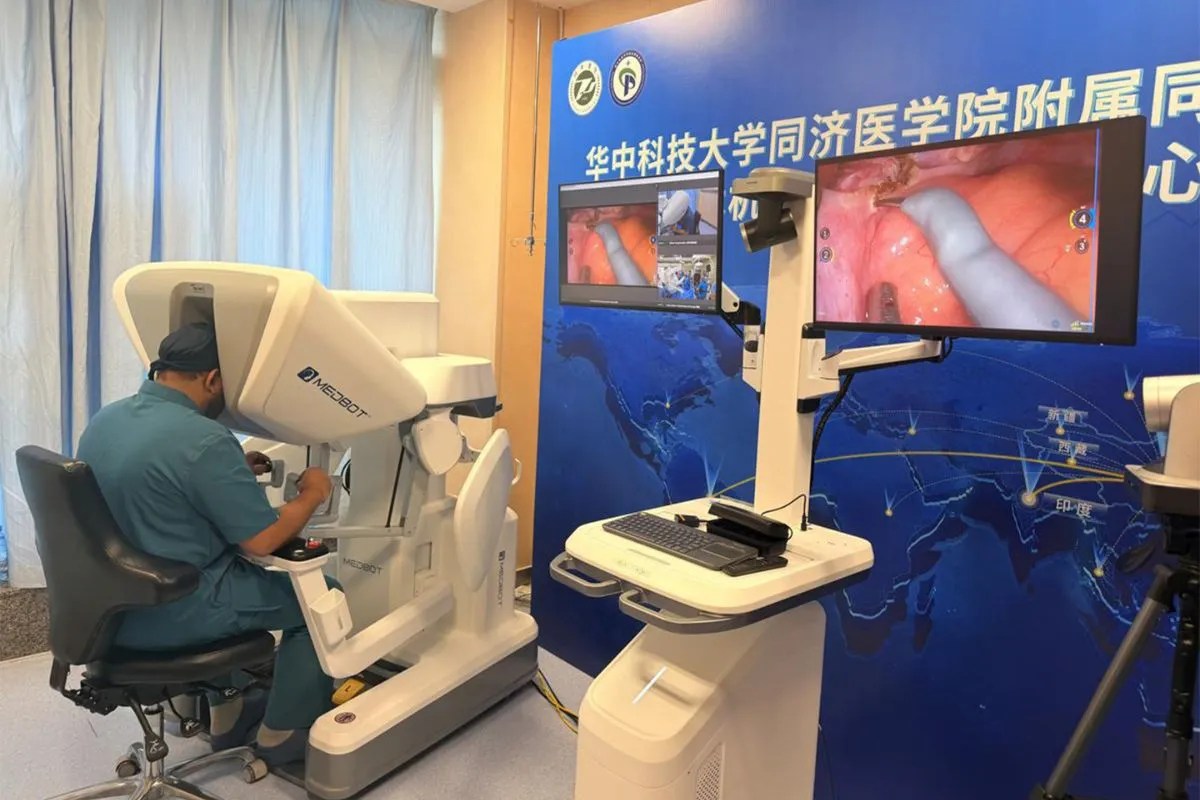
A surgeon sat in a console in China, his eyes locked on a high-definition monitor displaying a crystal-clear, three-dimensional view of a patient’s internal organs thousands of miles away. His fingers moved with practiced grace inside the robotic master controller. In Hyderabad, a corresponding robotic arm mirrored those exact movements with sub-millimeter precision.
Ninety minutes later, the operation was over. The patient was safe. The distance had vanished.
The Ghost in the Machine
To truly understand what happened during those ninety minutes, we have to look past the shiny metal chassis of the surgical robot. We have to look at the invisible infrastructure that kept a man alive.
When a surgeon operates in the same room as a patient, they rely heavily on tactile feedback. They feel the resistance of the tissue. They hear the rhythmic beep of the heart monitor. They can sense the tension in the room. Remote surgery strips away almost all of these sensory cues. It replaces them with data packets.
Every movement of the doctor's hand was translated into lines of digital code. This code was beamed across international data networks, routed through servers, and translated back into mechanical movement in India.
The enemy here is not distance. It is time.
In standard internet communication, a delay of 100 milliseconds is unnoticeable. It is the blink of an eye. But when a robotic scalpel is hovering near a major artery, 100 milliseconds is an eternity. If the doctor sees a bleed on his monitor a fraction of a second after it actually occurs, his corrective movement will arrive late.
To solve this, the engineering team utilized a dedicated, ultra-low-latency 5G network slicing technology. Think of it as creating a private, high-speed highway through the congested jungle of the global internet. No Netflix streams, no video calls, no financial transactions were allowed on this digital path. It was reserved solely for the binary pulses carrying a human being's chance at survival. The actual latency achieved was less than 30 milliseconds.
The human brain perceives anything under 50 milliseconds as instantaneous. For the doctor in China, it felt as though he was standing right there in Hyderabad.
The Cold Reality of the Waiting Room
Step away from the technology for a moment. Walk down the sterile corridors of the Hyderabad hospital and enter the waiting room.
This is where the true weight of innovation is felt. For the family of the patient, the technical specifications of a 5G network mean absolutely nothing. They do not care about data packets, bandwidth, or robotic degrees of freedom. They care about a husband, a father, a son.
When they were first told that the specialist executing the procedure would not be in the building, or even in the country, fear was the natural response. It sounds like science fiction, and not the comforting kind. It sounds risky. It feels disconnected.
"How can someone save my life if they can't even look me in the eye?"
This is a question that medical professionals face constantly as we move deeper into the era of telemedicine. It highlights a profound vulnerability. We are being asked to trust our lives to an invisible digital thread.
But consider the alternative. The patient required a highly specialized surgical technique that only a handful of doctors worldwide could perform with high success rates. In the past, this would mean weeks of logistical nightmares. Visas, expensive international flights, the physical toll of traveling while gravely ill, and the agonizing delay in treatment. Sometimes, time runs out before the logistics are sorted.
The technological leap did not distance the doctor from the patient. It brought the world's best expertise directly to a bedside that would have otherwise been unreachable.
The Anatomy of Ninety Minutes
The clock started ticking at precisely 2:00 PM.
The surgical team in Hyderabad had already prepared the patient, making the initial small incisions to allow the robotic arms access to the abdominal cavity. They stood around the table, not as primary surgeons, but as a highly trained support squad, ready to intervene manually if the connection dropped for even a moment.
That is the hidden anxiety of this milestone. The constant, nagging question: What if the screen goes black?
Fail-safes were layered upon fail-safes. Two independent internet service providers were used simultaneously. If one route failed, the data would instantly reroute through the other without losing a single frame of video. The robotic system itself possessed built-in artificial intelligence capable of instantly pausing all mechanical movement if it detected a connection anomaly, ensuring the instruments would freeze safely rather than move erratically.
In China, the surgeon wiped a bead of sweat from his forehead. He gripped the controllers.
The procedure required the removal of a precisely targeted mass, nestled precariously near a cluster of blood vessels. On the screen, the tissue appeared massive, magnified several times in high definition. The surgeon’s hands moved smoothly. In Hyderabad, the robotic instruments, shaped like tiny, elegant hands, snipped and sutured with absolute calm.
There was no drama. No sudden alarms. No frantic shouting. True medical triumphs are often surprisingly quiet. They are the result of thousands of hours of testing, simulation, and meticulous planning condensing into ninety minutes of flawless execution.
Breaking the Geography Curse
For centuries, human health has been dictated by the lottery of birth.
If you are born in a major metropolitan area with world-class medical centers, your chances of surviving a complex illness are statistically high. If you are born in a remote village, a secondary town, or a country with developing medical infrastructure, the odds shift dramatically against you.
This successful operation between China and India shatters that paradigm. It proves that physical presence is no longer a prerequisite for world-class healthcare.
Imagine a near future where a specialist in New York can operate on a soldier in a field hospital in the middle of a conflict zone. Imagine a surgeon in Tokyo performing a delicate pediatric procedure on a child in a rural African clinic. The geographic boundaries that have defined human mortality for generations are beginning to blur.
+--------------------------------------------------------------+
|                    THE TELE-SURGERY PIPELINE                 |
+--------------------------------------------------------------+
|  [Surgeon Console (China)]                                   |
|            |                                                 |
|            v (Hand movements converted to digital data)      |
|  [Dedicated 5G Network Slice]                                |
|            |                                                 |
|            v (3,000 km transit at <30ms latency)             |
|  [Robotic Receiver (Hyderabad)]                              |
|            |                                                 |
|            v (Data converted back to physical movement)      |
|  [Patient Operation]                                         |
+--------------------------------------------------------------+
We are not just talking about convenience. We are talking about the democratization of expertise. The knowledge locked inside the minds of the world’s greatest medical authorities is no longer trapped by the physical limitations of their travel schedules.
The Human Residue
As the anesthesia began to wear off in the Hyderabad recovery room, the patient opened his eyes. He saw the familiar faces of his local doctors. He felt the dull ache of healing incisions.
A few hours later, via a simple video call on a tablet, he spoke to the man who had guided the scalpel from three thousand kilometers away. The language barrier was bridged by a translator, but the expression of gratitude needed no translation.
Technology is often accused of coldness. We worry that automation and digitalization are stripping away the human touch, turning us into data points on a spreadsheet. But in this quiet recovery room, the exact opposite was evident. Technology had served as the ultimate bridge, connecting two human beings across an ocean of distance, purely for the purpose of preservation.
The machinery will get smaller. The networks will get faster. The distances will get longer. But at the center of it all will always remain that fundamental human drive: the refusal to let distance dictate who lives and who dies.