The silence at 4,000 meters isn’t empty. It is a heavy, pressurized thing, filled with the sound of your own pulse drumming against your temples. Up here, where the air in the Central Andes thins into a cold, blue haze, the world feels permanent. The ice looks like the bone of the earth itself—ribs of white frozen into the creases of the brown rock.
But permanence is a lie we tell ourselves to sleep better at night.
Down in the valleys of San Juan and Mendoza, the water coming out of the tap is ancient. It started as a snowflake centuries ago, landing on a glacier, pressing into ice, and waiting for the sun to call it down. In Argentina, this is not just geology. It is life. It is the wine in your glass, the fruit on your table, and the survival of cities built in the rain shadow of the world’s longest mountain range.
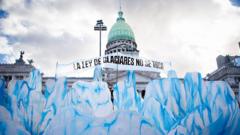
A few months ago, the legal shield protecting these ice giants began to crack.
Argentina’s legislature passed a sweeping reform bill that significantly narrowed the definition of what a protected glacier actually is. On paper, it looks like a bureaucratic adjustment. In reality, it is an invitation for drills and dynamite to move into the high-altitude nurseries of the continent’s water supply.
The Invisible Reservoir
Most people think of a glacier as a massive, glowing blue wall of ice—the kind you see in postcards from Patagonia. Those are the celebrities of the cryosphere. They are beautiful, they are shrinking, and they are easy to love.
However, the real workhorses of the Andes are the ones you wouldn't even recognize as ice. These are the periglacial environments: rock glaciers. To the untrained eye, they look like nothing more than a messy pile of rubble flowing slowly down a mountain slope. But beneath that layer of stone lies a core of pure, frozen water, insulated from the sun.
These rock glaciers are the bank accounts of the desert. When the surface glaciers melt away in the heat of a dry summer, the rock glaciers keep dripping. They are the "base flow" of the rivers. They are the reason a farmer in the valley can still water his crops during a ten-year drought.
The new legislation strips protection from many of these periglacial areas. By redefining the criteria for what constitutes a protected zone, the government has effectively moved the boundary lines to accommodate the mining industry. If the ice isn't "active" enough or "large" enough by the new legal metrics, it is no longer off-limits.
The Weight of Gold
Consider a hypothetical engineer named Mateo. He works for a multinational mining conglomerate. Mateo isn't a villain; he’s a man with a mortgage and a deep understanding of copper and gold. He knows that the transition to green energy—the electric cars and solar grids the world is screaming for—requires an astronomical amount of copper.
He also knows that some of the richest deposits of that copper sit directly beneath the periglacial rock glaciers of the Andes.
This is the agonizing paradox. To save the planet from carbon, we are tempted to sacrifice the very frozen reservoirs that keep specific regions habitable. Mateo’s company argues that they can "mitigate" the damage. They talk about moving ice or compensating for water loss.
But you cannot move a rock glacier any more than you can move a forest and expect the birds to stay.
The mining process in these high-altitude deserts is thirsty. It requires millions of liters of water to process ore. When a mine sits at the headwaters of a catchment area, it doesn't just threaten to use the water; it risks contaminating the source for everyone downstream. Acid mine drainage is a ghost that haunts a watershed for generations.
The Farmer’s Ledger
Drive six hours down from the high peaks and the temperature climbs forty degrees. Here, the ground is cracked and white with salt. This is where the narrative of the "frozen north" meets the reality of the dinner table.
Lucia is a third-generation grape grower. She doesn't read the official gazette every morning, but she reads the river. She knows the height of the stream by the way it sounds against the stones of the irrigation canal. For the last decade, that sound has been getting quieter.
"The mountain is tired," she says, gesturing toward the horizon.
For Lucia, the loosening of the glacier law isn't a debate about economic development versus environmentalism. It is a debate about who gets to exist in fifty years. When the mining companies argue that their projects will bring jobs and "robust" investment to impoverished provinces, Lucia looks at her vines. You can't drink copper. You can't eat gold.
The law was originally passed in 2010 after a brutal political battle. It was a landmark piece of legislation, one of the first in the world to give legal personhood, in essence, to ice. It recognized that glaciers were not just scenery, but strategic reserves. The recent reversal suggests that under the pressure of a collapsing national economy and a desperate need for foreign currency, the strategic reserve is being cashed in.
The Myth of the Trade-off
We are told we have to choose. We are told that a country with 50% poverty cannot afford the luxury of "untouchable" mountains. It is a seductive argument. It pits the immediate hunger of a child today against the thirst of a child tomorrow.
But the math doesn't hold up.
Glaciers are not a renewable resource on a human timescale. Once a rock glacier is excavated to reach the copper beneath it, that water storage capacity is gone. It took ten thousand years to build. It will not come back because a corporate social responsibility report says it will.
The stakes are invisible because they are slow. A mine doesn't blow up a glacier in a single day. It happens through the "death by a thousand cuts" of access roads, dust settling on the ice and absorbing heat, and the gradual lowering of the water table. By the time the impact is undeniable, the ore is gone, the company has moved on, and the valley is a graveyard of dry wells.
The air in the high Andes is so clear it feels like it might break if you speak too loudly. Standing there, looking at the wrinkled skin of the mountains, you realize that the ice is the only thing keeping the desert from reclaiming the cities.
The law has changed, but the physics of the mountain have not. The sun will still shine, the ice will still melt, and the rivers will eventually run dry if we continue to treat our life-support systems like a line item on a quarterly earnings report.
The wind picks up, carrying the scent of dry stone and old snow. Far below, the lights of the towns are beginning to flicker on, oblivious to the fact that their survival depends on a pile of rocks and ice that a group of men in a faraway city just decided was no longer worth protecting.
The mountain doesn't care about legislation. It only knows how to give what it has. And once it is empty, it will be silent forever.