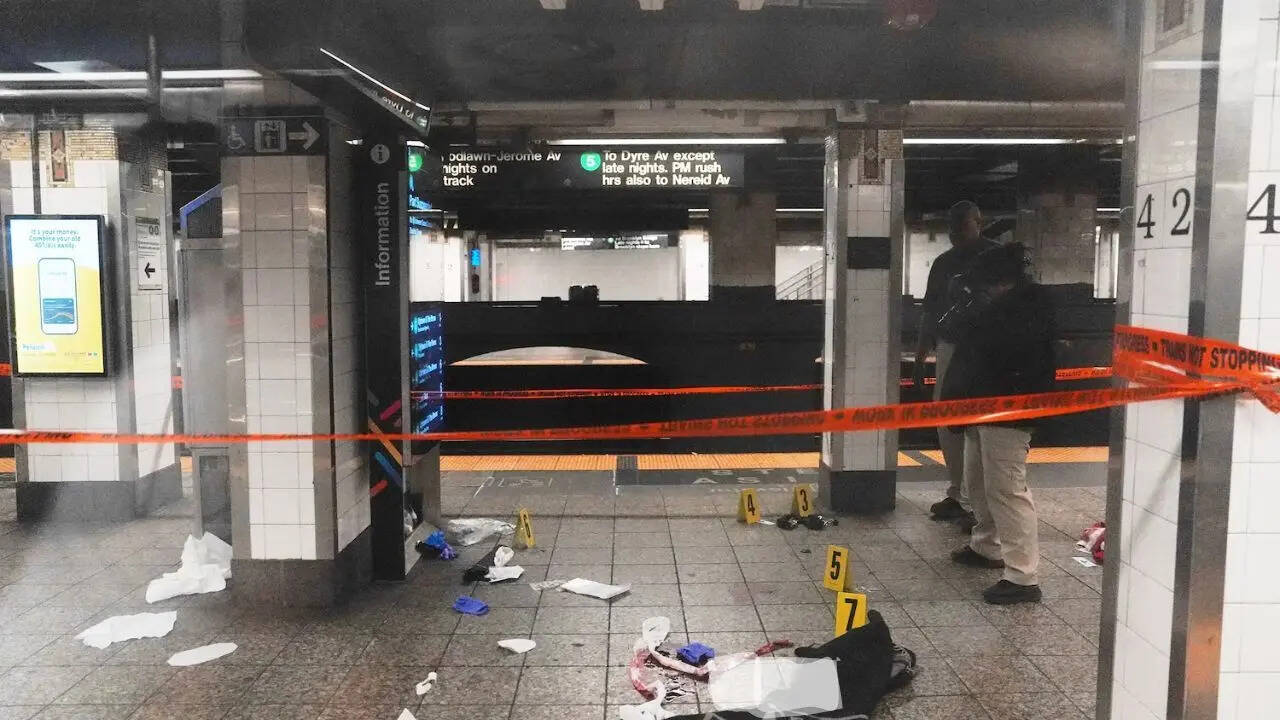
The standard narrative of urban violent encounters often reduces complex tactical failures to a binary of "incident" and "response." This framework is insufficient for understanding the lethal intersection of edged-weapon aggression and law enforcement intervention. In the specific context of the New York knife attack involving three casualties and the subsequent neutralisation of the suspect by police, the event serves as a case study in the compression of the decision-making OODA loop (Observe, Orient, Decide, Act). The failure of de-escalation in this environment is not a moral lapse but a byproduct of physiological and spatial constraints that render traditional negotiation impossible.
The Kinematics of Edged-Weapon Engagement
The primary variable in these encounters is the "Tueller Drill" distance, a concept that defines the reaction-gap threshold. In an urban environment, this threshold is often compressed below the 21-foot standard. When a suspect possesses an edged weapon, the lethal threat is constant and requires zero reload time, unlike a firearm. The suspect in this engagement managed to injure three individuals before law enforcement could establish a perimeter, indicating a failure of early-stage situational detection or a high-density environment that masked the initial draw.
The Spatial Compression Variable
Urban density acts as a force multiplier for a knife-wielding assailant. The presence of bystanders creates a "target-rich" environment while simultaneously restricting the clear lines of fire necessary for law enforcement to deploy kinetic force safely.
- The Proximity Hazard: An edged weapon does not malfunction or jam. Its efficacy is limited only by the physical reach and speed of the user.
- The Decision Gap: Officers must distinguish between a non-compliant individual and an active lethal threat within milliseconds. The transition from verbal commands to lethal force is often dictated by the suspect's sudden acceleration toward a third party or the officer.
- The Backstop Risk: In high-traffic areas, every shot fired by police carries a high probability of collateral hit-risk. The decision to use a firearm in this scenario suggests that the immediate threat to life surpassed the statistical risk of stray rounds.
The Failure Modes of Non-Lethal Alternatives
Critiques of police use of force often cite the absence of TASERs or pepper spray as a failure. However, tactical reality dictates that these tools have specific "failure envelopes." A TASER requires two probes to make contact and complete a circuit; if the suspect is wearing heavy clothing or moving erratically, the failure rate increases significantly. In a situation where three individuals have already been wounded, the risk-reward ratio for non-lethal tools shifts toward lethal force. The objective transitions from "apprehension" to "immediate cessation of hostilities."
The Biological Reality of Aggression
The suspect's ability to injure three people suggests a high level of physiological arousal or potentially a state of "excited delirium." In such states, the neurological pain-response is often dampened. Traditional compliance techniques (joint locks, pressure points) are ineffective.
- Adrenaline-Induced Persistence: A suspect may continue to attack even after sustaining fatal wounds due to the lag between physiological damage and circulatory collapse.
- The Reactionary Gap: By the time an officer perceives a lunge, the suspect has already covered half the distance. This is the "action beats reaction" axiom.
Structural Breakdown of Incident Escalation
The progression of this specific event follows a predictable sequence of failure points in public safety infrastructure.
The Early Warning Deficit
The interval between the first injury and the arrival of police represents the "vulnerability window." In high-density urban zones, this window is widened by the chaos of the crowd. Initial reports are often confused, describing a "fight" rather than an "active stabbing," which affects the tactical mindset of responding units.
The Lethal Force Threshold
Once the suspect was confronted, the transition to lethal force was likely triggered by a "commitment move"—a physical gesture indicating a direct attack on officers or a refusal to drop the weapon while closing distance. The use of firearms in this context is the final layer of a failed security stack.
- Systemic Failure: Mental health intervention or previous criminal justice interactions failed to remove the threat from the environment.
- Operational Failure: The immediate area was not secured before the suspect could engage multiple victims.
- Tactical Success: The use of force effectively ended the threat, preventing the casualty count from moving from three to four or more.
The Psychological Burden of High-Stress Neutralisation
The physiological response of the responding officers—specifically the "fight or flight" activation—leads to tunnel vision and auditory exclusion. The decision to fire is rarely a calculated choice in the moment; it is a conditioned response to a specific stimulus (the knife crossing a certain plane of movement). This explains why multiple rounds are often fired in a short burst. The brain requires time to process that the threat has stopped moving.
Operational Adjustments for Municipal Safety
The frequency of these incidents suggests that current urban patrol strategies are reactive rather than predictive. To decrease the lethality of these encounters, a shift in "threat-detection architecture" is required.
- Tactical Decoupling: Separation of first responders into those equipped for high-intensity violence and those for mental health crises. However, as seen in this case, the overlap is often immediate and lethal.
- Visual Analytics Integration: Leveraging existing CCTV to identify "pre-attack indicators" (specific pacing, weapon concealment postures) before the first strike occurs.
- Public Awareness of the Reaction Gap: Educating the public on the reality that "non-lethal" is not a universal solution for active-stabbing scenarios.
The immediate requirement for urban law enforcement agencies is the refinement of the "transition drill"—the physical act of switching from a non-lethal posture to a lethal one when a suspect closes the 21-foot gap. Until municipal infrastructure can address the root causes of spontaneous violent outbursts, the tactical burden remains on the individual officer to act as the final, violent barrier between an armed suspect and the public. The focus must remain on reducing the "time-to-neutralisation" to zero, as every second of delay in these environments is measured in human blood.