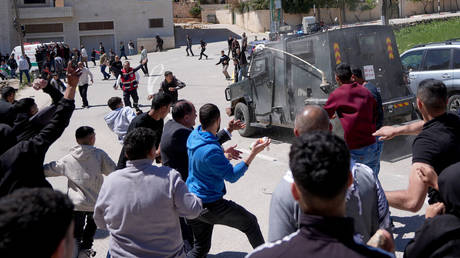
The persistence of settler violence in the West Bank is not a series of spontaneous, isolated outbursts but a functional component of a broader territorial strategy. To analyze this phenomenon through a purely criminal lens obscures the strategic utility of these actions. Instead, the interaction between settler groups and the Israeli state apparatus must be understood as a dual-track system of territorial acquisition. While the state operates through formal legal and bureaucratic channels—zoning, military orders, and administrative declarations—non-state actors provide a high-pressure kinetic force that accelerates Palestinian displacement from rural land. This synergy creates a "displacement engine" that operates with lower political friction than formal state-led annexation.
The Triad of Territorial Displacement
The mechanics of land control in Area C rely on three distinct but reinforcing pillars. When these pillars align, the cost of Palestinian residency becomes unsustainably high, leading to voluntary or forced migration. For an alternative look, check out: this related article.
1. Regulatory Asymmetry
The Israeli Civil Administration maintains exclusive authority over planning and construction in Area C. By rejecting approximately 99% of Palestinian building permit applications, the state creates a legal vacuum. Any structure built by Palestinians—homes, water cisterns, or solar panels—is classified as "illegal" and subject to demolition. This regulatory ceiling prevents natural demographic expansion and infrastructure development, making communities fragile before any physical violence occurs.
2. Kinetic Attrition
Non-state actors (settlers) introduce physical risk into the daily economic life of Palestinian rural communities. This attrition targets the three primary modes of Palestinian livelihood: Similar insight on the subject has been shared by NPR.
- Pastoral Access: Interdicting shepherds from reaching traditional grazing lands through physical intimidation or the establishment of "illegal" outposts (often sheep farms).
- Agricultural Sabotage: The destruction of olive groves or irrigation systems, which represents a direct hit to long-term capital assets.
- Domestic Terror: Direct attacks on residential structures, designed to break the psychological link between the resident and the land.
3. State-Sanctioned Impunity
The effectiveness of kinetic attrition depends on the absence of a credible deterrent. Data from human rights monitors consistently show that over 90% of investigations into settler violence are closed without an indictment. This lack of accountability functions as a tacit subsidy for violence. When the military fails to intervene—or provides security cover for the actors—it signals to the non-state groups that their actions align with the state’s broader geopolitical objectives.
The "Fait Accompli" Framework of Outpost Expansion
The strategic value of an "illegal" outpost lies in its ability to claim land faster than the formal legal system. An outpost starts as a minimal footprint: a mobile home, a water tank, and a handful of individuals. However, the operational radius of that outpost is significantly larger than its physical site.
By deploying "farm outposts," small groups can claim thousands of dunams of grazing land. This is a low-cost, high-leverage tactic. The state often provides these outposts with basic infrastructure—roads, electricity, and military protection—despite their lack of formal permits. Eventually, these outposts undergo "retroactive legalization," a process where the state formally recognizes the settlement once it has achieved a certain level of permanence. This creates a cycle where the non-state actor takes the initial legal and international reputational risk, and the state later consolidates the territorial gain.
Economic Degradation as a Catalyst for Displacement
The analysis of settler pogroms must quantify the economic impact on Palestinian communities. The goal of the violence is rarely the total physical elimination of the population; it is the destruction of the economic viability of staying.
The Cost of Survival
When a community loses access to its grazing land, it must pivot from free-range grazing to purchasing expensive fodder. This shift dramatically increases the cost of livestock maintenance, often leading to the liquidation of herds. For a pastoral society, the loss of the herd is the loss of the primary wealth-generating asset. Once the economic base is destroyed, the community becomes "internally displaced," moving into Areas A or B to find wage labor, effectively clearing Area C for further settlement.
Infrastructure Chokepoints
Violence often targets shared infrastructure. The destruction of a single water pipeline or the blocking of a primary access road can isolate a village. The time and capital required to repair these assets are often prohibited by the aforementioned regulatory asymmetry. The state might refuse to allow repairs, citing the lack of permits, thereby finalizing the displacement initiated by the non-state actor.
The Logic of Military Neutrality
A critical misconception in standard reporting is that the Israeli Defense Forces (IDF) are simply failing to do their jobs during settler attacks. A more rigorous analysis suggests that the military’s mandate is inherently conflicted. The IDF’s primary mission in the West Bank is the protection of Israeli citizens. When a settler (a citizen) engages in violence against a Palestinian (a protected person under international law), the military often prioritizes the safety of the citizen or avoids internal political friction by not arresting the settler.
This "protective umbrella" transforms the military from a neutral arbiter of order into a passive enabler of expansion. The soldiers on the ground are often caught between legal obligations to protect civilians and the political reality that their superiors—and the government ministers overseeing them—support the settlers' presence.
Strategic Divergence: Official Rhetoric vs. Operational Reality
While the Israeli government may issue occasional condemnations of "vigilantism" to satisfy international diplomatic requirements, the operational reality on the ground remains unchanged. The divergence is maintained through a complex web of departmental responsibilities:
- The Ministry of Defense: Oversees the Civil Administration and the military.
- The Ministry of Settlement and National Missions: Funds the expansion and provides resources to outposts.
- The Ministry of National Security: Controls the police, who are responsible for investigating settler crimes.
When these three ministries are aligned under a pro-expansionist ideology, the check-and-balance system fails. The police do not investigate, the military does not intervene, and the Civil Administration provides the infrastructure.
Quantifying the Threshold of Irreversibility
The ultimate objective of this dual-track policy is to reach a "threshold of irreversibility." This is a point where the demographic and infrastructural reality in Area C is so overwhelmingly skewed toward Israeli control that a Palestinian state becomes geographically impossible.
The metrics for this threshold include:
- The Ratio of Settlers to Palestinians in Area C: Currently, there are roughly 500,000 settlers to 300,000 Palestinians.
- The Percentage of Contiguous Land: The fragmentation of Palestinian enclaves through the strategic placement of outposts.
- The Infrastructure Integration: The degree to which settler roads and utilities are integrated into the main Israeli grid, making them permanent fixtures.
The Internal Political Economy of Violence
Settler violence also serves an internal Israeli political function. It radicalizes the frontier, creating a constituency that is ideologically committed to the land and willing to exert pressure on the central government. This constituency acts as a "veto group," ensuring that no government can realistically negotiate a withdrawal from the West Bank without risking significant internal civil unrest or the collapse of the governing coalition.
The violence, therefore, is a signaling mechanism. It signals to the Palestinian population that the state will not protect them, and it signals to the Israeli political center that the cost of evacuation is too high.
Geopolitical Friction and Buffer Zones
The international community generally responds to settler violence with verbal condemnation but lacks a mechanism for enforcement. The "pogrom" style attacks in places like Huwara or Turmus Ayya serve to test the boundaries of international tolerance. If the response remains limited to rhetoric, the "normative floor" for what is acceptable behavior shifts.
Each attack creates a temporary buffer zone. Fearful of the next escalation, Palestinian residents limit their movements, effectively ceding territory without a single shot being fired by a formal soldier. This "psychological fencing" is the most efficient form of territorial expansion because it requires no physical barriers or standing guards; it only requires the memory of violence and the certainty of its recurrence.
The Terminal Strategic Play
The current trajectory points toward a total administrative and demographic takeover of Area C. For analysts and policymakers, the focus must shift from "preventing violence" to "altering the incentive structure." As long as the territorial gains from settler violence exceed the diplomatic and legal costs to the Israeli state, the violence will continue.
The state has successfully outsourced the "dirty work" of displacement to ideological actors, allowing it to maintain a degree of plausible deniability on the international stage while reaping the territorial benefits. To interrupt this cycle requires a direct imposition of costs on the state itself, making the dual-track system a liability rather than an asset. Without a fundamental change in the cost-benefit analysis, Area C will continue to be absorbed into the Israeli state, one outpost and one displaced community at a time.