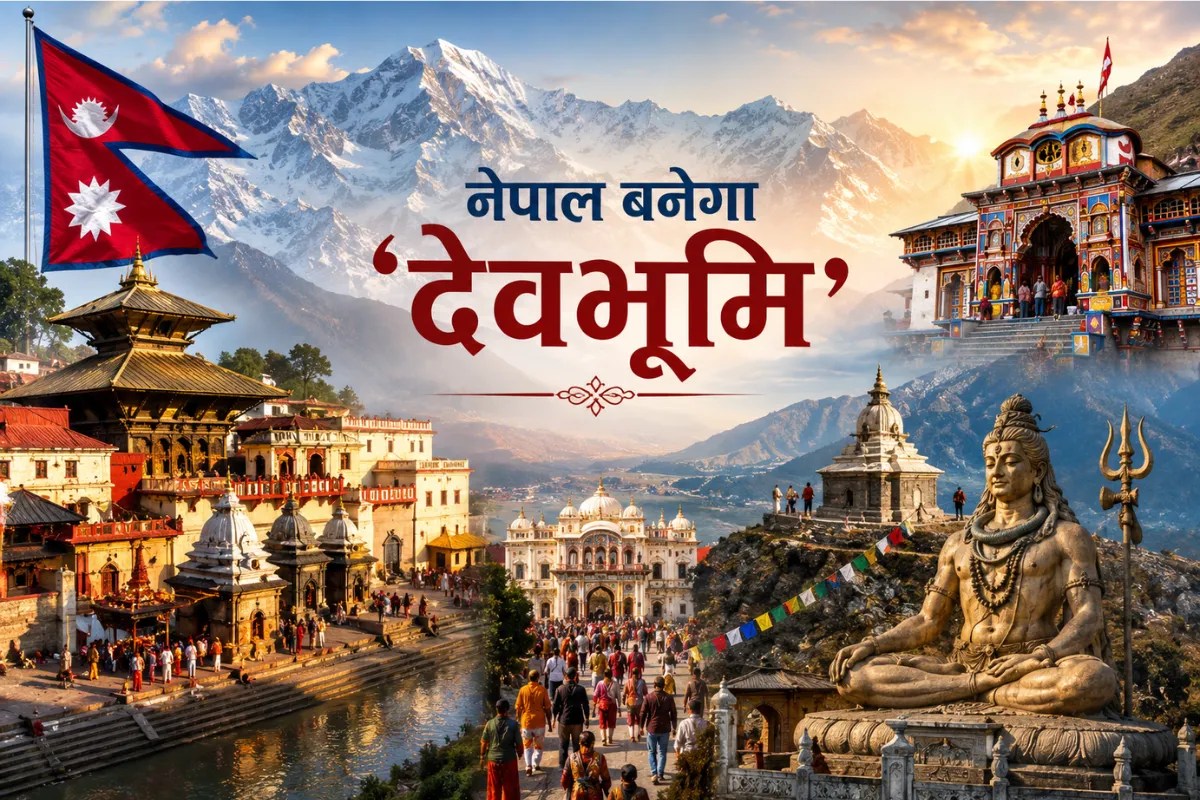
Nepal is transitioning from a passive beneficiary of geographical religious proximity to an active architect of a spiritual tourism economy. While historical narratives have long labeled the nation as "Devbhoomi," the current "Devbhoomi Mission" represents a pivot toward quantifying and commodifying the metaphysical. To understand the viability of this shift, one must analyze the intersection of three critical variables: religious soft power, infrastructure-driven accessibility, and the diversification of the high-net-worth spiritual traveler segment.
The Tri-Node Core of Nepal's Spiritual Value Proposition
The competitive advantage of Nepal in the global spiritual market is not merely rooted in the presence of sacred sites but in the concentration of high-density religious nodes within a manageable geographic radius. The Devbhoomi Mission attempts to formalize these nodes into a structured economic circuit.
- The Pashupatinath-Muktinath Axis: This represents the Vedic-Shaivite corridor. For the Indian diaspora and domestic markets, this axis functions as a non-negotiable pilgrimage requirement. The logic here is "Spiritual Necessity," which creates inelastic demand—travelers will visit regardless of price fluctuations if the access exists.
- The Lumbini Quadrant: As the birthplace of Siddhartha Gautama, Lumbini serves as the primary gateway for the East Asian and Southeast Asian Buddhist markets. This node operates on "Historical Authenticity." Unlike modern meditation retreats in the West, Lumbini offers a direct link to foundational Buddhist history.
- The Himalayan Hermitage Model: This covers the high-altitude regions (Manang, Mustang, and the Everest trail) which are being repositioned from trekking zones to "Vedic Energy Centers." This segment targets the wellness and mindfulness industry, which seeks isolation and environmental purity.
Capital Inflow and the Infrastructure Bottleneck
The success of a spiritual hub is mathematically linked to the "friction of travel." Historically, Nepal’s spiritual assets were stranded assets—historically significant but economically under-performing due to the high cost and physical risk of access. The Devbhoomi Mission addresses the cost function of travel through three specific infrastructure interventions.
International Gateway Expansion
The reliance on Kathmandu’s Tribhuvan International Airport (TIA) created a centralized bottleneck. The operationalization of Gautam Buddha International Airport in Bhairahawa (near Lumbini) and Pokhara International Airport changes the logistical calculus. By bypassing Kathmandu, the mission reduces the "time-tax" on pilgrims. A direct flight to Bhairahawa converts a three-day overland journey from India or a multi-leg international flight into a single-day entry.
The Connectivity Multiplier
Religious tourism in Nepal suffers from "single-site stagnation." Travelers visit one site and depart. The strategy now involves the "Circuity Model"—linking Pashupatinath (Kathmandu), Janakpur (the Mithila region), and Muktinath (Mustang) via improved road networks and domestic flight frequency. When the friction of moving between these sites decreases, the average length of stay (ALoS) increases.
Digital Layering and Managed Experiences
The mission incorporates a digital governance framework to manage the "Sacred Capacity." Overcrowding at sites like Pashupatinath during Maha Shivaratri degrades the brand value. By implementing digital ticketing and queue management systems, the mission attempts to professionalize the experience, moving it from chaotic pilgrimage to "managed spiritual tourism."
The Economic Transition from Pilgrimage to Spiritual Wellness
A critical distinction must be made between a "pilgrim" and a "spiritual tourist." A pilgrim often seeks low-cost, high-frequency access and contributes minimally to the secondary service economy (hotels, high-end dining, guided tours). The Devbhoomi Mission is strategically aiming at the "Spiritual Tourist"—individuals seeking luxury wellness, yoga retreats, and academic immersion.
The conversion of this segment depends on the Quality of Service (QoS) Index:
- Accommodations: The shift from basic dharamshalas to five-star eco-resorts in Mustang and the Kathmandu Valley.
- Curated Content: Moving beyond simple sightseeing to providing "Experiential Knowledge," such as guided Vedic philosophy sessions or monastic immersion programs.
- Safety and Standards: Standardizing the pricing and safety of helicopter rescues and high-altitude health services to de-risk the experience for older, wealthier demographics.
Geopolitical Synergy and the Indian Market Variable
Nepal’s spiritual mission is inextricably linked to the "Religious Circuit" development in India. The integration of the Ramayana Circuit (connecting Ayodhya to Janakpur) and the Buddhist Circuit (connecting Bodh Gaya to Lumbini) represents a cross-border economic engine.
The mechanism here is the Spiritual Spillover Effect. When the Indian government promotes domestic religious tourism, Nepal acts as the natural extension. The Devbhoomi Mission thrives by aligning its marketing and visa policies with these Indian circuits. This creates a symbiotic relationship where the "Devbhoomi" brand is validated by the sheer volume of the Indian middle class and the growing global interest in Indic philosophy.
Structural Risks and The Authenticity Dilution Paradox
No strategy of this scale is without systemic risks. The primary threat to the Devbhoomi Mission is the "Authenticity Dilution Paradox." As a site becomes more accessible and commercially optimized, it risks losing the raw, spiritual gravitas that attracted visitors in the first place.
- Ecological Degradation: Increased footfall in fragile Himalayan ecosystems (like Muktinath) leads to waste management failures and water scarcity. If the environment is compromised, the "Purity" brand of the Himalayas collapses.
- Commercial Over-Saturation: If the focus shifts too heavily toward high-end resorts, the local community and the traditional pilgrim may be displaced, leading to social friction and the loss of the "living culture" that defines Nepal.
- Dependence on Bilateral Stability: Since a majority of spiritual tourists enter via India or are of Indian origin, any diplomatic friction directly impacts the arrival numbers. Diversification into the Chinese Buddhist market and Western wellness markets is therefore a requirement, not an option.
Quantifying Success Beyond Arrival Numbers
To measure the effectiveness of the Devbhoomi Mission, analysts must look past gross arrival statistics and focus on three specific KPIs:
- Revenue Per Visitor (RPV): Is the mission successfully moving the needle from low-spending pilgrims to high-spending spiritual tourists?
- Repeat Visit Rate (RVR): Spiritual destinations often suffer from "one-and-done" syndrome. Success requires creating an environment where the spiritual practice necessitates annual or biannual returns.
- Regional Economic Dispersion: Are the profits of the Devbhoomi Mission staying in Kathmandu, or are they being successfully distributed to the remote regions of Mustang, Janakpur, and Lumbini?
The strategic play for Nepal is the institutionalization of the spiritual experience. By treating "Devbhoomi" as a rigorous economic framework rather than a sentimental label, the nation can secure its position as the global headquarters for Vedic and Buddhist practice. This requires a relentless focus on infrastructure, the professionalization of the hospitality sector, and a sophisticated digital marketing strategy that targets the psychological needs of a stressed, globalized workforce seeking transcendence.
The final phase of this mission must involve the integration of "Spiritual Governance"—creating a regulatory body that ensures the architectural and cultural integrity of sacred sites while facilitating private investment. Without this balance, the mission remains a marketing exercise; with it, Nepal defines the future of the global spiritual economy.