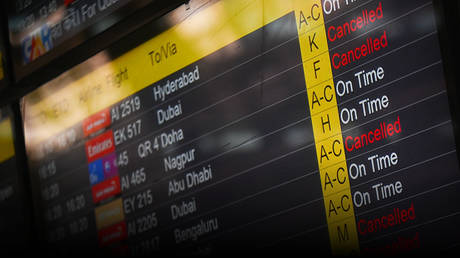
The fragility of the global "hub-and-spoke" aviation model is exposed not by a failure of technology, but by the rigid geometry of restricted airspace. When military escalation closes the corridors over Iran, Iraq, or the Levant, the result is an immediate, non-linear compounding of passenger displacement. For the hundreds of Indian nationals currently stranded in Dubai and other Gulf transit points, the crisis is a byproduct of three specific operational failures: the exhaustion of physical gate capacity, the breach of crew duty-time regulations, and the catastrophic collapse of the "minimum connection time" (MCT) buffer.
The Tri-Node Failure Mechanism
The current displacement is not merely a delay; it is a systemic breakdown across three critical nodes in the aviation value chain. To understand why a missile launch in one sub-region leads to a person sleeping on a floor in Terminal 3, we must deconstruct the physics of the hub.
1. The Geopolitics of Rerouting and Fuel Weight
Aviation is a business of margins, where weight equals cost. Standard flight paths from India to Europe or North America via Dubai typically utilize direct corridors over the Persian Gulf. When these are closed, aircraft must fly "around" the conflict zones—often adding 90 to 150 minutes of flight time.
This introduces a Fuel-Payload Penalty. If an aircraft must carry two extra hours of fuel to bypass a restricted zone, it may exceed its Maximum Takeoff Weight (MTOW). To compensate, the airline must offload "discretionary" weight. In a high-stakes environment, this often means cargo or, in extreme cases, bumping passengers. The stranded Indians are often the victims of this weight-balancing act, where the physical requirement to carry more fuel displaces the ability to carry the person who paid for the seat.
2. The Crew Duty-Time Clock
International aviation law mandates strict limits on how long a pilot and cabin crew can remain on duty. These regulations are binary; there is no "margin for error" during a crisis. When a flight is diverted or held on the tarmac for three hours while dispatchers negotiate a new flight plan, the crew often "times out."
Once a crew is illegal to fly, the aircraft is effectively grounded, regardless of its mechanical readiness. Because Dubai and Doha operate as high-frequency transit hubs, there is rarely a surplus of standby crews available to handle 50+ delayed flights simultaneously. This creates a Rolling Grounding, where planes are available, but the human capital required to operate them is legally incapacitated.
3. The MCT Breakdown
Hubs like Dubai International (DXB) are designed for a 60-to-90-minute Minimum Connection Time. This efficiency is the product of precise synchronization. When the "spoke" flight from Mumbai or Delhi arrives two hours late due to airspace congestion, the passenger misses the "hub" flight to London or New York.
Under normal conditions, this is a minor rebooking exercise. During a military escalation, the subsequent flights are already at 95% capacity. The math is brutal: if 300 passengers miss a connection and the next five flights only have five empty seats each, it will take 12 days to clear the backlog using existing scheduled capacity.
The Cost Function of Stranded Assets
For an airline, a stranded passenger is a liability that grows exponentially. The "Duty of Care" requirements—which vary by jurisdiction and airline policy—dictate that the carrier must provide meals, communication, and accommodation. However, when 500+ passengers are stranded at once, the local hotel infrastructure reaches a saturation point.
The Hierarchy of Displacement determines who gets a hotel room and who stays in the terminal:
- Tier 1: Revenue Class. First and Business class passengers, followed by high-tier frequent flyers.
- Tier 2: Protection Vulnerability. Families with infants, the elderly, or those with medical requirements.
- Tier 3: Economy Transit. The bulk of the stranded population, often Indian nationals traveling on labor contracts or as budget tourists, who possess the least leverage in the re-accommodation queue.
The bottleneck is exacerbated by visa restrictions. Many Indian passport holders do not have visa-on-arrival privileges in the UAE or Qatar. If the airport hotels are full, these passengers cannot legally exit the transit zone to find a hotel in the city. They are trapped in a legal and physical "gray zone"—the international terminal—where the infrastructure is designed for three-hour stays, not 48-hour encampments.
Logistical Cascades: The India-Gulf Corridor
The India-Gulf corridor is one of the densest aviation markets globally. This density, while profitable, creates a High-Density Fragility. Unlike a low-volume route where a missed flight might affect 20 people, a single canceled A380 flight from Dubai to an Indian metro city displaces nearly 500 people.
Airspace Saturation and Flow Control
When the primary "highways" in the sky are closed, the remaining open corridors (such as those over Saudi Arabia or the Southern Arabian Sea) become congested. Air Traffic Control (ATC) must implement Flow Control Measures, spacing aircraft further apart for safety.
Imagine a four-lane highway narrowing to one lane. The throughput drops by 75%, but the volume of cars remains the same. In the air, this results in "holding patterns." An aircraft circling for 45 minutes consumes the fuel reserves intended for its arrival and taxiing. If the fuel drops to a critical level (Minimum Diversion Fuel), the plane must land at an alternate airport—often one that is not equipped to handle the passenger load or the specific aircraft type. This scatters passengers across secondary airports, further complicating the recovery logistics.
Risk Mitigation for the Trans-Continental Traveler
In the face of regional volatility, the traditional reliance on "the cheapest connection" fails to account for the Volatility Tax. Travelers and corporate departments must shift from a cost-minimization strategy to a "Robustness Strategy."
The Direct-Flight Premium
The most effective way to bypass hub-related stranding is the elimination of the hub. Direct flights from India to Europe or North America (e.g., Air India or United Airlines) carry a price premium but eliminate the risk of being trapped in a third-country transit zone. In a data-driven risk assessment, the $300 USD premium for a direct flight is significantly lower than the "hidden cost" of a two-day stranding, which includes lost wages, health risks, and emergency expenses.
Transit Node Selection
Not all hubs are created equal in terms of geopolitical risk. When West Asian airspace is compromised:
- Eastbound Hubs (Singapore/Bangkok): Offer a safer transit for travel to North America (via the Pacific), though they add significant travel time for European destinations.
- Northern Corridors: Routes that utilize Central Asian airspace, though these are increasingly constrained by the ongoing conflict in Ukraine.
The Travel Insurance Fallacy
Most standard travel insurance policies contain "Force Majeure" or "Act of War" exclusions. Stranded passengers often find that their claims for hotel reimbursement are denied because the delay was caused by military escalation. Validating the "covered reasons" for delay in a policy is a prerequisite for any travel through volatile regions.
Operational Reality: The Recovery Timeline
Recovery from a 24-hour airspace closure takes approximately 72 to 96 hours of clear operations. The "bulge" of displaced passengers must be pushed through a pipe that is already full.
Airlines generally employ two recovery tactics:
- Equipment Up-gauging: Replacing a Boeing 737 with a Boeing 777 on a scheduled route to soak up an extra 150 passengers.
- Rescue Sweeps: Flying empty "ferry" aircraft to a hub specifically to pick up stranded passengers. This is rare and usually only happens when the reputational risk or government pressure (such as from the Indian Ministry of External Affairs) becomes significant.
The Indian government's role in these scenarios is often one of diplomatic facilitation rather than direct transport. While "Air India rescue flights" are a popular narrative, the logistical reality usually involves the Ministry of External Affairs negotiating with local airport authorities to waive visa requirements for stranded citizens or ensuring the airline meets its basic contractual obligations for food and shelter.
Strategic Recommendation for Displaced Passengers
If caught in a hub during an escalation, the immediate priority is to exit the "automated queue." Automated rebooking systems prioritize the simplest itineraries. A passenger with a complex, multi-leg journey will often be flagged for "manual intervention," which means they are placed at the bottom of the digital pile.
- Secure "Involuntary Downgrade": If an economy seat is unavailable for three days but a premium economy seat is available in 12 hours, demand the seat without paying the fare difference. Under international conventions, the airline's priority is carriage, not revenue protection, during a crisis.
- Request Interlining: Force the airline to look for seats on competitors. Most major carriers have "Interline Traffic Agreements" (ITA) that allow them to put their passengers on a rival's plane. In a crisis, airlines are often reluctant to do this because it involves a cash transfer to their competitor, but it is a valid path to extraction.
- Bifurcate the Journey: If you cannot get to your final destination, try to get to a "neutral" secondary hub with better visa access or hotel capacity (e.g., moving from Dubai to Muscat or Istanbul), where the pressure on infrastructure is lower and your leverage as a customer is higher.
The current situation in the Gulf is a reminder that the efficiency of modern travel is a thin veneer. It relies on the assumption of a static, peaceful sky. When that assumption fails, the passenger is no longer a customer; they are a logistical unit in a system that has run out of storage space.