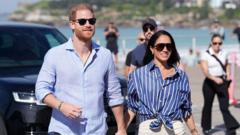
The operational footprint of high-profile international travel by public figures requires a complex balance of security management, public relations optimization, and domestic stability. When Prince Harry travels to London without the accompaniment of his spouse, Meghan, or their children, the decision is often framed through the lens of personal dynamics. However, a rigorous structural analysis reveals that this asymmetrical travel configuration operates as a calculated risk management strategy. By decoupling the family unit during transatlantic transits, the principals optimize their security posture, minimize media exposure friction, and protect the stability of their primary domestic base in the United States.
Understanding this operational strategy requires breaking it down into three core components: the Security Risk Function, the Media Friction Index, and the Principle of Household Continuity.
The Security Risk Function and Asset Vulnerability
The decision to isolate the principal traveller from the immediate family unit alters the overall threat matrix. In security logistics, the vulnerability of a principal group scales non-linearly with the number of high-value individuals traveling together.
The security calculus relies on three main variables:
- Threat Surface Area: A solo traveler possesses a predictable, compact physical footprint. Introducing a spouse and multiple young children expands the necessary security perimeter exponentially, requiring larger vehicular convoys, complex venue clearing protocols, and increased coordination with local law enforcement agencies.
- Response Agility: In the event of an extraction requirement or an unexpected threat escalation, a single individual can be moved with rapid tactical flexibility. Conversely, managing the extraction of a family unit involving young children introduces significant operational bottlenecks and slows down response times.
- Resource Allocation: Securing a family unit in a foreign jurisdiction requires extensive logistics, including counter-surveillance teams, secure transport vehicles, and residential security details. When the primary subject travels alone, these resources can be concentrated rather than diluted across multiple individuals with varying movement patterns.
Furthermore, the ongoing disputes regarding official state-funded security detail availability in the United Kingdom introduce a variable cost and legal constraint. Operating within a jurisdiction where the level of state protection is constrained forces reliance on private security infrastructure. Private security firms face strict regulatory limits regarding the carrying of firearms and access to real-time intelligence networks in foreign countries. By keeping the family unit within the legal and operational safety of their domestic residence, the overall risk exposure is minimized.
The Media Friction Index and Public Relations Optimization
International travel by prominent figures generates a predictable surge in media attention. The volume and tone of this coverage can be modeled as a function of the composition of the traveling party. A solo trip creates a localized, task-specific narrative, usually tied to a specific charity event, legal proceeding, or institutional milestone.
The presence of the entire family unit shifts the narrative structure from a professional engagement to a highly scrutinized public spectacle. This shift introduces two primary challenges:
The Speculation Premium
The inclusion of a spouse and children introduces variables that invite intense press speculation regarding internal family dynamics, reconciliation attempts, or symbolic snubs. This media noise completely overshadows the primary purpose of the trip, diluting the strategic value of the engagement.
Logistical Distractions
The logistics of moving a family through public transit hubs or private airfields creates high-value targets for photojournalists. The resulting media presence increases the physical security risk and adds operational friction to the travel schedule.
By limiting the traveling party to a single individual, the organization exerts greater control over the messaging environment. The trip remains focused on its specific objective, reducing the volume of speculative reporting and minimizing the financial value of paparazzi-generated assets.
The Principle of Household Continuity and Intergenerational Stability
Transatlantic travel across multiple time zones introduces significant physiological and psychological stress. For young children, the disruption to routines, sleep cycles, and educational schedules presents a distinct operational downside with zero corresponding strategic benefit.
Maintaining the primary family unit at the domestic base ensures absolute continuity. This strategy provides two distinct organizational benefits:
- Operational Resilience: Keeping the majority of the family unit in a stable environment ensures that day-to-day operations, security protocols, and support staff structures remain uncompromised. The domestic base functions as a controlled environment with established safety margins.
- Asymmetric Exposure Mitigation: Children of high-profile figures face long-term privacy risks when exposed to international media storms. Restricting travel to the primary adult subject shields the next generation from premature public exposure and preserves their long-term privacy optionality.
This operational decoupling mirrors the continuity of governance protocols utilized by corporate enterprises and state institutions. Splitting key assets ensures that an unforeseen crisis, logistical failure, or security breach affecting the traveling principal does not compromise the stability of the entire family structure.
The Structural Blueprint for Asymmetric Transatlantic Travel
The decision-making process behind this travel configuration can be formalized into a repeatable strategic framework.
[Determine Travel Objective]
        │
        ▼
[Assess Target Jurisdiction Risk Profile] ──(High Friction / Variable Security)──► [Deploy Solo Principal]
        │                                                                                   │
        ▼                                                                                   ▼
[Maintain Domestic Base Continuity] ◄───────────────────────────────────────────────[Shield Family Assets]
When evaluating international movements under high-scrutiny conditions, organizations must systematically isolate the essential traveler from secondary stakeholders. The primary subject acts as the targeted execution mechanism for foreign objectives, while the core support structure remains anchored in the domestic zone of maximum security.
Future international deployments will likely adhere strictly to this divided model. As long as security variables remain volatile and media scrutiny remains high, the operational overhead of unified family travel outweighs the strategic returns. The most efficient path forward requires maintaining a lean, agile profile for foreign engagements while preserving the integrity and safety of the domestic base. Executing travel through this disciplined, divided approach minimizes institutional friction and maximizes long-term operational sustainability.