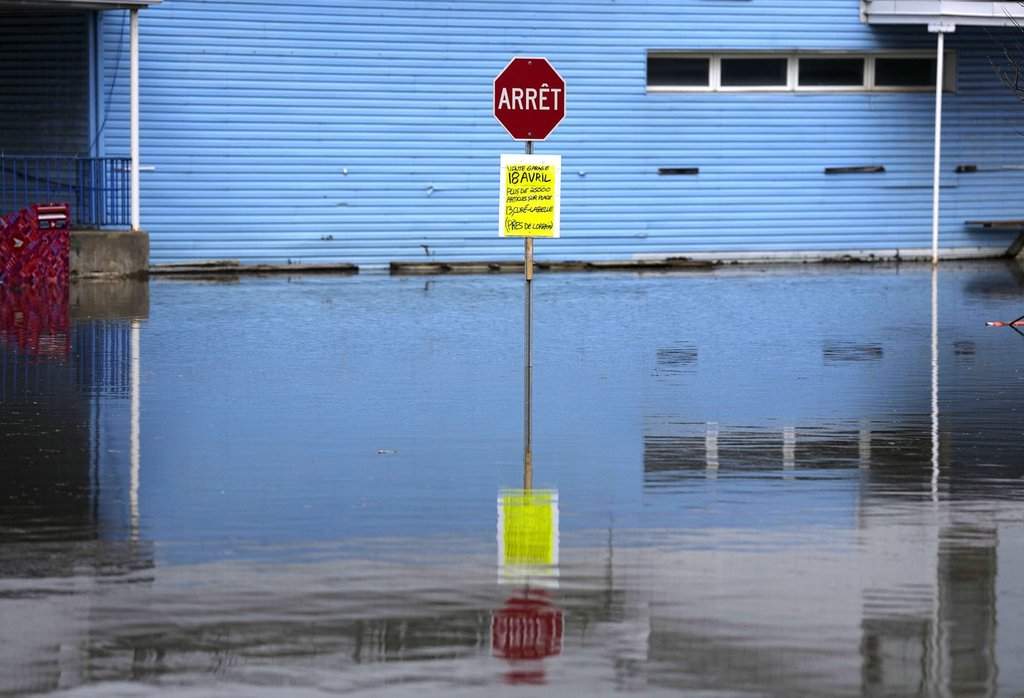
The annual ritual of sandbagging in Gatineau is a performance of futility. Every spring, news cameras flock to the banks of the Ottawa River to capture residents hauling heavy bags and politicians promising "resiliency." The narrative is always the same: a tragic battle against an unpredictable natural enemy.
That narrative is a lie. For a more detailed analysis into similar topics, we suggest: this related article.
The flooding in Gatineau and across the Ontario-Quebec border isn't a surprise, and it isn't a tragedy of nature. It is a tragedy of bad urban planning and a stubborn, subsidized refusal to accept basic hydrology. We aren't "at risk" from rising waters; we have built our lives inside a drainpipe and are acting shocked when it gets wet.
The Subsidized Delusion of the Floodplain
Governments love to talk about infrastructure. They promise better dams, higher berms, and sophisticated monitoring systems. What they won't tell you is that these "solutions" often make the problem worse. To get more context on this topic, extensive reporting can be read on The Washington Post.
When you build a wall to protect one neighborhood, you increase the velocity and pressure of the water for the person downstream. It is a zero-sum game played with millions of taxpayer dollars. We are currently trapped in a cycle of "Moral Hazard." Because the government provides disaster relief and subsidized insurance, developers keep building on low-lying land, and buyers keep signing mortgages for homes that are effectively boats without hulls.
If the market were allowed to price the risk of a Gatineau waterfront property accurately, those homes would be uninsurable and unsellable. Instead, we spread the cost of this geographic stubbornness across every taxpayer in the country. We are paying people to stay in harm's way.
Why 100-Year Floods Happen Every Three Years
The media clings to the term "100-year flood" as if it’s a shield. They use it to imply that once a big one hits, we’re safe for another century.
This is a fundamental misunderstanding of statistical probability. A 1 in 100-year event has a 1% chance of happening in any given year. But more importantly, the data sets used to calculate these risks are obsolete. They rely on historical patterns from a climate that no longer exists.
In the Ottawa River basin, we are seeing a shift in the timing and volume of the spring freshet. The combination of rapid snowmelt and heavy spring rain is no longer an anomaly; it is the new baseline. When Gatineau faces "concerns" about rising waters, it isn't an outlier. It’s the river reclaiming its territory.
The False Promise of Hydro-Quebec’s Control
A common refrain from disgruntled residents is that the dams should "fix it." There is a persistent myth that Hydro-Quebec or Ontario Power Generation can simply turn a dial and stop a flood.
I have spent years looking at the flow data on these systems. The Ottawa River is largely "run-of-river." The reservoirs in the north have a finite capacity. Once they are full, the water has nowhere to go but down. Expecting a dam to stop a massive spring melt is like expecting a kitchen sponge to stop a fire hose.
By blaming the utilities, residents and local officials avoid the harder conversation: managed retreat.
Managed Retreat is Not a Dirty Word
Politicians avoid the phrase "managed retreat" because it sounds like losing. It sounds like giving up. In reality, it is the only adult response to the situation.
Instead of spending $50,000 to repair a basement for the third time in a decade, that money should be used to facilitate a permanent move. We need to stop "rebuilding" and start "relocating."
Gatineau’s current strategy—and by extension, Quebec’s—is a patchwork of bureaucracy that makes it difficult for people to leave even if they want to. The "Special Intervention Zones" (ZIS) were a start, but they were met with immediate legal and social pushback from people worried about their property values.
Here is the brutal truth: Those property values are already gone. They are being propped up by a collective hallucination. The moment the subsidies stop or the insurance companies finally walk away, the floor drops out.
The Economic Cost of Sentimentalism
We treat the loss of a home to a flood as a purely emotional event. It is also an economic drain. Every time a major flood hits the Gatineau-Ottawa region, productivity stops. Emergency services are diverted. Infrastructure like roads and sewers are decimated, requiring tens of millions in repairs that only last until the next cycle.
From a business perspective, continuing to invest in flood-prone zones is a "sunk cost" fallacy in the most literal sense. We are throwing good money after bad water.
The "nuance" that the mainstream media misses is that "resilience" has become a buzzword used to justify the status quo. True resilience isn't a stronger sandbag; it’s a park where a house used to be. It’s a wetland that is allowed to soak up the overflow instead of a paved driveway that funnels it into the neighbor’s living room.
Stop Asking When the Water Will Recede
The questions being asked in news reports are all wrong.
- "When will it be safe to go back?" (Never)
- "How can the government protect us?" (They can't)
- "Why is this happening again?" (Because you live in a riverbed)
We need to shift the focus toward a radical redesign of the waterfront. This means turning floodplains into public green spaces that are designed to go underwater without causing a financial crisis. It means stopping all new permits for any structure that isn't on stilts or designed to be amphibious.
If you own a home in a high-risk zone in Gatineau, you aren't a victim of "rising waters." You are a stakeholder in a failing enterprise. You can wait for the river to take your equity, or you can demand the right to leave before the next melt.
The river isn't rising; it's returning. Move.