The air at three thousand feet doesn't move; it waits. Up there, atop the Bonnet à l’Evêque mountain, the Citadelle Laferrière sits like a massive stone prow of a ship that never sailed, a monument to a freedom won in blood and maintained through sheer, defiant architectural will. It is a place of pilgrimage. For Haitians, it is the physical manifestation of the soul. For the rest of the world, it is a UNESCO World Heritage site, a marvel of nineteenth-century engineering. But on a Tuesday that should have been defined by the celebratory echoes of history, the mountain became a trap.
Thirty lives ended in the shadow of those ten-foot-thick walls. Not by fire, not by war, and not by the collapse of the ancient stone. They were taken by the one thing the Citadelle was never designed to defend against: the weight of too many people seeking the same small piece of hope at once.
Consider a young man named Jean-Baptiste—a hypothetical figure, but one who represents the thousands of students and families who make this trek every year. He would have started the climb from Milot long before the Caribbean sun turned the trail into a furnace. He would have smelled the damp earth and the roasting coffee from the small stalls lining the path. To reach the Citadelle is to prove you are Haitian. You walk past the ruins of the Sans-Souci Palace, your lungs burning, until finally, the great stone fortress reveals itself through the mist.
It is breathtaking. It is also terrifyingly narrow in the places that matter most.
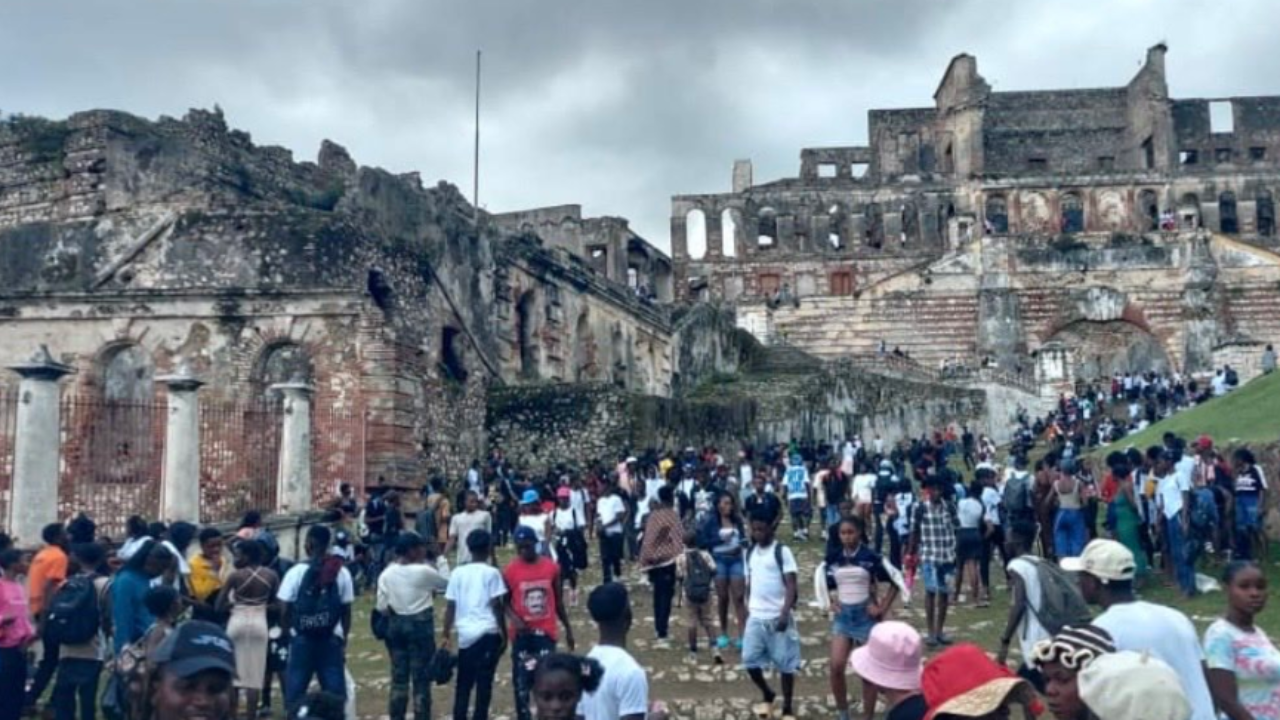
The tragedy began near the main gateway, a bottleneck designed two centuries ago to slow down invading Napoleonic armies. It worked too well. Reports indicate that a sudden surge in the crowd—triggered by a momentary panic or perhaps just the sheer, unyielding pressure of a group too large for the space—turned the entrance into a crush. In physics, there is a point where a crowd stops behaving like a collection of individuals and starts behaving like a fluid. Turbulence sets in. People lose the ability to breathe not because they are being hit, but because the very air is squeezed out of their lungs by the collective force of a thousand bodies.
Panic has a sound. It isn't a scream; it’s a low, guttural roar of oxygen being sought and denied.
The Citadelle was built by King Henri Christophe between 1805 and 1820. It was a statement to the world: "We are free, and we will never be enslaved again." It houses 365 bronze cannons, some still sitting on their original wooden carriages, pointing out toward an ocean that once brought chains. The irony is suffocating. A structure built to ensure the survival of a people became the site of their most senseless loss.
When we talk about "capacity" in tourism, we often treat it as a dry metric found in a spreadsheet. We discuss "load management" and "visitor flow" as if they are abstract concepts for urban planners. They are not. They are the difference between a life-changing cultural experience and a catastrophe. On this day, the infrastructure of the mountain—designed for a garrison of 5,000 soldiers who knew how to move in formation—could not handle the chaotic, joyous, and ultimately desperate movement of a modern civilian crowd.
The casualties were largely young. Students on field trips. Families. The very people who are supposed to inherit the legacy of the stone giant.
We must look at the invisible stakes here. Haiti is a nation that has been battered by every conceivable force: seismic shifts of the earth, the fury of hurricanes, and the grinding gears of political instability. The Citadelle was the one thing that felt permanent. It was the "Eighth Wonder of the World" that belonged to them. When a tragedy happens at a site of such profound national pride, the wound goes deeper than the physical loss. It creates a tremor in the national identity.
How did we get this so wrong? We often assume that because a structure has stood for two hundred years, it is invincible. We mistake durability for safety. The Citadelle is durable; it can withstand a siege or an earthquake. But it cannot manage the modern world's thirst for spectacle without intervention.
Safety isn't just about the strength of the floorboards or the height of the railings. It is about the psychology of the space. Imagine the heat inside those stone corridors. The walls, sun-baked and radiating warmth, offer no escape. The stairs are uneven, worn smooth by two centuries of footsteps. In a moment of calm, they are charming. In a moment of panic, they are a staircase to nowhere.
The response from officials has been the standard litany of grief and promises of investigation. But a deep dive into the logistics of the site reveals a recurring problem in global heritage travel. We want the "authentic" experience. We want to see the ruins as they were, without the intrusion of modern safety barriers, plexiglass, or turnstiles. We want the history raw. But "raw" history is often dangerous.
There is a tension between preservation and protection. If you widen the gates of the Citadelle to prevent a crush, you destroy the architectural integrity of a fortress designed to be impenetrable. If you limit the visitors to a trickle, you deny a struggling nation the vital tourism revenue it needs to survive and keep the site from crumbling into the jungle.
It is a cruel choice.
The real problem lies in the disconnect between the grandeur of the destination and the fragility of the journey. The road to the Citadelle is a winding, steep ascent. Emergency services in the region are not equipped for mass casualty events on the side of a mountain. Every minute counts when someone is suffering from traumatic asphyxiation, yet on that Tuesday, time was a luxury no one had. The victims weren't just lost to the crowd; they were lost to the geography.
Think of the silence that followed. After the sirens faded and the survivors were led down the mountain, the Citadelle remained. It didn't change. The cannons still pointed at the sea. The wind still whistled through the ramparts. The stone doesn't care about the lives it witnesses. It is we who imbue these places with meaning, and it is we who must bear the responsibility for those who visit them.
We have a habit of looking away from Haiti until blood is spilled. We treat the country as a series of headlines rather than a place where people live, dream, and climb mountains to touch their history. This stampede wasn't a "natural" disaster. It was a failure of management, a failure to respect the power of a crowd, and a failure to provide the necessary guardrails for a national treasure.
Trust in a destination is a fragile thing. For the families of the thirty who died, the Citadelle is no longer a monument to freedom. It is a headstone.
The tragedy at the Citadelle Laferrière is a reminder that our most sacred spaces require more than just veneration. They require a sober, modern vigilance. We cannot simply worship at the altar of history; we have to ensure that the people who come to pay their respects actually get to go home.
As the sun sets over the Bonnet à l’Evêque, the shadow of the fortress stretches long across the valley. It looks, from a distance, like a sleeping protector. But for those who were there, for those who felt the air vanish and the world close in, the mountain will always feel a little colder, and the stone a little harder, than it did the day before.
The cannons are silent, but the mountain still holds its breath.