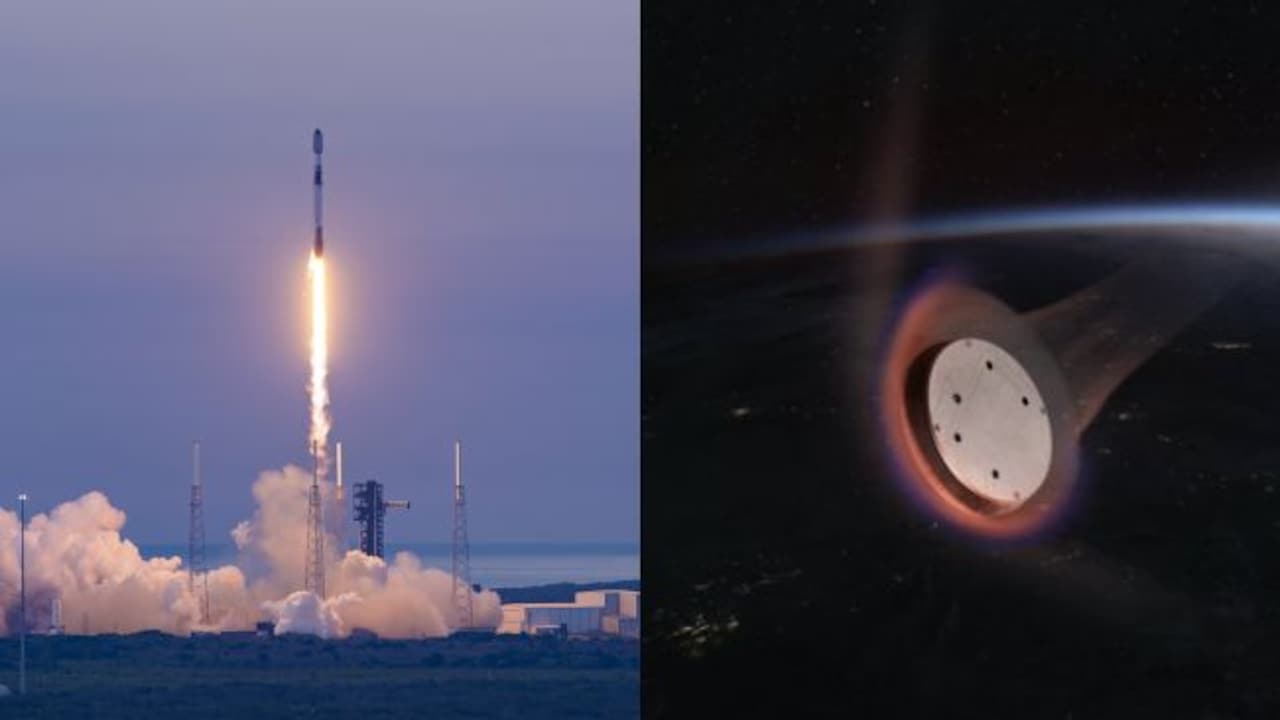
SpaceX just launched something strange from Cape Canaveral, and it wasn't another batch of Starlink satellites.
On June 23, 2026, a Falcon 9 rocket lifted off into the early morning Florida sky carrying a payload named Starfall. If you watched the official broadcast, you probably noticed the company went completely silent after the first-stage booster landed on its drone ship. No footage of the upper stage. No views of the deployment. Total radio silence. Recently making waves in related news: What Most People Get Wrong About WhatsApp New CEO Kunal Shah.
The media is calling it a simple debut mission for an ocean-bound cargo capsule. They're missing the bigger picture. Starfall isn't just a new spacecraft; it's a massive shift in how we manufacture high-tech materials, drugs, and military equipment. It addresses a glaring bottleneck in modern space exploration: getting stuff back down to Earth.
Here's the raw truth about what Starfall is, why its shape defies conventional engineering, and what its successful deployment means for industries completely unrelated to aerospace. Further details regarding the matter are covered by ZDNet.
The Giant Hockey Puck in Low Earth Orbit
Traditional reentry vehicles like the Dragon capsule or Russia's Soyuz look like cones. They have a heavy base that takes the brunt of atmospheric friction and tapers up toward the top.
Starfall throws that geometry out the window. It looks exactly like a giant hockey puck.
Measuring 3.1 meters (about 10.2 feet) in diameter and a mere 0.75 meters (2.5 feet) thick, this flat disk weighs roughly 2,100 kilograms empty. Federal Aviation Administration (FAA) regulatory documents show it can carry up to 1,000 kilograms of payload inside its pressurized internal bay.
The structure is divided into two distinct components:
- An aluminum top plate weighing 1,400 kilograms that holds the cargo bay and attitude control components.
- A carbon-fiber heat shield weighing 700 kilograms wrapped in a proprietary thermal protective layer.
Why build a flat capsule? A wide, flat disk distributes heat across a larger surface area during high-speed reentry. It creates high drag without requiring a massive, deep volume. SpaceX is optimizing for cargo space and structural simplicity, not human comfort.
The Missing Engine and the Blackout Trick
Here's a weird technical detail that confused a lot of onlookers: Starfall has no onboard chemical propulsion system. It cannot deorbit itself.
Instead of using rockets to push itself out of orbit, the capsule relies entirely on its launch vehicle or an external kick-stage to shove it into a terminal trajectory toward Earth. Once it enters the upper atmosphere, it uses cold-gas nitrogen thrusters to control its attitude and prevent it from tumbling.
Because nitrogen is an inert gas, the capsule is fundamentally non-hazardous. If something goes wrong and the capsule fails to open its parachutes, there are no toxic liquid fuels—like hydrazine—to contaminate the landing zone. It just vents its pressurized systems and becomes inert before hit hitting the water.
But the coolest piece of tech on this debut flight involves the plasma blackout phase.
When an object reenters the atmosphere at Mach 25, the air around it compresses and ionizes into a superheated shroud of plasma. This plasma completely blocks radio signals, leaving mission control blind for several agonizing minutes. SpaceX solved this by mounting Starlink Earth stations directly onto the Starfall prototypes. They're testing whether they can punch a telemetry stream straight up to the Starlink constellation during peak heating, bypassing the horizontal blackout zone entirely.
Moving Factories to Space
You might wonder why anyone needs a dedicated vehicle just to drop a ton of cargo into the Pacific Ocean. The answer lies in microgravity manufacturing.
Making certain materials on Earth is incredibly difficult because gravity causes convection currents and sedimentation. When you remove gravity from the equation, fluids mix perfectly, crystals grow without defects, and organic tissues form three-dimensional structures without collapsing.
+--------------------------+----------------------------------------------------+
| Industry                 | Microgravity Benefit                               |
+--------------------------+----------------------------------------------------+
| Pharmaceuticals          | Growing perfect protein crystals for targeted drugs|
| Semiconductors           | Flawless semiconductor layers without defects      |
| Fiber Optics             | ZBLAN fibers that transmit light without loss       |
| Bioprinting              | Printing human organs without structural collapse  |
+--------------------------+----------------------------------------------------+
Companies like Varda Space have already proven this model works on a small scale with their 300-kilogram capsules. SpaceX is scaling it up dramatically. Starfall allows pharmaceutical giants and advanced materials laboratories to mass-produce products in orbit and return them to Earth in commercial quantities.
The Military Point to Point Angle
There's another reason SpaceX kept this mission shrouded in secrecy. The U.S. military is deeply invested in point-to-point cargo delivery from space.
The Air Force has long eyed rocket cargo systems capable of dropping 100 tons of equipment anywhere on the globe within an hour. While Starship is built for those massive payloads, it requires a launch pad or highly specific clearing to land safely.
Starfall offers an alternative. It can loiter in orbit indefinitely, acting as an automated supply depot. If a remote military unit needs critical medical supplies, specialized drone parts, or communication hardware instantly, a Starfall capsule can deorbit and deploy a parachute-assisted splashdown right off the coast. No landing infrastructure required.
What Happens Next
The debut capsule is currently orbiting Earth, executing its checkout operations. According to FAA permits granted in May 2026, SpaceX has approval for two initial test flights, both targeting a splashdown zone in international waters in the Pacific Ocean, roughly 1,300 kilometers off the coast of California and Mexico.
Once the capsule hits the water, the carbon-fiber heat shield will jettison, and recovery boats will hook the main top plate containing the internal bay to haul it aboard.
If you want to track the progress of this new orbital logistics system, keep an eye on maritime hazard notices for the East Pacific. The true test of Starfall won't be how it went up on that Falcon 9, but how cleanly it handles the fiery trip back down. Look for the splashdown coordinate announcements over the next few weeks to see when SpaceX intends to bring its hockey puck home.