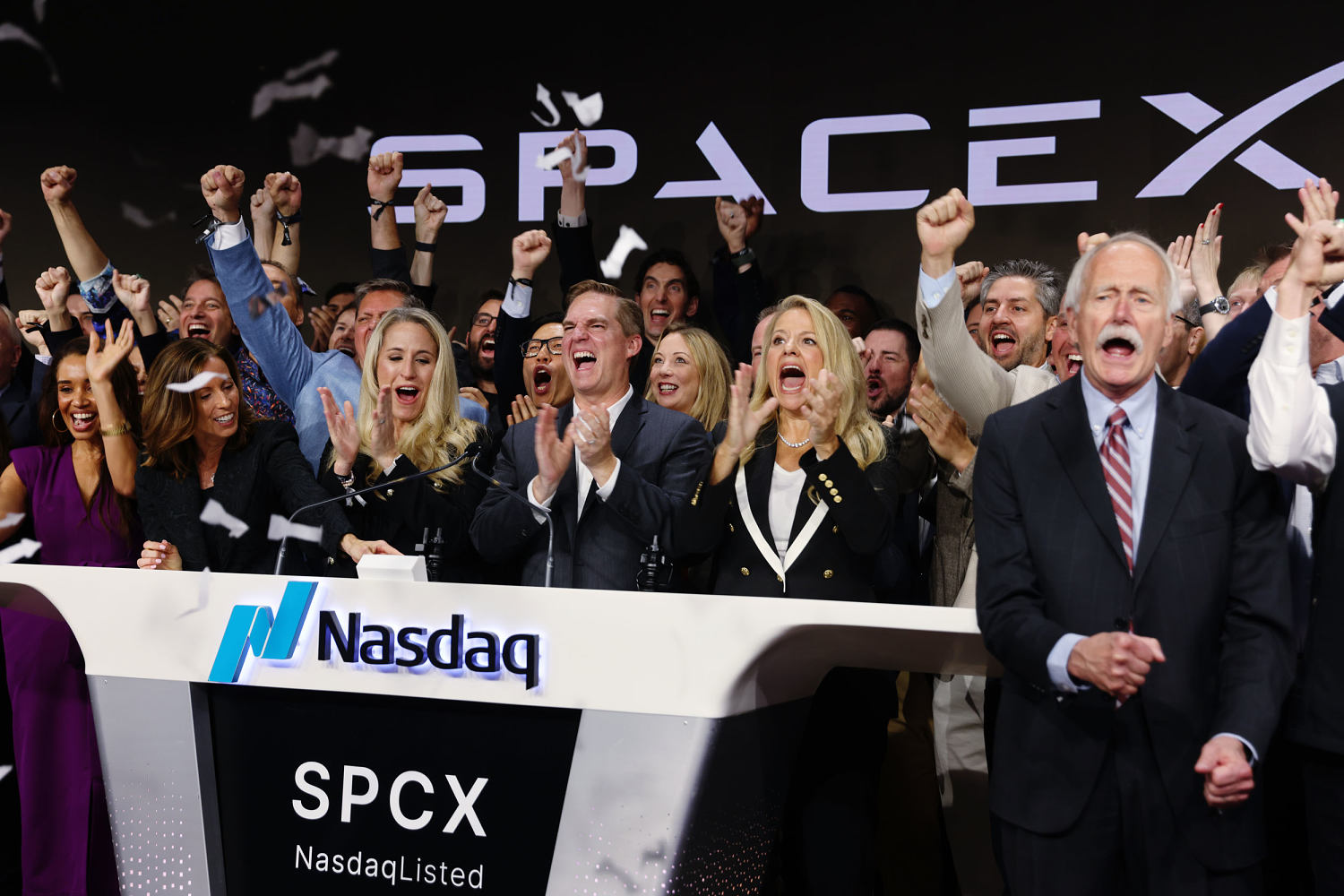
The trading floor of the Nasdaq exchange just witnessed something completely unprecedented. As Elton John's "Rocket Man" blasted through the speakers, Space Exploration Technologies Corp. officially went public under the ticker SPCX. Priced at a flat $135 per share, the stock instantly popped to $150 at the opening bell. Within hours, it surged past $171, driving the company's valuation well over the $2 trillion mark.
This initial public offering didn't just break records as the largest IPO in history by raising $75 billion. It also pushed Elon Musk's net worth past $1 trillion, making him the first paper trillionaire in human history.
Retail investors flooded brokerages like Robinhood, Fidelity, and Charles Schwab, eager to grab a piece of the action. But behind the celebratory headlines and the massive wealth creation lies a complicated financial reality. SpaceX is entering the public markets with an eye-watering valuation, yet the business itself is losing billions of dollars. If you're thinking about buying into this frenzy, you need to understand exactly what you're paying for.
The Brutal Reality of the SpaceX Balance Sheet
The media is hyper-focused on Musk's new trillionaire status, but smart investors are looking at the S-1 filing. The numbers inside are jarring. SpaceX pulled in $18.7 billion in revenue for the full year of 2025. Sounds great, right? Except the company also recorded a massive net loss of $4.28 billion in the first quarter of 2026 alone.
When you look closely at where the money goes, the core rocket business isn't actually the problem. The financial drain comes from two massive capital sinks: satellite internet and artificial intelligence.
- Starlink: This is the current cash cow. It brought in $11.4 billion in 2025, which represents roughly 61% of total company revenue. Starlink is currently the only profitable part of the entire operation.
- The Space Division: Launching Falcon rockets and developing Starship is incredibly expensive. This arm lost $619 million recently, with Starship development costs eating up $15 billion so far.
- The AI Arm: This is the real shocker. SpaceX absorbed Musk's AI startup, xAI, and the cash burn is staggering. The AI unit lost $2.5 billion in a single quarter. Capital expenditures for AI hit $7.7 billion in the first three months of 2026, up from $12.7 billion for the entirety of 2025.
SpaceX is priced like a high-margin software giant, but it operates with the heavy infrastructure costs of a manufacturing and aerospace conglomerate. Paying a price-to-sales ratio that hovers around 90 is a massive stretch when established tech leaders like Nvidia trade at a fraction of that multiple.
What Retail Investors Get Wrong About the Offering
Wall Street handled this listing very differently than a standard corporate debut. Usually, investment banks provide a target price range to test investor demand. SpaceX didn't do that. They offered an ultimatum: $135 a share, take it or leave it.
Because investor demand was oversubscribed by up to four times, the take-it-or-leave-it strategy worked beautifully. However, this structure creates unique risks for regular investors who buy in at the current $171 level.
First, consider the voting power. You might own a piece of the equity, but you have zero say in how the company is run. Musk retains roughly 42% of the economic stake in SpaceX, but he commands a staggering 85% of the voting shares. If he decides to divert billions of dollars from satellite internet to fund a highly speculative colony on Mars, public shareholders can't stop him.
Second, the stock is being fast-tracked into total market index funds due to its sheer size. While it won't immediately enter the S&P 500, millions of everyday savers will soon own a piece of SpaceX through their retirement accounts and pension plans. If the stock experiences a sharp correction, it won't just hurt billionaires; it'll hit regular retirement portfolios.
The Space Data Center Bet
To justify a $2 trillion valuation, SpaceX has to grow into an entirely new market. The company's investor pitch outlines an absolute moonshot: building orbital data centers.
The logic behind this plan relies on the massive power demands of modern artificial intelligence. Running massive AI clusters on Earth requires vast amounts of electricity and cooling water, which is triggering regulatory backlash and resource strain in places like Memphis. SpaceX wants to bypass Earth entirely by launching football-field-sized data centers directly into orbit, powering them with raw solar energy and using the cold vacuum of space for natural cooling.
This sounds like science fiction, but it's the core thesis supporting the current stock price. Analyst models from firms like Morningstar suggest that if Starship becomes fully reusable and these space data centers scale successfully, the current premium makes sense. The trouble is the probability of executing both perfectly is low. If Starship encounters technical delays or if orbital data transmission proves too latent for commercial AI workloads, the fundamental value of the stock drops significantly.
How to Navigate the SPCX Trading Frenzy
If you're holding shares or deciding whether to buy the first-day pop, you need a concrete plan. Blind enthusiasm is a quick way to lose capital in a volatile market.
- Check your exposure: Review your mutual funds and tech ETFs over the coming weeks. You might end up owning SpaceX automatically as index managers rebalance their funds to accommodate this massive market cap.
- Size your position properly: Treat SPCX as a speculative tech position, not a stable value investment. If you buy individual shares, keep the allocation to a small percentage of your overall portfolio.
- Watch the Starlink margins: Track whether Starlink's subscriber growth can continue to subsidize the billions being spent on xAI data centers and Starship test launches. Starlink's cash flow is the only thing keeping the lights on right now.
- Ignore the daily net worth trackers: Musk gaining or losing $50 billion in a afternoon makes for great clickbait, but it tells you nothing about the company's long-term operational health. Focus on quarterly capital expenditure reports instead.
SpaceX has undoubtedly changed the aerospace industry, and the excitement surrounding its public debut is historic. But don't confuse a historic cultural moment with a safe financial investment. The company is burning cash at a breathtaking pace to build an extraterrestrial infrastructure that might not be viable for years. Trade carefully, keep your position sizes manageable, and don't let the trillionaire headlines dictate your financial strategy.