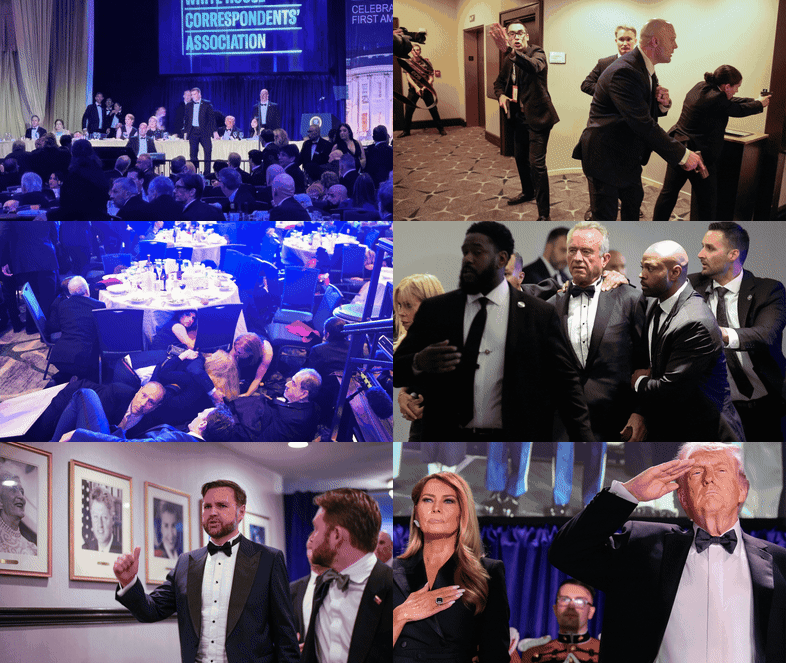
The chandelier did not just shake; it sang. It was a high, crystalline vibrato that cut through the low hum of expensive catering and the practiced baritones of men who believe they own the room. For a split second, the air inside the Washington hotel ballroom didn't feel like air at all. It felt like static. Then came the cracks. Not the rhythmic pop of champagne, but the jagged, metallic intrusion of lead meeting stone.
Security detail is trained to ignore the instinct to duck. Instead, they become shields. In the chaotic seconds that followed the first shots, the carefully manicured image of American power dissolved into a primal scramble for survival. Donald Trump, a man defined by his presence and his voice, was suddenly a figure being hurried toward an exit, swallowed by a phalanx of dark suits and frantic energy. The cameras, usually focused on the optics of a political win, caught something else entirely: the raw, unscripted friction of history happening in real-time.
The Fragility of the Inner Circle
We often view political figures as static icons. We see them on stages, framed by flags, insulated by layers of bureaucracy and bulletproof glass. But when the perimeter fails, the distance between the podium and the pavement vanishes.
Imagine a young staffer, perhaps twenty-four years old, holding a stack of briefing notes that were, moments ago, the most important documents in the world. Now, they are just paper. As the screams echoed off the marble walls, those notes fluttered to the floor, trampled by the boots of fleeing dignitaries and the heavy tread of Secret Service agents. This is the human cost of political volatility. It isn't just about the figures on the ballot; it is about the hundreds of people who populate the ecosystem of power—the waiters, the clerks, the photographers—who suddenly find themselves in a crossfire they never signed up for.
The physical layout of a luxury hotel is designed for ease and elegance. Wide hallways. Grand staircases. Open lobbies. In a crisis, these features become vulnerabilities. Every open door is a question mark. Every corner is a blind spot. As the former president was moved through the service corridors—spaces usually reserved for laundry carts and quiet kitchen staff—the juxtaposition was jarring. The gold-leafed world of the elite was forced into the grit of the functional underground.
The Psychology of the Crowd
Chaos has a specific scent. It is a mixture of ozone, floor wax, and the sharp, acidic tang of adrenaline. When the shots rang out, the collective intelligence of the room fractured.
Psychologists often talk about the "social proof" phenomenon, where individuals look to others to determine how to behave. In a ballroom filled with leaders, the irony was thick: everyone was looking for someone to lead them to safety. Senators, once poised and commanding, were seen climbing over chairs. Donors in four-figure dresses were pressed against the carpet, their jewelry catching the harsh emergency lights.
Consider the perspective of a veteran photojournalist standing at the back of the room. Their job is to stay upright when everyone else goes down. Through the viewfinder, the world becomes a series of frames. They see the sweat on a politician's brow. They see the white-knuckle grip of a spouse's hand. They capture the moment a Secret Service agent draws a weapon, a gesture that signals the definitive end of the "event" and the beginning of a "situation."
The images that emerged from that afternoon were not just news photos. They were Rorschach tests for a divided nation. To some, they were evidence of a targeted assault on a movement. To others, they were a terrifying symptom of a country where violence has become the default language of disagreement. But in that room, those tribal identities didn't matter. There was only the sound of breathing, the ringing in the ears, and the desperate need to find an exit.
The Invisible Stakes of a Broken Perimeter
When we talk about security failures, we focus on the "how." How did the shooter get close? How did the protocol break down? But the "why" is often more haunting. We live in an era where the boundary between public discourse and physical danger has become porous.
The hotel, a symbol of Washington’s institutional stability, was transformed into a crime scene. This shift is more than just a logistical headache for the police; it is a psychic wound for the city. If a secure event featuring a former president and multiple high-ranking officials can be pierced, then the concept of a "safe space" becomes a relic of the past.
Safety is a luxury we only notice when it is gone. It is the quiet background noise of a functioning society. When that noise is replaced by the crack of gunfire, the social contract feels thin. We realize that our institutions are only as strong as the people guarding the doors, and those people are human. They have families. They have fears. They are tasked with standing in front of a bullet, a concept that is easy to admire in a movie but impossible to fully grasp until you see the tension in their jaws as they scan a mezzanine for a second shooter.
The Aftermath of the Silence
Eventually, the sirens arrived. The screaming stopped, replaced by the rhythmic, blue-and-red pulse of police lights against the hotel’s limestone facade. The VIPs were gone, whisked away in armored convoys to undisclosed locations, leaving behind a ghost town of half-eaten hors d'oeuvres and discarded coats.
In the hours that followed, the narrative began to crystallize. The "cold facts" were sorted into bullet points for the evening news. The number of rounds fired. The caliber of the weapon. The condition of the injured. But these numbers are a poor substitute for the truth of the experience. They don't capture the way the air felt cold once the adrenaline began to fade. They don't describe the trembling hands of the hotel manager as he tried to account for his staff.
The political fallout was immediate and predictable. Accusations were hurled like stones. Press releases were drafted before the smoke had even cleared. Yet, for the people who were in that ballroom, the political implications were secondary to a much simpler, more harrowing realization: the world changed in the time it took to pull a trigger.
We are left with the images. A single shoe left on a red carpet. A shattered window reflecting the Washington Monument in the distance. A group of men in suits, huddled behind a concrete pillar, their faces stripped of the masks of office. These photos tell a story that no press conference can capture. They tell us that power is a fragile thing, and that the distance between a gala and a tragedy is exactly the width of a hallway.
The glass on the floor will be swept up. The carpet will be steamed. The hotel will host another fundraiser, and another, and another. But the vibration of that singing chandelier remains in the bones of the city. It is a reminder that the stakes are no longer just about who wins an election, but about whether the institutions we built to hold our society together can still withstand the weight of our own divisions.
The sun set over the Potomac that evening, casting long, distorted shadows across the city. On the streets outside the hotel, the yellow tape fluttered in the breeze, a thin, plastic barrier between the world we thought we knew and the one we actually inhabit.