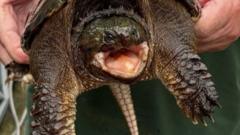
The discovery of a non-native common snapping turtle (Chelydra serpentina) at Penllergare Valley Woods in Swansea, Wales, exposes a critical breakdown in regional biosecurity protocols and highlights a growing black-market exotic pet dilemma. While mainstream media accounts dramatize the event by comparing the reptile's bite force to a slamming car door, they fail to analyze the precise biomechanical risk factors, environmental vectors, and resource allocation models required to mitigate such ecological threats. Managing non-native apex predators in non-endemic freshwater systems requires a clinical understanding of species-specific mechanics, economic vectors of introduction, and cold-climate survivability constraints.
The Biomechanical Reality of Chelydra Serpentina
To quantify the actual risk posed to public safety and native fauna, the physiological architecture of the common snapping turtle must be decoupled from hyperbolic media narratives. The specimen captured in South Wales—a juvenile weighing approximately one kilogram with a carapace length of 35 centimeters—does not possess the mechanical capacity to amputate human limbs, yet it poses a severe laceration and structural soft-tissue hazard.
The bite mechanism of the snapping turtle relies on speed and structural leverage rather than sheer crushing pressure. The mechanical advantage of the jaw can be broken down into two distinct variables:
The Beak Morphology: Unlike mammalian predators that rely on specialized dentition, Chelydra serpentina utilizes a sharp, keratinized tomis (beak) over a modified bony jaw structure. The force is not distributed across multiple teeth but is concentrated entirely along a razor-sharp, curved edge. This minimizes the surface area of impact, maximizing the pressure exerted on target tissue via the formula:
$$P = \frac{F}{A}$$
Where $P$ is pressure, $F$ is force, and $A$ is the area of the cutting edge. This means even a moderate bite force generates enough localized pressure to easily shear through skin, muscle, and digital tendons.
Muscular Velocity vs. Force Production: Adult common snapping turtles exert a jaw closing force of roughly 210 to 650 Newtons, depending on mass and skull dimensions. For comparison, a human adult can exert an average molar bite force of 700 Newtons, while an alligator snapping turtle (Macrochelys temminckii) can exceed 1,000 Newtons. The danger of the common snapping turtle lies in its kinetic speed and rapid strike reflex, which relies on a highly flexible, elongated neck capable of projecting outward at extreme velocities when threatened on land.
The behavioral catalyst for this force application is strictly defensive. In their native North American habitats, snapping turtles are highly aquatic and typically choose flight over confrontation when submerged. However, when confronting threats in shallow water or during overland nesting migrations, their inability to fully retract their head and limbs into their plastron (the ventral shell) eliminates their primary structural defense. The organism is highly evolutionarily incentivized to deploy its jaw mechanism as an active counter-offensive strategy.
The Microeconomic Failure of the Exotic Pet Supply Chain
The introduction of Chelydra serpentina into Welsh ecosystems is not an isolated biological anomaly; it is a direct consequence of a microeconomic market failure within the exotic pet trade. A clear causal pathway drives these introductions:
[Low Initial Capital Asset] ──> [Exponential Cost of Maintenance] ──> [Negative Externalization via Illegal Release]
The Capital-to-Maintenance Divergence
Juvenile snapping turtles are frequently acquired as low-cost novelty assets when they measure fewer than 10 centimeters. The initial purchase price fails to reflect the long-term capital expenditure required to maintain the animal's life cycle, which can easily span 30 to 50 years. As a juvenile matures over a three-to-four-year period, its biometric scaling demands a parallel escalation in containment infrastructure:
- Volumetric Habitat Requirements: A 35-centimeter specimen requires a minimum tank capacity of 380 to 570 liters, necessitating dedicated structural floor space and industrial-grade water filtration systems capable of processing high bio-loads.
- Thermoregulation and Energy Demands: Operating high-wattage ultraviolet (UVB) and ceramic heat lamps continuously over decades creates a compounding utility cost profile that many casual hobbyists fail to model.
When the marginal cost of maintaining the biological asset exceeds the owner's perceived utility or financial capacity, the asset depreciates to zero value. Because no legal, high-liquidity secondary market exists for large, aggressive reptiles, owners frequently opt to externalize their private disposal costs by illegally releasing the organism into public waterways.
Ectothermic Viability and Cold-Climate Bottlenecks
A primary variable determining whether an introduced species shifts from a localized nuisance to an established invasive threat is its physiological tolerance for the host environment's climate profile.
| Environmental Factors | Endemic North American Range | South Wales Climate Profile |
|---|---|---|
| Thermal Range | Extreme continental fluctuations (-20°C to 40°C) | Moderate maritime climate (0°C to 25°C) |
| Brumation Requirements | Deep freeze tolerances, mud-burrowing hypoxia survival | Mild winters; inconsistent freezing temperatures |
| Reproductive Thresholds | Consistent summer soil temperatures above 20°C | Sub-optimal nesting thermal units; high failure rate |
The common snapping turtle possesses a highly resilient ectothermic profile, with a native geographic distribution extending from southeastern Canada across the eastern United States. This indicates a high pre-adaptation for cold-weather survival.
The primary barrier to Chelydra serpentina establishing self-sustaining populations in Western Europe is not winter mortality, but rather a reproductive thermal bottleneck. The species utilizes environmental sex determination during incubation. Successful embryonic development and balanced sex ratios require sustained nesting soil temperatures between 20°C and 30°C for approximately 60 to 90 days. The contemporary maritime climate of Wales lacks the consistent, high-heat summer periods required to hatch viable clutches, meaning wild-caught individuals almost certainly represent individual dumping events rather than wild-born populations.
However, individual survival rates remain high. A released snapping turtle can easily shift its diet to exploit native Welsh biodiversity. Its generalist trophic profile allows it to consume amphibians, native waterfowl fledglings, macroinvertebrates, and indigenous fish populations like brown trout and Atlantic salmon smolts. The absence of natural apex competitors or predators within these local river systems means a single adult turtle can monopolize a small ecosystem niche indefinitely, creating a localized bio-density collapse.
Biosecurity Frameworks and Targeted Intervention
Relying on reactive, ad-hoc volunteer rescues when an animal is spotted by the public is an inefficient containment strategy. A robust biosecurity framework must shift from reactive mitigation to proactive enforcement and systematic surveillance.
The National Centre for Reptile Welfare (NCRW) serves as a critical containment bottleneck for captured specimens, but long-term stabilization requires a two-pronged structural strategy:
- Supply-Side Point of Sale Tracking: Implementing mandatory microchipping at the wholesale point of import and retail sale for all high-risk reptile species would establish a direct line of legal custody. If a specimen is recovered from a public waterway, forensic scanning of the transponder would allow environmental enforcement agencies to trace the animal back to the registered owner, enabling the imposition of severe financial penalties under the Wildlife and Countryside Act 1981.
- Environmental DNA (eDNA) Surveillance: Rather than waiting for visual confirmation in high-density recreational waters, regional conservation trusts should deploy localized eDNA sampling across high-risk urban adjacent waterways. This biotechnology isolates genetic material shed via skin cells, feces, and mucus from water samples, confirming the presence of non-native chelonians long before visual tracking is possible.
Local authorities must resist allocating scarce conservation capital toward widespread public signage campaigns, which yield low compliance rates. Resources must instead be funneled into permanent, centralized surrender networks that allow pet owners to transfer high-risk exotic animals to secure sanctuaries anonymously without legal or financial reprisal. Eliminating the friction of surrender is the only viable method for interrupting the cycle of illegal environmental release.
Snapping Turtle Bite Analysis
This detailed field analysis breaks down the specific trauma, mechanics, and defensive behavior associated with a snapping turtle strike to demonstrate the exact physiological risks involved when handling these reptiles.