The wind off the Firth of Forth doesn’t care about legislation. It sweeps across the saltmarshes, cold and indifferent, carrying the scent of damp earth and the faint, metallic tang of an industrial history Scotland has spent thirty years trying to outrun.
If you stand on the hills above Grangemouth on a sharp November morning, you can see the twin realities of a nation caught between its memory and its future. To your left, the giant cooling towers and petrochemical stacks trace a jagged line against the gray sky. To your right, the sleek, white blades of wind turbines spin silently on the horizon.
For a long time, Scotland told itself a beautiful story. The narrative was simple: we are the green pioneers. We are the country that will scrub the carbon from our skies faster, bolder, and more completely than almost anyone else on earth. The targets were locked into law with a flourish of political pens. A 75% reduction in greenhouse gas emissions by 2030. Net-zero by 2045.
But laws are just ink on parchment. The atmosphere doesn't read the statute books.
Recently, the official data boys dropped a quiet bombshell wrapped in bureaucratic prose. Scotland’s greenhouse gas emissions did fall. They dipped by a fraction of a percent. But beneath that microscopic victory lay a brutal truth: the momentum has stalled. The easy wins are gone. The low-hanging fruit has been plucked from the branches, and now the nation is staring up at a towering, gnarled tree of systemic inertia.
To understand why a nation’s grand ambition grinds to a halt, you have to leave the parliament buildings in Edinburgh and look at a radiator in a tenement flat.
The Cold Front in the Living Room
Consider Callum. He isn't a statistic, though he features in one. He is a retired crane driver living in a sandstone tenement in Glasgow. His home has high ceilings, beautiful cornices, and windows that rattle like dice in a cup whenever the Atlantic gales roll in.
Callum’s flat is heated by a gas boiler that hums in his kitchen cupboard. It is old, slightly temperamental, but it works. When the Scottish government announces that hundreds of thousands of homes must transition to low-carbon heating systems like heat pumps within the decade, Callum looks at his bank account, then at his floorboards, and sighs.
"They want me to rip up the floor," he says, pouring a mug of strong tea. "They want me to install radiators three times the size of these ones. And the cost? It’s more than I made in a year back in the nineties. Who is paying for that? Because I'm certainly not."
This is where the grand tapestry of climate policy tears at the seams. It is easy to shut down a coal-fired power station. You turn a key, you offer redundancy packages, you clear the site, and the emissions graph drops like a stone. Scotland did that. Longannet power station, once the largest coal-fired plant in Europe, was demolished in a spectacular cloud of dust years ago. That was the easy part.
The hard part is Callum’s kitchen.
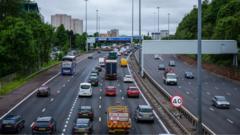
The hard part is persuading millions of individuals to fundamentally alter how they heat their water, how they cook their dinner, and how they get to work. When the recent emissions data was parsed, transport and home heating emerged as the twin anchors dragging down Scotland’s progress. Transport emissions barely nudged downward. Why? Because people still need to drive. The buses in rural Aberdeenshire don't run every ten minutes. If you have to get a sick child to a clinic in the middle of winter, you don't wait for a theoretical electric train; you turn the key in your diesel hatchback.
The Ghost of Transitions Past
There is a deep, psychological scar in the Scottish landscape that dictates how people react to the word "transition."
In the 1980s, the heavy industries that built modern Scotland—the shipyards on the Clyde, the steelworks at Ravenscraig, the coal mines of Fife—were dismantled. It was called an economic transition. In reality, it felt like an execution. Whole communities were left stranded, their purpose erased overnight, replaced by nothing but damp air and generational unemployment.
When people hear about the "green transition" today, the older generation doesn't picture a clean, sparkling future of high-tech jobs. They picture boarded-up shop fronts in Motherwell.
This fear isn't irrational. Look at Grangemouth, where the oil refinery—a cornerstone of the nation’s industrial identity for a century—is scheduled to cease refining operations. The plan is to turn it into an import terminal. Fewer moving parts. Vastly fewer jobs. The workers there are being told that their skills will eventually be needed for the hydrogen economy or carbon capture technology. But "eventually" doesn't pay a mortgage next month.
The reality of climate action is that it requires an immense amount of trust. The public must trust that the sacrifices they make today will result in a viable tomorrow. When progress slows, that trust begins to evaporate. People look at the microscopic drop in emissions and ask: Why am I paying higher fuel duties if the needle isn't even moving?
The Problem with the Soil
The stalling of Scotland's climate journey isn't just a story of cars and boilers. It is a story of the land itself.
Scotland is famous for its peatlands. These vast, dark, boggy landscapes cover nearly a quarter of the country. When they are healthy and wet, they are nature’s ultimate vault, locking away billions of tons of carbon—far more than all the forests in the UK combined.
But for centuries, we drained them. We dug them up for fuel. We planted commercial pine forests over them.
Now, those damaged, drying peatlands are doing something terrifying. Instead of soaking up carbon, they are breathing it back out. They have transformed from a shield into a source. The scale of this issue is so vast that when the government adjusted its formulas to properly account for peatland degradation, the national emissions total instantly jumped.
Fixing a bog is not like building a solar farm. It requires painstaking, muddy work. It means blocking old drainage ditches with peat dams, removing non-native trees, and waiting for the sphagnum moss to return. It is slow, unglamorous medicine. It takes years for the land to heal, and even longer for that healing to show up on a spreadsheet in Edinburgh.
The contradiction is glaring. While ministers debate targets in pristine chambers, the actual carbon balance of the nation is being decided by moss growing in a remote bog in the Highlands, and whether a mechanic in Dundee can afford an electric van.
The Illusion of the Horizon
We suffer from a collective cognitive flaw: we treat future dates as if they possess some magical property. We talk about 2030 or 2045 as if, upon reaching them, a switch will flip and the world will reset.
The recent slowdown in emissions reduction is a reminder that time is linear, but progress is a staircase. Scotland has climbed the first few flights. The steps were wide and solid. Now, the staircase is narrowing, the air is getting thinner, and each step requires a level of political courage and public investment that nobody has quite figured out how to fund.
The policy experts call it the "delivery gap." It is the space between what we say we will do and what we are actually doing.
To close that gap, the conversation has to change. It cannot be about abstract percentages anymore. It has to be about the tangible mechanics of daily life. It means acknowledging that changing a nation’s infrastructure is an act of deep tissue surgery, not a cosmetic lift. It means admitting that it will be messy, it will be expensive, and it will occasionally fail.
The sun goes down early over the Forth in the winter. By four in the afternoon, the lights of the Grangemouth complex are twinkling against the dark water, a brilliant, complex constellation of human ingenuity that has sustained thousands of lives for decades. You cannot simply blow it up and hope for the best.
The white turbines out in the water keep turning, catching the invisible wind. They don't look back, and they don't wait for us to catch up. The challenge ahead isn't about proving that climate change is real, or that emissions need to fall. Everyone knows the score. The challenge is looking Callum in the eye and offering him a future that doesn't feel like a threat to his present. Until we figure out how to do that, the smoke will keep rising over the heather, and the numbers on the charts will remain stubbornly, unforgivingly still.