The asphalt at the Shanghai International Circuit doesn’t just hold water; it turns into a mirror. When the clouds finally broke over the marshlands of the Jiading District, the track transformed from a high-tech racing surface into something treacherous and unpredictable. This wasn't just a qualifying session for a Saturday sprint. It was a psychological war of attrition where the bravest men on earth were suddenly terrified of their own brakes.
Imagine standing on a sheet of wet glass while wearing rollerblades, tasked with sprinting at two hundred miles per hour. That is the reality of a wet qualifying session in modern Formula 1. The cars are monsters of downforce, but when the rain falls, that downforce becomes a ghost. You feel it one second, and it’s gone the next. You are left with nothing but a steering wheel that feels like it’s connected to nothing and a throttle pedal that threatens to send you spinning into a concrete wall with the slightest twitch of a toe.
George Russell stood in the middle of this chaos.
For months, the narrative surrounding Mercedes had been one of decline. The once-mighty Silver Arrows had become erratic, a shadow of the team that redefined the sport for a decade. But rain is the great equalizer. It strips away the aerodynamic advantages of the billionaire-funded wind tunnels and places the burden squarely on the shoulders of the person in the cockpit.
The Calculus of Risk
The session began with a frantic energy. In the dry, Formula 1 is a game of millimeters. In the wet, it is a game of survival. As the intermediate tires struggled to find purchase on the painted white lines—lines that become as slick as ice when dampened—the giants of the sport began to crumble.
Max Verstappen, usually the master of the elements, found himself fighting a car that refused to turn. Charles Leclerc, perhaps the most naturally gifted qualifier of his generation, kissed the barriers, his Ferrari spinning like a top as the Chinese crowd gasped. The tension in the pit lane was thick enough to choke on. Every team principal stared at their monitors, watching the purple and green sectors flicker like a dying heartbeat.
Then there was Russell.
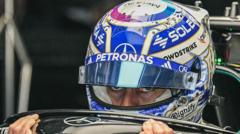
He didn't look like a man fighting a machine. He looked like a man in a trance. While others were sawing at the steering wheel, desperately trying to catch slides, Russell’s inputs were microscopic. He understood something his rivals didn't: you cannot fight the rain. You have to flow with it. You have to feel the vibration of the tires through the carbon fiber seat and know exactly when the rubber is about to give up its ghost.
The clock ticked down. The rain intensified.
A Lap Between the Drops
On his final flying lap, the track was at its most lethal. A thin film of water had pooled in the heavy braking zone of Turn 1, a tightening right-hander that has claimed more front wings than almost any other corner on the calendar. Russell plunged into it. The car squirmed. For a fraction of a second, the rear end stepped out, threatening to end his day in a cloud of carbon fiber dust and regret.
He didn't lift.
He kept his right foot pinned, trusting that the tiny patches of contact between the tire and the road would hold. It was a display of sheer, unadulterated commitment. To go that fast when your eyes are telling you it’s impossible requires a specific kind of madness. It’s the madness of a competitor who has been told he’s no longer the favorite and has decided to rewrite the script through sheer force of will.
When he crossed the line, the timing screens turned a defiant shade of purple.
The gap wasn't just a few thousandths of a second. It was a chasm. In a sport where success is usually measured in the time it takes to blink, Russell had found a country mile. He had claimed the pole position for the Chinese Grand Prix Sprint race with a dominance that silenced the skeptics and sent a shockwave through the paddock.
The Invisible Stakes
To the casual observer, a sprint pole might seem like a minor achievement. But for George Russell and the hundreds of engineers back in Brackley, this was a lifeline.
Success in Formula 1 is a fragile thing. It is built on confidence as much as it is built on horsepower. When a driver knows he can put the car on the front row in the most difficult conditions imaginable, it changes the way he speaks to his engineers. It changes the way he walks into the garage the next morning. It reminds the world that while the car might be struggling, the man behind the wheel remains world-class.
The paddock in Shanghai is a lonely place when you're losing. The lights are bright, the hospitality suites are decadent, but the silence of a slow car is deafening. Russell broke that silence. He did it by embracing the gray, by finding grip where there was only water, and by refusing to accept the mid-pack fate that many had already assigned to him.
As the cars were pushed back into the garages, the rain continued to lash the circuit. The mechanics worked in silence, drying the wings and checking the floors for damage. Russell climbed out of the cockpit, his suit soaked, his face a mask of exhaustion and adrenaline.
He didn't celebrate wildly. There were no fist-pumps for the cameras. He simply nodded to his crew and walked toward the scales. He knew the job wasn't finished, but for one afternoon in the mist of China, the Silver Arrow was back where it belonged.
The true test would come the next day when the lights went out and the spray from twenty cars turned the first corner into a blind nightmare. But as the sun set behind the smog and the clouds, one thing was clear. The rain had asked a question, and only one man had the courage to answer it.
He sat in the post-qualifying press conference, the fluorescent lights reflecting off the damp patches on his fire suit. Outside, the track was still weeping. Russell looked at the trophy, then at the time sheets, and finally at the wall of cameras. He looked like a man who had just survived a shipwreck and was already planning how to sail back into the storm.
The mirror of the Shanghai asphalt had reflected a lot of failures that day. It had shown champions spinning into the dirt and veterans losing their nerve. But in the center of that mirror, sharp and unwavering, was the image of a young man who refused to blink.
The sprint would be a different battle altogether. Tires would degrade, batteries would drain, and the strategy would shift with every passing lap. Yet, the psychological blow had been landed. The field knew that if the clouds gathered again, there was a driver in a silver car who wasn't afraid of the dark.
In the end, racing isn't about the machine. It’s about the person who can convince the machine to do the impossible. George Russell did more than just drive a lap; he reclaimed a narrative. He reminded a global audience that even when the world is washed out and the path forward is invisible, there is always a way to find the line.
He walked out of the media center and into the cool night air. The rain had slowed to a drizzle. Somewhere in the distance, the hum of the city continued, oblivious to the drama that had just unfolded on the strip of tarmac. Russell didn't look back. He just kept walking toward the garage, his mind already calculating the grip levels for the start, his heart still beating to the rhythm of a perfect, terrifying lap.