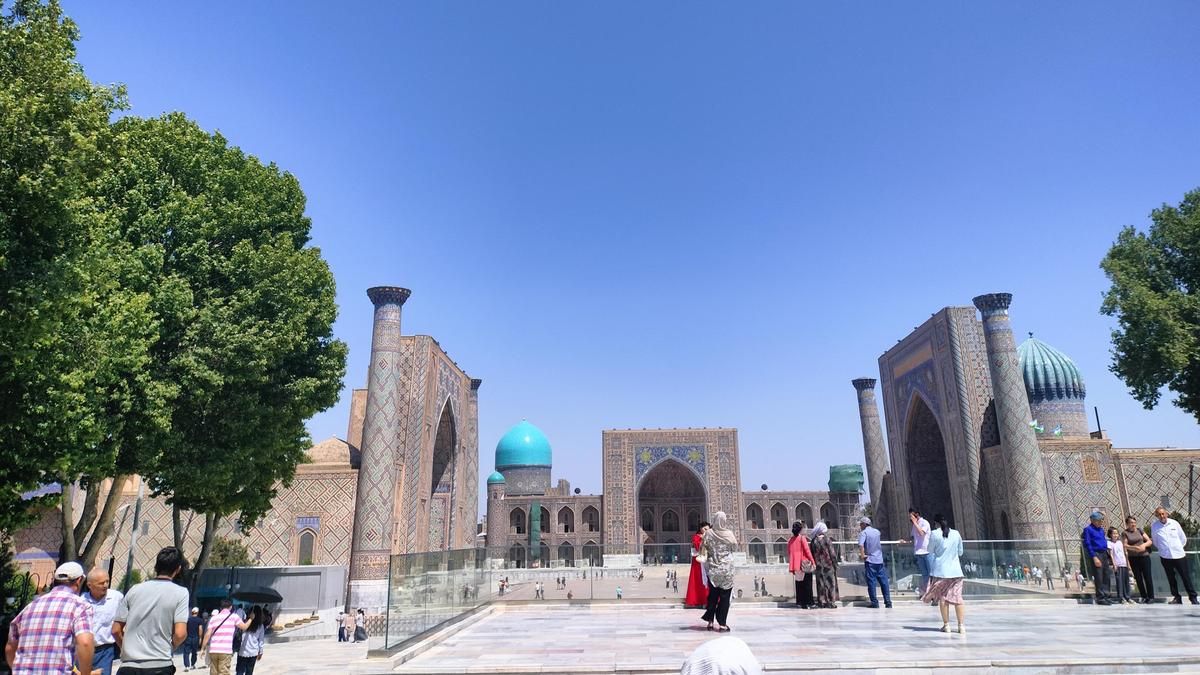
Tourism boards love to paint Uzbekistan as a flawless, static museum where travelers can seamlessly step back into the days of Tamerlane. Glossy brochures focus entirely on the shimmering turquoise tiles of Samarkand, the towering minarets of Bukhara, and the mud-brick walls of Khiva, framing the country as a romanticized time capsule. But this curated narrative tells only half the story. The reality of traveling through Uzbekistan today is a complex, sometimes jarring collision between aggressive rapid modernization, Soviet-era bureaucratic hangovers, and the delicate preservation of ancient Islamic heritage.
To truly understand Uzbekistan, you have to look beyond the heavily restored facades. The country is undergoing a profound transformation that is reshaping its infrastructure, its economy, and the very nature of the traveler’s experience. Navigating this shifting terrain requires more than just an appreciation for architecture. It demands an understanding of how a post-Soviet nation is actively rewriting its identity for a global audience. Discover more on a connected topic: this related article.
The High Speed Rail Revolution and its Hidden Cost
Getting around the country has fundamentally changed over the last decade, primarily due to the introduction of the Afrosiyob high-speed train network. Connecting Tashkent, Samarkand, Bukhara, and recently expanding toward Khiva, these Spanish-built trains whiz across the desert at speeds of up to 250 kilometers per hour. It is an undeniable triumph of modern infrastructure that turns what used to be a grueling, day-long car journey across bumpy roads into a comfortable two-hour trip.
But this efficiency has created a highly centralized tourism corridor. Additional journalism by National Geographic Travel explores comparable perspectives on the subject.
Because the high-speed rail makes it incredibly easy to hop between the three major destination cities, the vast majority of international visitors follow the exact same linear path. This has led to intense overtourism in specific, localized pockets. During the peak spring and autumn travel seasons, the Registan in Samarkand can feel less like an ancient center of Islamic learning and more like a crowded theme park.
Furthermore, securing a ticket on the Afrosiyob has become a notorious logistical nightmare. Tickets officially go on sale 45 days in advance and routinely sell out within minutes. A thriving secondary market has emerged, with local tour agencies and independent fixers buying up blocks of tickets using automated systems, leaving independent travelers stranded or forced to rely on slow, outdated Soviet-era trains or expensive private drivers. The infrastructure is modern, but the distribution system still suffers from old-world opacity.
The Missing Middle of Uzbek Transit
When the high-speed train is unavailable, travelers are forced to confront the stark duality of Uzbek transit. There is very little middle ground. On one hand, you have domestic flights operated by Uzbekistan Airways, which are reasonably reliable but require navigating rigid airport security protocols that still feel deeply bureaucratic.
On the other hand, you have the shared taxi system. This is how the locals move. Travelers pack into unmarked Chevrolet sedans at designated parking lots, waiting until every single seat is filled before the driver departs. It is an authentic, chaotic, and often exhausting experience that exposes visitors to the real infrastructure of the country—pot-holed highways, erratic driving etiquette, and frequent vehicle checkpoints. It provides a raw look at daily life, but it stands in sharp contrast to the sanitized, high-speed rail experience sold to Western tourists.
The Preservation Dilemma Restoration versus Rebuilding
A major point of contention among historians, architects, and seasoned travelers is the nature of Uzbekistan’s monument restoration. Walking through the streets of Khiva’s Ichan Kala, the inner walled city, everything looks remarkably pristine. Perhaps too pristine.
Uzbekistan has historical adopted a heavy-handed approach to reconstruction. Rather than merely stabilizing and preserving ruins, the state has frequently opted for full-scale rebuilding projects designed to recreate how these structures looked at their absolute zenith. In some areas, centuries of layered history have been scraped away to install bright, flawless new tilework that lacks the patina of age.
+------------------+-----------------------------------+-----------------------------------+
| Metric           | Heavy-Handed Reconstruction       | Minimalist Archaeological Care   |
+------------------+-----------------------------------+-----------------------------------+
| Visual Appeal    | Striking, highly photogenic       | Muted, showing visible decay      |
| Historical Truth | Often speculative or idealized    | High, preserves original material |
| Tourist Draw     | Massive appeal for casual crowds  | Attracts specialists, academics   |
+------------------+-----------------------------------+-----------------------------------+
This strategy makes for incredible photography, but it can alienate travelers seeking genuine antiquity. In Samarkand’s Shah-i-Zinda, a breathtaking avenue of mausoleums, the line between original 14th-century tilework and late 20th-century replication is incredibly blurry. For the untrained eye, it matters little. For those looking for tangible links to the past, the aggressive sanitization of these spaces can make them feel somewhat disconnected from their historical context.
The Displacement of Local Communities
This drive to create postcard-perfect tourist zones has also had a social cost. Historically, Uzbek mahallas—traditional, tightly knit urban neighborhoods characterized by low-slung mud-brick homes, shared courtyards, and community mosques—surrounded these great monuments. They were the living heartbeat of the cities.
In the rush to beautify the areas around major sights, several historic mahallas have been demolished or hidden behind high decorative walls. In their place, the government has constructed wide, paved pedestrian avenues lined with standardized souvenir shops. The locals who once lived a stone's throw from the ancient mosques have been relocated to Soviet-style apartment blocks on the fringes of the cities. Visitors are left with beautiful monuments, but the organic local life that once gave those monuments context has been pushed out of sight.
The Ghost of the Soviet Superstate
You cannot fully grasp Uzbekistan by looking only at its medieval history. The country’s identity is irrevocably tied to its time as a Soviet Republic, a chapter that remains highly visible despite efforts to center national pride around ancient dynasties.
Tashkent, the capital, is the ultimate testament to this era. In 1966, a devastating earthquake leveled most of the old city. Soviet planners viewed the tragedy as a blank canvas, rebuilding Tashkent into a model socialist metropolis defined by brutalist architecture, massive public squares, and wide, sweeping avenues designed to handle military parades rather than modern traffic.
The Art of Navigating the Metro
The Tashkent Metro is arguably the most spectacular remnant of this period. Built to double as a nuclear bomb shelter, each station was designed by top Soviet artists and architects to reflect specific themes, utilizing marble, granite, and massive chandeliers.
For decades, photographing the metro was strictly forbidden due to its military classification. Police presence was heavy, and travelers were routinely stopped for passport checks. While the photography ban was lifted in 2018 as part of the country’s tourism opening, the atmosphere remains distinct. The platforms are clean, efficient, and eerily quiet compared to the subways of Western Europe or North America. It is a functional piece of living history that shows how deeply entrenched state control and meticulous planning remain in the country's DNA.
Money Connectivity and Bureaucracy in the Digital Age
For years, traveling to Uzbekistan required carrying bricks of cash. The local currency, the Uzbek Som, suffered from hyperinflation, and the largest bank notes were worth mere pennies. Travelers would exchange US dollars on the black market—often in the back of a car or a market stall—to get a fair rate, resulting in backpacks literally stuffed with paper money.
Today, that black market is gone. The currency has been stabilized, and ATMs that accept international Visa and Mastercard are common in major hotels and tourist hubs. However, the financial system is still far from seamless.
- Cash is still king outside of major hotels and high-end restaurants. Independent travelers must constantly manage their cash reserves, as regional ATMs frequently run out of money or experience network outages.
- Card terminals in smaller shops often fail to connect to international banking networks, making transactions unpredictable.
- US Dollars remain the ultimate backup. Clean, uncreased, post-2013 hundred-dollar bills are accepted almost anywhere for emergency exchanges.
The Connectivity Bottleneck
Staying connected is another area where modern expectations clash with state control. While major hotels offer Wi-Fi, the speeds are often sluggish and subject to sudden drops. Purchasing a local SIM card as a foreigner has become easier, but it still requires a formal registration process involving your passport and your official immigration entry slip.
The state maintains tight control over the digital space. Certain messaging apps and independent news sites face periodic, unannounced throttling or blocking. Travelers expecting to run a remote business or upload massive video files seamlessly while traveling through the provinces will quickly find themselves frustrated by the technological limitations.
Beyond the Silk Road Triad
The biggest mistake a traveler can make is confining their journey strictly to Samarkand, Bukhara, and Khiva. To see the forces shaping modern Uzbekistan, one must venture into the regions that tourism campaigns frequently ignore.
The Fergana Valley and Independent Commerce
To the east lies the Fergana Valley, the agricultural and industrial heartland of the country. This region is largely devoid of the grand turquoise domes found in the west, but it offers something far more valuable: an unfiltered look at contemporary Uzbek culture.
The valley is highly conservative, intensely industrious, and deeply entrepreneurial. It is home to Margilan, the center of the country’s traditional silk production, and Rishtan, famous for its unique blue-glazed ceramics. Here, the workshops are not state-run tourist traps; they are functioning enterprises driving the local economy. Visiting the Fergana Valley reveals a society that is fiercely proud of its traditions but entirely focused on its economic future.
The Ecological Tragedy of Moynaq
Conversely, a trip northwest into the autonomous republic of Karakalpakstan brings travelers face-to-face with one of the worst man-made environmental disasters in human history: the drying of the Aral Sea.
+-----------------------------------+-----------------------------------+
| Historical Reality (Pre-1960s)    | Modern Consequence (Post-2000s)   |
+-----------------------------------+-----------------------------------+
| Thriving fishing port at Moynaq   | Ship graveyard stranded in desert |
| Fourth-largest inland sea in world| Split into small, hypersaline pools|
| Balanced regional microclimate    | Toxic dust storms, extreme weather|
+-----------------------------------+-----------------------------------+
In the town of Moynaq, a rusted fleet of fishing trawlers sits stranded in the sand, miles from the current shoreline. Decades of Soviet agricultural planning diverted the rivers feeding the Aral Sea to irrigate massive cotton fields in the desert. The sea vanished, leaving behind a toxic wasteland of salt and pesticides.
Visiting Moynaq is an unsettling, melancholic experience. It provides an essential counterweight to the triumphant narrative of the Silk Road cities, serving as a stark reminder of the devastating impact of 20th-century industrial ambition on this fragile region.
The Reality of Hospitality
Uzbek hospitality is legendary, and it remains the country's greatest asset. Even in a rapidly changing tourism ecosystem, the warmth of the local people feels genuine. It is common to be invited into a family home for tea, or offered assistance by strangers when navigating a confusing market bazaar.
However, as international visitor numbers skyrocket, this hospitality is inevitably becoming commercialized in the major hubs. The homestays of Bukhara and Samarkand are increasingly run like boutique hotels, where interactions can feel transactional. To experience the unvarnished generosity that has defined Central Asia for millennia, travelers must step off the high-speed rail path and explore the small villages of the Nurata Mountains or the remote outposts of the Kyzylkum Desert.
Uzbekistan is not a seamless fairytale frozen in time. It is a nation working hard to modernize its infrastructure, manage the pressures of global tourism, and balance its complex Soviet past with its ancient heritage. Accepting the friction between the glossy travel brochures and the gritty, bureaucratic reality makes a journey through this part of Central Asia incredibly rewarding.


