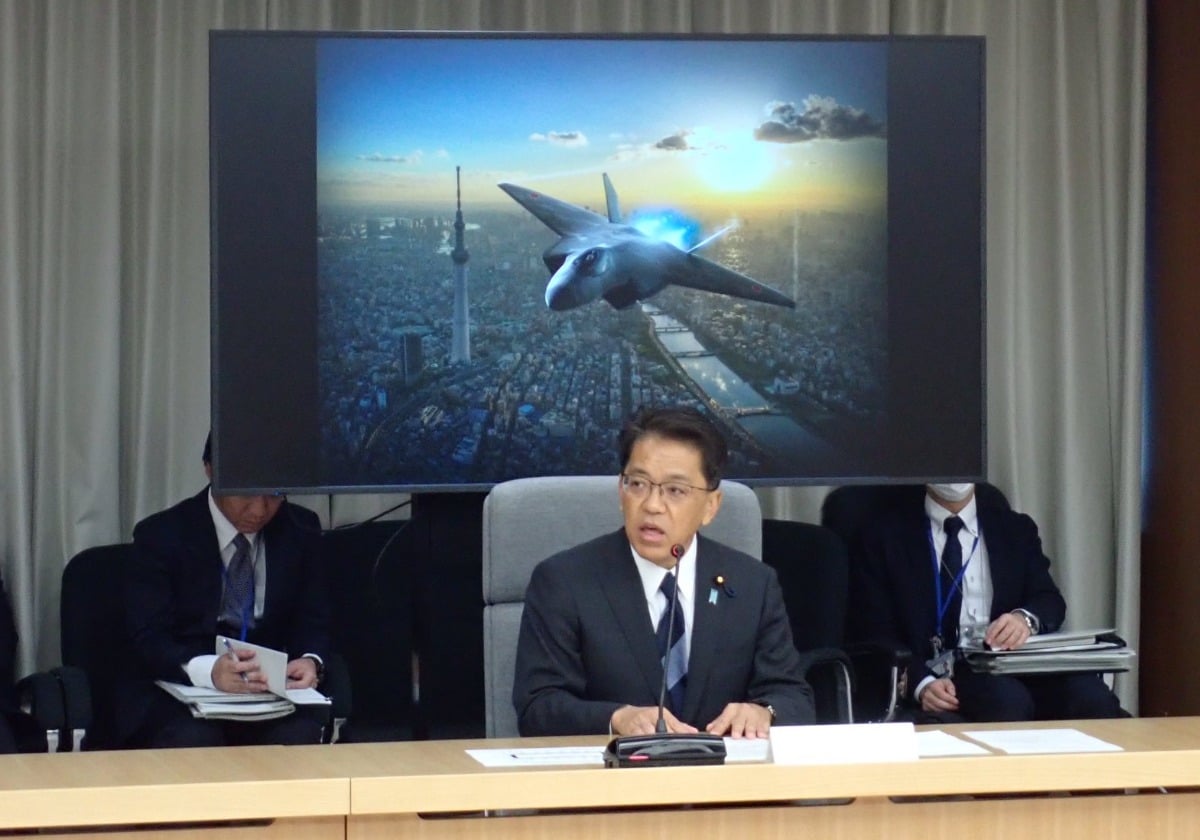
The ink on a defense contract smells surprisingly normal. It smells like standard office toner and crisp stationery, not kerosene, titanium, or the ozone tang of a high-altitude cockpit. Yet, when representatives from London, Tokyo, and Rome quietly signed the latest extension of the Global Combat Air Programme (GCAP), they weren't just executing a corporate maneuver. They were locking three nations into a marriage of necessity that will stretch until 2027 and beyond, binding their engineers, taxpayers, and geopolitical destinies together for the next half-century.
To the casual observer, defense news reads like a ledger of acronyms and astronomical numbers. A contract extension here, a joint venture there. But strip away the bureaucratic jargon, and you find a deeply human drama. It is a story about the terrifying speed of technological obsolescence, the fragile nature of international trust, and the realization that no single nation—no matter how proud its history—can survive the future alone.
Consider a hypothetical engineer named Kenji, working late in a research facility outside Nagoya. He is staring at a digital simulation of a carbon-fiber wing structure. Kenji’s grandfather might have worked on the legendary Zeke fighters of World War II, relying on draft sheets and mechanical intuition. Today, Kenji isn't just designing a piece of metal; he is trying to predict how a piece of software will behave in 2040, interacting with an artificial intelligence that hasn't been written yet, communicating with satellites that haven't been launched.
The pressure is immense. If Kenji’s calculations are off by a millimeter, or if his UK counterparts at BAE Systems use a slightly incompatible data architecture, the entire multi-billion-dollar apparatus stumbles. This is the reality behind the dry headlines announcing that the GCAP contract has been extended through 2027. It is a three-year window to solve a thousand impossible puzzles.
The Illusion of Sovereignty
For decades, building a frontline fighter jet was the ultimate statement of national sovereignty. It was proof that a country possessed the industrial muscle and scientific genius to defend its own skies. The UK had the Spitfire and the Vulcan. Japan had its domestic aerospace programs. Italy possessed an exquisite lineage of aviation design.
Then, the world changed.
The sheer complexity of modern aviation shattered that independence. A next-generation fighter is no longer just an airplane with guns and radar. It is a flying supercomputer, a command-and-control node, a mothership for autonomous drones, and a stealth platform all at once. The cost to develop such a machine independently is no longer just prohibitive; it is economically ruinous.
Let us look at the raw numbers that drive this desperation. Developing a fifth-generation fighter like the American F-35 cost an estimated $50 billion just for the engineering and manufacturing development phase. For a sixth-generation platform—which GCAP aims to produce by 2035—that figure could easily double. When a single nation tries to shoulder that burden alone, they end up sacrificing their healthcare systems, their infrastructure, or the size of their actual military fleets. They buy twenty perfect jets because they cannot afford twenty-one.
By extending the industrial contract through 2027, the UK, Japan, and Italy are splitting the bill. But more importantly, they are pooling their brains. They are betting that British expertise in complex systems integration, Japanese mastery of advanced electronics and materials, and Italian brilliance in aerospace manufacturing can fuse into something greater than the sum of its parts.
It sounds beautiful on paper. In practice, it is a cultural minefield.
When Three Worlds Collide
Imagine a conference room in Bristol. Around the table sit engineers from BAE Systems, Leonardo, and Mitsubishi Heavy Industries. They are debating how the aircraft’s cockpit should display threat data to a pilot.
The British team favors an evolution of the Typhoon's interface, heavy on symbolic data. The Japanese team, shaped by a different philosophy of human-machine interaction, pushes for an entirely intuitive, minimalist display. The Italian team reminds everyone that if the system is too complex, maintenance crews on a pitching aircraft carrier deck will never be able to service it under fire.
They speak different languages, both literally and culturally. They operate under different regulatory frameworks and varying levels of military secrecy. Yet, they must agree on every bolt, every line of code, and every sensor frequency.
This is what the 2027 extension is truly about. It is not about bending metal yet. It is about building the invisible infrastructure of cooperation. It is about establishing the joint venture legal entities, securing the intellectual property rights, and proving to skeptical politicians in three capitals that these traditional rivals can actually work as a single team.
The stakes could not be higher. If GCAP fails, none of these nations will have a home-grown option for the mid-century. They will be forced to buy American hardware off the shelf, effectively surrendering their aerospace industries and their strategic autonomy to Washington. They would become customers rather than creators.
The Ghost in the Machine
We often talk about these jets as weapons, but the engineers see them as ecosystems. The GCAP aircraft will not fight alone. It will fly at the center of a "system of systems," surrounded by loyal wingmen—uncrewed, autonomous drones that act as shields, decoys, and extra sensor eyes.
To make this work, the aircraft needs an unprecedented amount of electrical power. The engines, being designed by Rolls-Royce, IHI Corporation, and Avio Aero, cannot just produce thrust; they have to act as flying power stations. They must generate enough electricity to power laser weapons, massive radar arrays, and AI processors that generate more heat than a small data center.
Think of the heat. That is the enemy no one talks about. A stealth aircraft must keep its internal systems cool without venting hot air that would make it light up like a flare on an enemy thermal camera. The laws of thermodynamics are unforgiving. You cannot bribe them, and you cannot bypass them with a clever press release.
Every engineer working on GCAP carries this quiet anxiety. They are trying to outsmart physics while working across nine time zones. They are building a machine that must remain dominant in an era where software updates happen in minutes, but hardware takes a decade to manufacture.
The Race Against an Uncertain Clock
Why 2027? Why is this specific date the focal point of the recent contract extension?
Because 2027 is the point of no return. It is the year the program intends to transition from definition and design to full-scale manufacturing development. By then, the digital blueprints must be locked. The assembly lines must be prepared. The billions of dollars of national budgets must be firmly committed through the 2030s.
Between now and then, the geopolitical landscape will continue to shift like quicksand. Governments will change. Budgets will face pressure from economic downturns or domestic crises. The temptation to look inward, to cancel expensive long-term projects for short-term political gain, is a constant gravity pulling at the project.
The 2027 extension is a defensive wall built against that political volatility. It is a declaration to adversaries and allies alike that this partnership is too deeply intertwined to be easily broken by a change in prime ministers or a shift in public mood. It creates momentum. In the world of aerospace procurement, momentum is the only thing that keeps programs alive.
The pilots who will eventually fly this aircraft are currently sitting in primary school classrooms, completely unaware of the frantic meetings taking place in Tokyo or London. They are learning long division while teams of international experts argue over the radar cross-section of a tail fin that will one day keep those children alive in air space thousands of miles from home.
The contract extension is signed. The corporate statements have been archived. The true work returns to the quiet labs, the glowing monitors, and the late-night cups of lukewarm coffee shared via video link across a shrinking planet. The silent race continues.