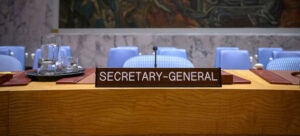
A memo landed on thousands of desks this week, its tone as flat and gray as the concrete walls of the Secretariat building in New York. It arrived as an "administrative instruction," a dry piece of bureaucratic housekeeping. But for the men and women who wear the United Nations badge, it was a gag order wrapped in a reminder. The message was simple: stay out of the race.
As the hunt for the next Secretary-General begins to stir in the backrooms of the Security Council, the rank-and-file staff have been told to keep their hands off the levers of power. No campaigning. No public endorsements. No using the vast machinery of the world’s most ambitious peace project to tilt the scales for a favorite candidate. If you enjoyed this piece, you should read: this related article.
To an outsider, this looks like common sense. To the people inside the glass tower, it feels like being told to watch the captain of your ship be chosen while you are locked in the engine room.
The Myth of the Neutral Observer
Imagine a mid-level policy advisor named Sarah. She has spent twelve years in the field, working in places where the "international community" is not an abstract concept, but a convoy of white trucks carrying flour and medicine. Sarah knows that who sits on the 38th floor matters more than any resolution passed in the General Assembly. One leader might prioritize climate displacement; another might be a hard-nosed realist who views human rights as a secondary concern to regional stability. For another perspective on this development, refer to the recent update from BBC News.
Sarah has opinions. She has lived the consequences of past leadership failures. Yet, under the newly reinforced guidelines, Sarah must remain a ghost in the political process.
This enforced neutrality is the bedrock of the international civil service. It is designed to ensure that the UN serves 193 masters without becoming the puppet of any single one. If staff were allowed to campaign, the organization would dissolve into a series of warring factions, each internal department becoming a campaign headquarters for a different national interest. The "United" in United Nations would evaporate, replaced by a chaotic scramble for patronage.
The stakes are invisible until they aren't.
The Ghost in the Machine
The selection of a Secretary-General is often described as the most impossible job on earth. You are expected to be a "secular Pope," a diplomat with no army, and a manager of a sprawling, often inefficient global bureaucracy. The process has historically been a game of shadows played by the Five Permanent Members of the Security Council—the US, UK, France, China, and Russia.
In the past, this was a true "smoke-filled room" affair. Candidates were vetted in secret, and a name was presented to the world like white smoke from the Vatican. Recent years have seen a push for transparency, with public "town halls" and televised debates. But this shift toward democracy creates a friction point for the staff.
When the process becomes public, the temptation to participate becomes visceral.
Consider the logic of the UN Ethics Office. If a staff member uses their official email to blast out a manifesto for a specific candidate, they aren't just expressing a preference. They are signaling to the world that the UN’s internal resources are up for sale. They are suggesting that the "impartiality" promised in the UN Charter is a thin veneer.
But there is a human cost to this silence. We are asking the very people who are most informed about the world's crises to have no say in who leads the response to them. It creates a strange, hollowed-out workplace culture where the most important conversation in the building is the one you aren't allowed to have at the water cooler.
The Invisible Fence
The memo doesn't just ban loud cheering; it bans the quiet nudge. It prohibits staff from providing "non-public information" to candidates or using their working hours to assist a campaign. It is a fence built to keep the technical expertise of the UN from being weaponized by political hopefuls.
In a world where misinformation is a primary tool of statecraft, this boundary is a survival mechanism. If a candidate were to cite "internal UN data" provided by a friendly staffer to bolster their campaign, the credibility of that data—and the department that produced it—would be permanently tainted. The data would no longer be seen as a factual record of human suffering or economic progress; it would be seen as a campaign contribution.
Trust is the only currency the UN has. Once it is debased, the blue flag loses its power to cross borders and negotiate ceasefires.
The Weight of the Badge
There is a specific kind of loneliness in being a career diplomat. You represent everyone and no one. You are a citizen of a country, but your primary loyalty is to a charter written in 1945. You are a human with political leanings, but your professional life requires you to be a blank slate.
This recent directive is a reminder of that sacrifice. It tells the staff that their expertise belongs to the office, not the person who might occupy it. It demands a level of discipline that is increasingly rare in our hyper-partisan, "all-access" modern world.
The tension in the hallways is palpable. Every time a candidate makes a speech, the staff listen with a dual mind. They listen as experts who know exactly where the candidate is overpromising, and they listen as subordinates who will have to implement those promises. They are the ones who will be sent into the flooded valleys and the scorched conflict zones. They have skin in the game, but they are forbidden from betting on the player.
The directive acts as a shield for the staff as much as a restriction. By being officially "off-limits," staffers are protected from the pressure of candidates who might come knocking for internal support. It gives the policy advisor and the field medic a simple, ironclad excuse: "I am not allowed."
The Unspoken Agreement
We often think of power as the ability to speak, to vote, and to lead. But in the grand, fragile experiment of global governance, there is a different kind of power found in restraint. It is the power of the civil servant who puts their personal politics in a drawer every morning so they can serve the collective whole.
The search for the next Secretary-General will continue to dominate the headlines. There will be speculation about geographical rotation, about the long-overdue need for the first female leader, and about the vetos of the Great Powers. The candidates will travel the world, shaking hands and making grand declarations about the future of humanity.
Behind them, the 30,000 employees of the UN will continue their work in silence. They will process the visas, distribute the grain, and draft the reports. They will watch the political theater from the wings, prohibited from joining the chorus.
This silence is not a sign of apathy. It is the sound of a machine trying to remain functional in a storm. It is the quiet of a surgeon who cannot afford to have a shaking hand, regardless of who is paying for the operation.
The memo is just paper. The instruction is just words. But the reality is a high-wire act performed without a net. The UN staff are being asked to maintain the world’s balance while the ground beneath them is shifted by the very leaders they are forbidden to influence.
In the end, the most powerful thing an international civil servant can do is stay in their chair, keep their eyes on the data, and wait for the new captain to arrive. They are the permanent occupants of a house with a revolving door, and their silence is the only thing keeping the roof from caving in.
The lights in the Secretariat will stay on late tonight. Emails will be sent, and strategies will be mapped. But for the first time in years, the most important topic in the room will be the one nobody is talking about.